

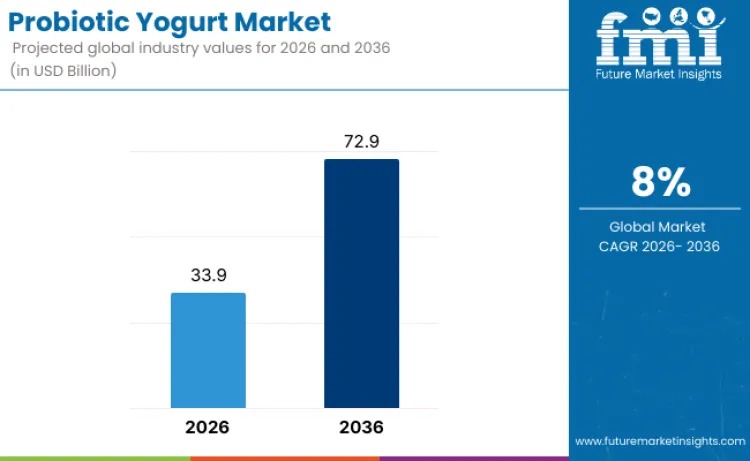
The global probiotic yogurt market is entering a high-growth phase, driven by rising consumer focus on digestive health, immunity, and functional nutrition. Valued at USD 33.9 billion in 2026, the market is projected to reach USD 72.9 billion by 2036, expanding at a robust CAGR of 8% over the forecast period. Once viewed as a niche wellness product, probiotic yogurt has rapidly evolved into a daily dietary staple across developed and emerging economies alike.
Probiotic yogurt’s growth is closely linked to the increasing prevalence of gut health awareness, fueled by scientific research highlighting the role of balanced microbiota in digestion, immunity, and overall well-being. Consumers are actively seeking foods that go beyond basic nutrition, positioning probiotic yogurt as a convenient, evidence-backed solution that aligns with modern health priorities.
Get Exclusive Access To Data Tables, Market Sizing Dashboards, And Analyst Insights. Request Sample Report! https://www.futuremarketinsights.com/reports/sample/rep-gb-3259
Functional Foods Drive Sustained Demand
Functional foods have moved firmly into the mainstream, particularly in North America and Europe, where health-conscious consumers are prioritizing preventive nutrition. Probiotic yogurt stands out due to its clinically supported benefits, ease of consumption, and compatibility with busy lifestyles. In parallel, Asia Pacific is emerging as the leading region by 2036, supported by rising disposable incomes, urbanization, and long-standing cultural acceptance of fermented foods.
Emerging economies are witnessing rapid adoption as dietary habits shift toward packaged, health-oriented foods. The growing middle class, combined with increasing retail penetration and digital grocery platforms, is accelerating market access and product awareness across countries in Asia, Latin America, and parts of the Middle East.
Innovation Reshapes Product Portfolios
Product innovation remains a defining growth lever in the probiotic yogurt market. Manufacturers are expanding beyond traditional spoonable formats, responding to evolving consumer expectations around convenience, inclusivity, and personalization. Key innovation areas include:
- Plant-based probiotic yogurts, catering to vegan and lactose-intolerant consumers
- Drinkable and on-the-go formats, aligned with urban lifestyles
- High-protein and low-sugar formulations, targeting fitness-focused buyers
- Clean-label and organic offerings, addressing transparency and sustainability concerns
Among these, plant-based probiotic yogurt is expected to be the fastest-growing segment from 2026 to 2036, reflecting the global shift toward dairy alternatives made from oat, almond, soy, and coconut bases.
Regional Outlook Highlights Shifting Growth Centers
While North America leads the market in 2026, growth momentum is steadily shifting eastward. Asia Pacific is forecast to become the dominant regional market by 2036, supported by strong demand in Japan, China, South Korea, and Southeast Asia.
Country-level projections underline diverse growth dynamics:
- United Kingdom: CAGR of 12.2%, driven by gut health awareness and preventive nutrition
- France: CAGR of 11.5%, supported by a strong dairy culture and clean-label trends
- Germany: CAGR of 9.9%, fueled by functional food adoption and plant-based innovation
- United States: CAGR of 8.3%, led by millennials, DTC channels, and product diversification
- Japan: CAGR of 7.6%, anchored in fermented food traditions and aging demographics
These markets are increasingly shaped by personalization trends, with consumers showing interest in strain-specific probiotics and transparent health claims.
Competitive Landscape Focuses on Science and Scale
The probiotic yogurt market is moderately fragmented, featuring a mix of multinational leaders, regional dairy specialists, and emerging functional food startups. Global players such as Danone, Chobani, General Mills, Nestlé, Lactalis, and Yakult Honsha dominate through strong brand equity, clinical research investments, and extensive distribution networks.
Danone continues to strengthen its position with clinically validated strains and personalized nutrition initiatives, while Chobani is expanding aggressively into plant-based and functional drink formats. Nestlé and General Mills are focusing on synbiotic formulations that combine probiotics with prebiotic fibers to enhance efficacy.
At the same time, smaller innovators like Lifeway Foods, Yofix Probiotics, and Next Gen Foods are gaining traction by targeting niche wellness segments, including metabolic health, mental well-being, and microbiome tracking. Direct-to-consumer models and subscription-based offerings are enabling these brands to build loyalty and collect real-time consumer insights.
Market Outlook Remains Strong
As health and wellness continue to influence global food consumption patterns, probiotic yogurt is expected to remain a cornerstone of the functional dairy and plant-based nutrition space. The market’s future will be shaped by clinical validation, strain innovation, clean-label positioning, and digital engagement, ensuring sustained demand across age groups and regions.
With consumers increasingly viewing food as medicine, probiotic yogurt is well-positioned to deliver long-term value for manufacturers, retailers, and health-focused consumers worldwide.
