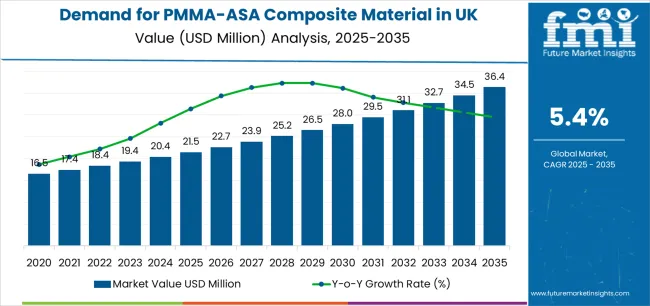
The United Kingdom’s market for PMMA/ASA composite materials is poised for sustained growth through 2035, with sales expected to nearly double from an estimated USD 21.5 million in 2025 to USD 36.6 million by 2035 at a projected compound annual growth rate (CAGR) of 5.4%. This robust outlook is underpinned by increasing demand across key industrial sectors, particularly in automotive manufacturing, construction and advanced industrial applications, where lightweight and high-performance materials are in high demand.
PMMA (Polymethyl Methacrylate) combined with ASA (Acrylonitrile Styrene Acrylate) offers manufacturers a unique blend of mechanical strength, weather resistance and processing versatility—attributes that are driving adoption across traditional supply chains and innovative applications alike. As the UK accelerates its focus on technological performance and environmentally resilient materials, both legacy players and emerging companies are investing in new formulations and processing capabilities to seize market share in this dynamic segment.
Market Growth Driven by Precision and Performance Needs
The expansion of the UK PMMA/ASA composite material market reflects broader industry trends: the shift toward lightweight components in automotive applications, elevated performance standards, and enhanced material integration across manufacturing operations. With the injection molding grade leading at around 24% of the market share, producers and converters are increasingly prioritizing high-precision and high-yield production technologies that align closely with evolving automotive and industrial design specifications.
The automotive sector, long a cornerstone of the UK manufacturing landscape, continues to be a major driver for PMMA/ASA composites. These materials enable substantial weight reduction without sacrificing durability, making them ideal for exterior trims, body panels and precision components in both traditional and electric vehicle platforms. Growth is supported by manufacturers seeking to meet strict performance benchmarks while improving fuel efficiency and reducing emissions.
Simultaneously, construction and industrial manufacturing applications are embracing PMMA/ASA composites for their inherent resistance to weathering and UV exposure. Architectural components, advanced façade systems, and industrial components stand to benefit from materials that deliver both longevity and aesthetic appeal in demanding environments.
To access the complete data tables and in-depth insights, request a sample report here
Established Leaders and Rising Innovators in Competitive Landscape
The competitive landscape of the UK PMMA/ASA composite material market is shaped by a mix of globally established chemical and polymer specialists, alongside agile innovators focusing on specialized grades and tailored solutions.
Among the leading established players, industry stalwarts such as INEOS Styrolution, SABIC, LG Chem, Arkema, and Trinseo continue to anchor the market with broad portfolio offerings and deep distribution networks. These companies bring decades of polymer expertise, robust R&D pipelines, and proven ability to scale production to meet complex requirements—qualities that have helped secure long-term contracts with major OEMs and industrial manufacturers.
In parallel, emerging manufacturers and niche specialists are making significant strides by differentiating their offerings through advanced material technologies and tailored service value propositions. Companies such as Asahi Kasei, Chi Mei Corporation, Kumho Sunny, LOTTE Chemical, and Wanhua are demonstrating a commitment to innovation, often focusing on high-impact formulations and performance-enhanced composites that address application-specific challenges.
These new entrants are expanding the competitive landscape by bringing fresh perspectives to composite formulation, processing techniques and performance optimization—creating opportunities for partnerships with forward-looking manufacturers eager to integrate next-generation materials into their products.
Technology Integration and Strategic Industry Collaborations
The UK’s composite materials ecosystem is also benefiting from strategic collaborations between material suppliers, technology integrators and manufacturing firms. Adoption of advanced processing technologies such as automated injection molding, real-time quality monitoring and integrated polymer management systems is helping producers and converters enhance throughput while maintaining rigorous quality standards.
Manufacturers who invest in scalable processes and strong technical support infrastructure are poised to unlock recurring business from clients who value technical consultation and performance optimization services. As manufacturing systems evolve toward higher degrees of automation and digital integration, the ability to offer composite materials aligned with smart factory environments presents a compelling value proposition for both buyers and suppliers.
Outlook and Opportunities Ahead
Looking ahead to 2035, the UK PMMA/ASA composite material market is expected to maintain its upward trajectory on the back of strong industrial demand, material innovation and collaborative growth strategies. As traditional manufacturers and new technology-driven players continue to expand their capabilities and address emerging application needs, the sector stands to be a key contributor to the UK’s advanced manufacturing landscape.
With growing interest from automotive, construction, consumer electronics and home appliance segments, the stage is set for both established leaders and up-and-coming innovators to strengthen their market positions and accelerate adoption of composite material solutions that deliver performance, reliability and competitive advantage.