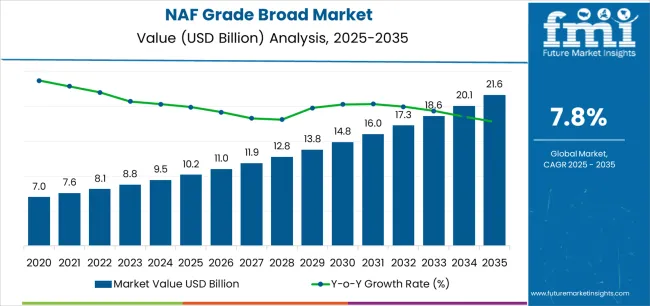
The global NAF (No Added Formaldehyde) Grade Broad Market is poised for robust growth, with the market size estimated at USD 10.2 billion in 2025 and projected to more than double to USD 21.6 billion by 2035, reflecting strong and sustained interest in eco-friendly material solutions. This unprecedented growth trajectory underscores a widespread transition in construction, furniture production, and interior design toward healthier, sustainable materials that prioritize indoor air quality and meet stringent environmental standards. Fueled by shifting consumer preferences, evolving regulations, and rapid adoption of greener production technologies, the NAF Grade Broad Market has become a critical pillar of the future materials ecosystem.
As global markets increasingly embrace No Added Formaldehyde engineered wood products—from particleboard and fiberboard to plywood—industry leaders and emerging players alike are unlocking new opportunities for business expansion and technological innovation. Demand for these low-emission materials continues to rise in residential, commercial, education, and healthcare environments, where concerns about formaldehyde emissions and volatile organic compounds (VOCs) are driving procurement decisions and product specifications.
A major driver of this market’s expansion is the heightened focus on regulatory compliance and certification standards. Green building certifications and strict indoor air quality mandates are pushing manufacturers to enhance product performance while maintaining sustainability credentials. Leading manufacturers are responding with advanced resin systems, recycled wood integration, and moisture-resistant formulations that not only meet but often exceed regulatory requirements. These advancements are strengthening both the performance and market appeal of NAF-certified board products across diverse applications.
Among established global manufacturers, Kronospan continues to lead with a vertically integrated production footprint and a strong commitment to formaldehyde-free solutions. Kronospan’s extensive portfolio and consistent quality standards have positioned it as a market benchmark, particularly within the particleboard segment, which holds the largest share of the overall market due to its cost effectiveness and versatile performance. Other key market incumbents such as Arauco, Daiken New Zealand, Duratex, and Georgia-Pacific Building Products are also scaling up production capacity while strengthening global distribution networks to meet surging demand.
At the same time, industry dynamics are welcoming a wave of new and agile manufacturers seeking to expand their footprint in this rapidly evolving landscape. Regional producers like Huazhou Wood Industry, Fenglin Group, Treezo Group, Luli Wood, and Wanrun Wood Industry are emerging as compelling competitors, particularly in Asia Pacific and other high-growth regions. These companies are known for their cost efficiency, resonant response to local demand nuances, and nimble adoption of sustainable practices, making them key contributors to the market’s vibrant competitive environment.
To access the complete data tables and in-depth insights, request a sample report here
Europe’s well-established players, including Egger, Pfleiderer, and Kastamonu Entegre, are investing heavily in lifecycle sustainability and next-generation resin technologies. Their efforts reflect a commitment not just to compliance, but to leadership in material innovation and design adaptability for high-end residential and commercial interiors. Meanwhile, North American heavyweights such as West Fraser, Louisiana-Pacific, and Weyerhaeuser continue to expand their engineered wood offerings by integrating digital control systems and eco-optimized manufacturing processes.
The race toward innovation is further amplified by ongoing research and development in adhesive and binder technologies, which aim to close any performance gaps between traditional formaldehyde-based products and contemporary NAF alternatives. Breakthroughs in bio-based adhesive systems and advanced curing processes are expanding application scopes while elevating product durability and consistency—core factors that matter to architects, builders, and end-use consumers alike.
Regionally, Asia Pacific stands out as the fastest-growing market, supported by booming construction and furniture manufacturing sectors across China, India, and Southeast Asia. European and North American markets uphold steady demand, largely driven by eco-certification frameworks and heightened awareness of indoor air quality impacts on health and wellbeing. Across all regions, collaborative efforts between established market leaders and innovative newcomers are accelerating the shift toward sustainable materials that enhance environmental performance without sacrificing quality or economic feasibility.
As the NAF Grade Broad Market continues its upward trajectory, industry players are not only embracing environmental responsibility but are also harnessing technology and strategic expansion to unlock new markets and value chains. With sustainable materials rapidly becoming the standard rather than the exception, both established and emerging manufacturers are well-positioned to lead the transition toward healthier, greener building and design practices worldwide.