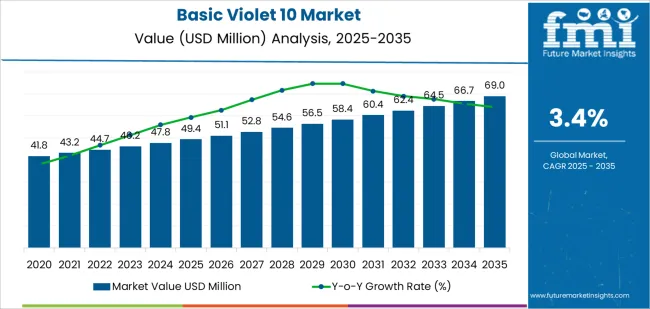
The global Basic Violet 10 market is increasingly gaining momentum, with the industry estimated to be valued at USD 49.4 million in 2025 and projected to reach USD 69.0 million by 2035, reflecting steady growth as manufacturers and end-users alike expand applications of this specialized dye. As the market evolves, both long-standing industry leaders and new entrants are investing in cutting-edge technologies and strategic initiatives to enhance production capabilities, broaden geographic reach, and meet the rising demand for advanced colorant solutions across textile, printing, and specialty chemical sectors.
Basic Violet 10 has long been recognized as a vital colorant in textile dyeing, printing inks, pigments, and other industrial applications due to its vibrant coloration properties, formulation flexibility, and compatibility with modern manufacturing processes. In today’s competitive landscape, established manufacturers such as KOHINOOR GROUP, Ranbar, and Mayur Dye Chem continue to reinforce their positions through comprehensive product portfolios, quality optimization, and extensive distribution networks. These companies are leveraging decades of experience to deliver reliable, high-performance Basic Violet 10 products that meet stringent quality standards while enabling operational efficiencies for textile manufacturers and chemical processors.
At the same time, several emerging manufacturers are making strategic inroads into the Basic Violet 10 market, bringing fresh innovation and agile production models that complement the offerings of legacy players. Firms like Tianjin Xiangrui Dyestuff, Dezhou Hongqiao Dyestuff Chemical, Hebei Ruixin Chemical, Xincheng Weiye Chemical, and Tianjin No.3 Dyestuff Chemical Factory are gaining traction by focusing on specialized formulations, competitive pricing, and rapid response to evolving customer requirements. Their presence underscores the growing diversity and dynamism within the market, as more companies recognize the potential to expand their businesses by tapping into demand from high-growth regions and application segments.
Industry observers note that the liquid form of Basic Violet 10 currently dominates the market, capturing a significant share due to its ease of handling, uniform dissolution characteristics, and compatibility with automated and continuous manufacturing systems. Meanwhile, powder formulations remain relevant for applications where concentrated forms and customized dilution are preferred, especially in regions where logistics and storage flexibility are key considerations. Manufacturers are investing in production technologies that optimize both liquid and powder dye solutions to better serve diverse industrial applications.
Across the application spectrum, traditional dye usage continues to command the largest share, reflecting the long-standing reliance on Basic Violet 10 in textile processing and fabric coloration. However, demand in pigment, ink, and other specialty applications is also rising, driven by the expanding needs of surface coating, industrial marking, and niche chemical formulations. More textile mills, printing facilities, and specialty product manufacturers are adopting advanced dye systems that offer enhanced color performance—such as improved fastness and consistency—while integrating seamlessly with modern processing equipment.
To access the complete data tables and in-depth insights, request a sample report here
A key driver of market growth is the rapid expansion of manufacturing infrastructure in Asia-Pacific, particularly in China and India, where booming textile industries and increased investment in chemical processing create broad opportunities for Basic Violet 10 adoption. Manufacturers in these regions are scaling their production capabilities, establishing new facilities, and forming strategic partnerships to better support both domestic consumption and export markets. This regional surge is attracting attention from global players who are aligning strategies to serve fast-growing customer bases by enhancing local distribution and technical support.
In Europe and North America, established markets maintain strong performance through ongoing innovation and quality-centric manufacturing philosophies. Companies in Germany, France, the United Kingdom, and the United States are integrating Basic Violet 10 into advanced material applications and specialized industrial processes that require precise color control and performance reliability. Collaboration between dye producers and end-users has facilitated tailored solutions that meet exacting specifications across highly regulated sectors.
Beyond traditional sectors, emerging application areas are beginning to influence the competitive landscape, with manufacturers exploring new uses for Basic Violet 10 in advanced textiles, coatings, and niche chemical products. This trend is encouraging firms—both seasoned and new—to invest in research and development aimed at enhancing sustainability, expanding functional properties, and improving application versatility. A focus on eco-compliant formulations and process innovations is gaining priority, as industries increasingly demand products that align with environmental standards and performance expectations.
As the Basic Violet 10 market continues on its projected growth trajectory, industry players are emphasizing a combination of technological advancement, market diversification, and strategic partnerships. By balancing innovation with operational excellence, both established and emerging manufacturers are well-positioned to unlock new opportunities, expand their commercial footprint, and contribute to the evolving global landscape of specialty chemical solutions.