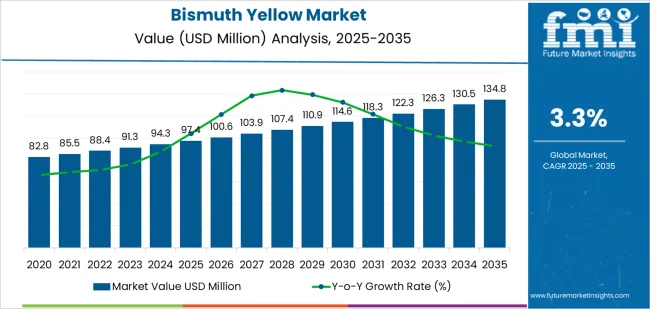
The global bismuth yellow market a critical segment in the inorganic pigment industry—is projected to reach USD 97.4 million in 2025, with notable growth expected through 2035 as demand expands across coatings, plastics, inks and specialty applications. With a forecasted trajectory marked by steady expansion and technological advancement, the market presents fertile ground for both established players and new entrants seeking to drive innovation and scale their operations.
Growing environmental regulations, particularly restrictions on lead-based pigments, are propelling demand for bismuth yellow pigments, which offer a safer, non-toxic alternative without compromising performance. This shift toward eco-friendly coloration is reshaping the industry landscape, enabling opportunities for companies of all sizes to introduce advanced pigment solutions that meet emerging regulatory and sustainability standards.
Market Dynamics: Demand Meets Innovation
Bismuth yellow pigments—especially those based on bismuth vanadate chemistry—are increasingly preferred for high-performance coatings and plastics due to their superior color strength, light fastness and environmental compliance. These attributes make them ideal for industrial finishes, architectural paints and specialty plastics, helping manufacturers align with stricter safety and sustainability mandates.
The market’s evolution reflects broader industrial trends. Traditional pigment suppliers are expanding their portfolios, investing in research and development to create formulations that are easier to disperse, deliver consistent color quality and integrate into automated manufacturing systems. At the same time, technology innovators and regional manufacturers are introducing niche products that address specialized needs, such as high-temperature plastics and custom printing inks.
Established Leaders and New Innovators Shape the Landscape
Leading global chemical companies with extensive pigment experience continue to dominate market share, thanks to their deep technical capabilities, global supply networks and established relationships with large coatings and plastics manufacturers. These firms leverage decades of expertise to develop high-performance pigments that deliver reliable results across various end-use applications.
However, the rise of new manufacturers and technology-focused startups is creating fresh momentum. These emerging players are challenging traditional paradigms by focusing on differentiated pigment chemistries, localized production efficiencies and cost-effective solutions for regional markets. Their agile innovation approaches are driving rapid adoption in emerging economies and attracting partnerships with coatings formulators seeking bespoke pigment systems.
To access the complete data tables and in-depth insights, request a sample report here
Regional Growth and Opportunities
Asia Pacific remains a powerhouse for market expansion, driven by rapid industrialization, robust coatings production and increasing environmental regulation enforcement. Countries with substantial manufacturing ecosystems are witnessing accelerated adoption of bismuth yellow pigments, presenting opportunities for both multinational and local pigment producers to scale operations.
North America and Europe continue steady uptake, supported by stringent environmental standards and a mature industrial base that prioritizes advanced pigment solutions. These regions also serve as testbeds for cutting-edge pigment technologies, where integration into automated quality monitoring and coating production systems is becoming standard.
Emerging markets, including Southeast Asia and parts of Latin America, are experiencing growing interest in bismuth yellow pigments as infrastructure development and industrial diversification expand demand for high-performance, environmentally compliant colorants.
Technology Pathways and Strategic Directions
The evolution of the bismuth yellow market is underpinned by several strategic pathways that manufacturers are pursuing:
- Advanced Formulations: Investing in cutting-edge chemical engineering to enhance pigment stability, color vibrancy and manufacturing efficiency, enabling premium positioning in competitive markets.
- Localized Production Hubs: Building regional facilities to reduce lead times, cut import dependencies and offer cost-effective solutions tailored to local regulations and industrial requirements.
- Application Diversification: Expanding beyond coatings into plastics, specialty inks and niche industrial uses, allowing companies to capture value across multiple end-use sectors.
- Environmental Compliance Focus: Positioning products as superior eco-friendly alternatives through transparent sustainability credentials, attracting environmentally conscious manufacturers and procurement programs.
These strategic directions not only support incremental market growth but also push the entire industry toward sustainable innovation and competitive differentiation.
Collaborative Ecosystems and Future Outlook
Collaboration is emerging as a key catalyst in shaping the bismuth yellow market’s future. Partnerships between pigment producers and downstream manufacturers—coating formulators, plastics processors and industrial OEMs—are increasing the efficacy and speed of product development cycles. Joint innovation initiatives are enabling tailored solutions that precisely meet performance, regulatory and cost expectations.
As demand for sustainable pigment solutions continues to accelerate, opportunities abound for companies ready to invest in technology, expand geographically and build strong partnerships. Established manufacturers can leverage their scale and R&D strengths, while emerging players can capitalize on agility and market niche focus to make substantial gains.