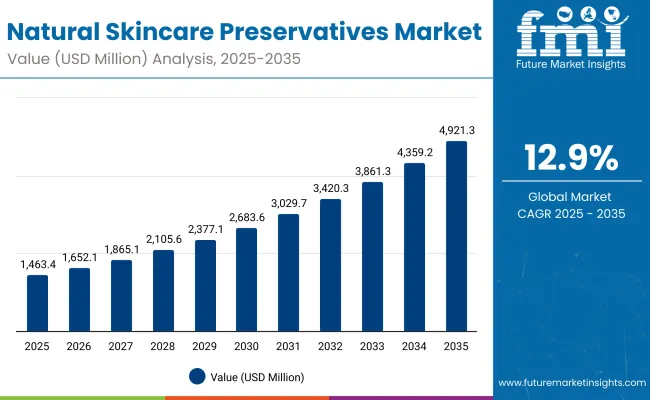
The Natural Skincare Preservatives Market is entering a high-growth phase as global cosmetic and personal care brands accelerate their shift toward clean-label, sustainable, and regulation-compliant formulations. According to the latest industry outlook, the market is projected to grow from USD 1,463.4 million in 2025 to USD 4,921.3 million by 2035, reflecting an impressive 193% growth over the decade. This expansion represents a robust CAGR of 12.9%, translating into a 3.4X increase in market size.
This strong momentum highlights not only the leadership of established ingredient manufacturers but also the rising influence of new and emerging players that are investing in advanced technologies, fermentation-based solutions, and eco-certified preservation systems to expand their global footprint.
To access the complete data tables and in-depth insights — Request Your Sample Report Now
Market Growth Outlook: From Niche to Mainstream Ingredient
During the first half of the forecast period (2025–2030), the market is expected to expand from USD 1,463.4 million to USD 2,683.6 million, accounting for 35% of total decade growth. This phase is characterized by steady adoption of plant-derived preservatives (47.5% share) and their widespread use in creams and lotions (46.5% share), driven by growing consumer trust in botanical and herbal skincare.
The second half of the decade (2030–2035) is forecast to contribute 65% of total growth, adding USD 2,237.7 million in new revenue. This acceleration is powered by fermentation-based bio-preservatives, premium skincare applications, and rapid expansion across Asia-Pacific, particularly China (15% CAGR) and India (16.9% CAGR). By 2035, global leaders such as Symrise, BASF, and Givaudan Active Beauty are expected to consolidate their positions through innovation-driven portfolios and long-term B2B partnerships with cosmetic brands.
Why the Natural Skincare Preservatives Market Is Growing
The market’s growth is anchored in three structural shifts reshaping the global beauty industry:
- Regulatory pressure in Europe, North America, and Asia-Pacific is accelerating the replacement of synthetic preservatives such as parabens and formaldehyde donors. Compliance with EU Cosmetic Regulation (EC) No 1223/2009 and evolving FDA guidance has turned natural preservatives into a necessity rather than an option.
- Consumer demand for clean-label skincare continues to rise, particularly among Millennials and Gen Z, who associate botanical and bio-based ingredients with safety, transparency, and sustainability.
- Technological innovation, especially in microbial fermentation and biotechnology, is overcoming historical limitations of natural preservatives by improving stability, scalability, and multifunctional benefits.
Together, these forces are enabling suppliers to capture premium pricing while aligning with brand trust and regulatory compliance.
Key Segments of the Natural Skincare Preservatives Market
By Source Type
- Plant-derived preservatives (rosemary, thyme, tea tree) – 47.5% share in 2025, driven by clean-label positioning and botanical appeal.
- Fermentation-based bio-preservatives – fastest-growing segment, supported by biotechnology innovation.
- Organic acids (benzoic, sorbic, lactic) – gaining traction for stability and formulation flexibility.
By Application
- Creams & lotions – 46.5% share, reflecting daily-use skincare dominance.
- Serums & oils – rapidly expanding in premium and anti-aging categories.
- Haircare products – benefiting from natural and sulfate-free positioning.
By Product Form
- Liquid concentrates – 49.5% share, favored for ease of formulation and uniform dispersion.
- Powders – niche use in dry and specialty formulations.
- Oil-dispersible forms – supporting serums and oil-based products.
By Distribution Channel
- Ingredient suppliers (B2B) – dominant channel, driven by partnerships with cosmetic manufacturers.
- Cosmetic brand manufacturers (B2C) – increasing in-house R&D for proprietary preservation systems.
By Region
- Asia-Pacific – fastest-growing region led by China and India.
- Europe – strong regulatory-driven adoption.
- North America – mature but steady clean beauty demand.
- Latin America & Middle East & Africa – emerging opportunities tied to natural beauty trends.
Regional Highlights: Asia-Pacific Leads the Growth Curve
Asia-Pacific stands out as the most dynamic region in the Natural Skincare Preservatives Market. India’s 16.9% CAGR is fueled by Ayurveda-inspired skincare, MSME exports, and government support for herbal products. China’s 15.0% CAGR reflects the influence of C-beauty and K-beauty trends, rising disposable incomes, and rapid e-commerce penetration. Japan, growing at 12.2% CAGR, benefits from strong demand for anti-aging and functional skincare.
Europe remains a stronghold for regulatory-compliant formulations, with the UK (9.7% CAGR) and Germany (7.3% CAGR) leading adoption of COSMOS and ECOCERT-certified preservatives. North America, led by the USA (6.2% CAGR), continues to see steady growth driven by clean-label marketing and premium skincare expansion.
Competitive Landscape: Established Leaders and New Innovators
The Natural Skincare Preservatives Market is moderately fragmented, creating opportunities for both established multinationals and emerging innovators. Global leaders such as Symrise, BASF, Lonza, and Givaudan Active Beauty leverage strong R&D pipelines, biotechnology investments, and broad ingredient portfolios. Mid-sized players including Ashland, Evonik, and Clariant are expanding through hybrid preservative blends and organic acid innovation.
At the same time, niche and regional specialists like Schülke & Mayr, Kemin Industries, Active Micro Technologies, and Tonymoly are gaining visibility by offering vegan-certified, allergen-free, and customized preservation systems. Competitive advantage is shifting away from scale alone toward sustainability credentials, innovation speed, and collaborative partnerships with cosmetic brands.
Looking Ahead: Innovation Will Define the Next Decade
As natural preservatives evolve from functional additives into multifunctional cosmetic actives, the market is poised for sustained expansion through 2035. Biotechnology-enabled fermentation, AI-supported formulation insights, and eco-certified sourcing will define success for manufacturers seeking to expand globally. For both established leaders and new entrants, the Natural Skincare Preservatives Market represents a high-growth opportunity aligned with the future of clean, safe, and sustainable beauty.
Why FMI: https://www.futuremarketinsights.com/why-fmi
About Future Market Insights (FMI)
Future Market Insights, Inc. (FMI) is an ESOMAR-certified, ISO 9001:2015 market research and consulting organization, trusted by Fortune 500 clients and global enterprises. With operations in the U.S., UK, India, and Dubai, FMI provides data-backed insights and strategic intelligence across 30+ industries and 1200 markets worldwide.
Contact Us:
Future Market Insights Inc.
Christiana Corporate, 200 Continental Drive,
Suite 401, Newark, Delaware – 19713, USA
T: +1-347-918-3531
For Sales Enquiries: sales@futuremarketinsights.com
Website: https://www.futuremarketinsights.com
LinkedIn| Twitter| Blogs | YouTube