

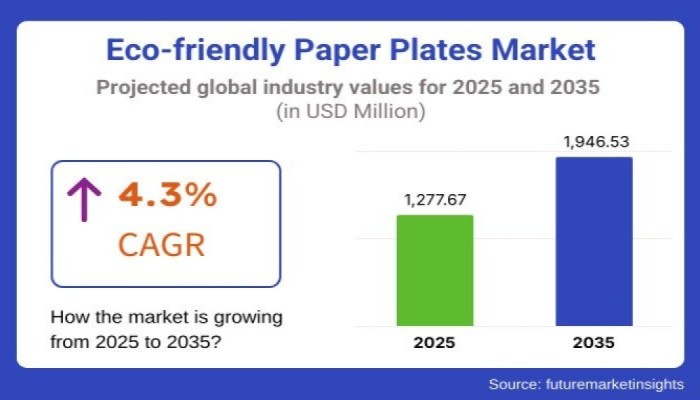
The global Eco-Friendly Paper Plates Market is entering a decade of accelerated transformation as shifting consumer preferences, regulatory pressures, and rapid innovation reshape the disposable tableware landscape. Valued at USD 1,277.67 million in 2025, the market is projected to reach USD 1,946.53 million by 2035, registering a steady CAGR of 4.3%. This growth is driven by rising demand for sustainable dining solutions, increasing adoption of compostable packaging, and the widespread transition away from single-use plastics.
Eco-friendly paper plates primarily made from recycled paper, bagasse, bamboo fiber, and other plant-based materials are becoming key alternatives in food service, catering, retail, and household consumption. Increasing environmental awareness, enhanced durability of biodegradable plates, and new water-resistant and greaseproof coatings are further strengthening market performance.
Explore Opportunities – Get Your Sample of Our Industry Overview Now!
Strong Regional Momentum Supports Global Expansion
North America: A Leader in Sustainable Food Service Adoption
North America accounts for a significant share of the global market, driven by heightened consumer awareness, stringent plastic bans, and rising investments in next-gen biodegradable packaging. Manufacturers across the U.S. and Canada are developing moisture-resistant, compostable, and high-durability plates tailored for quick-service restaurants (QSRs) and large institutional buyers.
Corporate sustainability initiatives, zero-waste events, and partnerships between food service chains and green packaging companies continue to fuel regional demand. The U.S. market alone is forecast to grow at a 4.5% CAGR through 2035.
Europe: A Hotspot for Circular Economy Innovation
Europe remains at the forefront of the sustainability movement. Supportive regulatory frameworks, circular economy initiatives, and high consumer demand for plastic-free alternatives drive strong market conditions in Germany, France, the United Kingdom, and Italy.
Manufacturers are prioritizing recyclable, compostable, and bio-coated plates, while ongoing advancements in plant-based coatings and home-compostable materials open new commercial opportunities. The EU region is projected to expand at a 4.2% CAGR between 2025 and 2035, with rising adoption across catering, organic food retail, and premium sustainable dining segments.
Asia-Pacific: Fastest-Growing Market Fueled by Urbanization & Government Policies
Asia-Pacific is projected to emerge as the world’s fastest-growing eco-friendly paper plates market due to population growth, rapid urbanization, and intensified efforts to reduce plastic waste. China, India, and Japan are investing heavily in R&D to develop cost-efficient, high-performance plates made from agricultural waste, sugarcane bagasse, and bamboo pulp.
Growth in QSRs, food delivery services, and eco-conscious consumer lifestyles are also expanding market penetration. Japan and South Korea are witnessing significant traction due to premium, microwave-safe, anti-leak, and customizable paper plate innovations, growing at 4.4% and 4.3% CAGR, respectively.
Market Drivers: What’s Fueling the Next Decade of Growth?
- Rising Demand for Sustainable & Disposable Tableware: Consumers and businesses alike are shifting rapidly towards compostable and recyclable tableware. Eco-friendly paper plates are replacing plastic and foam plates across fast-food chains, catering services, and households.
- Advancements in Bio-Based Material Science: Breakthroughs in bio-coatings, leak-proof laminations, plant-based fibers, and molded fiber technology are enhancing durability and heat resistance, enabling wider usage in food delivery and high-heat applications.
- Global Regulatory Push Against Single-Use Plastics: Governments worldwide are strengthening bans on plastic disposables. Manufacturers must comply with certifications such as BPI, ASTM D6868, and EN 13432, driving investments in high-quality sustainable materials.
- Growing Integration of AI, Automation & Smart Waste Management: The next decade will witness the adoption of AI-driven material sourcing, blockchain-based eco-certification, smart waste tracking, and digital eco-labeling, improving both sustainability and operational efficiency.
Key Market Challenges
High Production Costs
Sustainable raw materials like bagasse, bamboo fiber, and recycled paper remain relatively costly due to limited availability and advanced processing requirements.
Complex Regulatory Compliance
Achieving compostability certifications requires extensive testing, adding time and cost to product development cycles.
Emerging Opportunities
- Circular Economy Expansion: Zero-waste initiatives, closed-loop recycling, and compostable packaging systems are creating new revenue opportunities for eco-focused manufacturers.
- Rising Demand in B2B and B2C Segments: Restaurants, hotels, event planners, and food delivery companies are driving bulk purchases, while households and small vendors are increasingly purchasing sustainable plates via supermarkets and e-commerce.
Market Segmentation Highlights
Size Trends: 8–12 Inch Plates Dominate Demand
Preferred for their versatility across meals, snacks, and catering, these sizes see high adoption in both commercial and residential settings.
Product Types: Partition vs. Plain Plates
Partitioned plates are gaining popularity in institutional and catering applications, while plain plates remain dominant for everyday use and low-cost requirements.
Competitive Landscape & Market Share Insights
The market is moderately consolidated, with leading players investing heavily in compostable coatings, plant-based fibers, and molded fiber technology.
| Company Name | Market Share (%) |
| Huhtamaki Oyj | 18–22% |
| Dart Container Corporation | 14–18% |
| Novolex Holdings, Inc. | 11–15% |
| Pactiv Evergreen Inc. | 8–12% |
| Biodegradable Food Service, LLC | 6–10% |
| Others | 30–40% |
Huhtamaki leads through global distribution and advanced molded fiber solutions, while Dart Container continues to pioneer water-resistant, grease-proof technologies. Novolex, Pactiv Evergreen, and several rising eco-focused startups are accelerating innovation in biodegradable and compostable materials.
Why FMI: https://www.futuremarketinsights.com/why-fmi
About Future Market Insights (FMI)
Future Market Insights, Inc. (FMI) is an ESOMAR-certified, ISO 9001:2015 market research and consulting organization, trusted by Fortune 500 clients and global enterprises. With operations in the U.S., UK, India, and Dubai, FMI provides data-backed insights and strategic intelligence across 30+ industries and 1200 markets worldwide.
Contact Us:
Future Market Insights Inc.
Christiana Corporate, 200 Continental Drive,
Suite 401, Newark, Delaware – 19713, USA
T: +1-347-918-3531
For Sales Enquiries: sales@futuremarketinsights.com
Website: https://www.futuremarketinsights.com
LinkedIn| Twitter| Blogs | YouTube




