

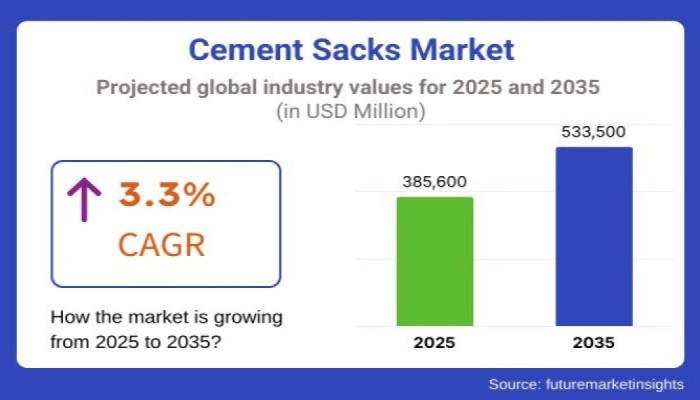
The global Cement Sacks Market is entering a decade defined by resilience, technological transformation, and rising sustainability standards. According to new industry projections, the market is expected to reach USD 385,600 million in 2025 and further expand to USD 533,500 million by 2035, reflecting a CAGR of 3.3%. This consistent growth is driven by rapid urbanization, massive infrastructure development, and increasing adoption of advanced packaging materials designed for durability and environmental compliance.
As smart cities, urban migration, and industrial construction reshape global landscapes, the need for high-strength, lightweight, moisture-resistant, and low-waste cement sacks has never been greater. Regulatory pressures and environmental responsibility have also shifted market trends toward more sustainable packaging solutions, prompting manufacturers to innovate at an unprecedented pace.
Discover Growth Opportunities in the Market – Get Your Sample Report Now
Growing Construction Activity Fuels Global Demand
Between 2025 and 2035, cement sack demand is anticipated to rise steadily as governments ramp up spending on residential, commercial, and industrial projects. The accelerating construction boom—particularly in emerging economies—is strengthening the market for durable, dust-resistant, and damp-proof sacks essential for safe cement storage and transportation.
Multi-layered, anti-leak, and tear-resistant sack technologies are gaining significant traction as cement producers seek to reduce material loss during transit, prevent moisture exposure, and improve overall handling efficiency. Strict regulatory mandates on packaged cement safety and waste reduction are further propelling the development of next-generation sacks.
Sustainability Takes Center Stage
With global regulations urging a shift away from traditional plastics, the industry is increasingly adopting biodegradable, recyclable, and fiber-based cement sacks. Innovations in kraft paper, woven polypropylene (PP), hybrid composites, and bio-based coatings are enabling manufacturers to design sacks that meet both durability and sustainability benchmarks.
Technological advancements are also accelerating transformation. Digital printing, barrier-enhanced paper technologies, and smart packaging features—such as product traceability and real-time monitoring—are enhancing brand value, supply chain oversight, and regulatory compliance.
As environmental concerns intensify, manufacturers are making sustainability a foundational pillar of the next generation of cement sacks.
Regional Market Trends
North America
North America continues to advance due to strong investments in infrastructure modernization, sustainable construction practices, and eco-friendly packaging materials. The United States and Canada are leading the shift toward degradable sacks, smart packaging technologies, and moisture-resistant PP and paper-based cement bags. Growth is further supported by initiatives aimed at reducing plastic waste and enhancing urban infrastructure.
Europe
Europe remains a global frontrunner in sustainable cement packaging. Countries such as Germany, France, Italy, and the United Kingdom are adopting recyclable and compostable sack materials in line with EU directives, including the Packaging Waste Directive and Circular Economy Action Plan. Lightweight hybrid paper-polymer sacks and anti-leak coatings are driving operational efficiency and strengthening the region’s market leadership.
Asia-Pacific
The Asia-Pacific region is poised for exceptional growth as megacities expand and governments invest heavily in transportation, housing, and commercial infrastructure. China, India, Japan, and South Korea are witnessing rising demand for high-performance cement sacks that support large-scale construction ecosystems. Smaller developing economies are also experiencing growing requirements as they embark on economic modernization and urban development initiatives.
Challenges and Opportunities
Key Challenges
- Environmental regulations limiting plastic-based sacks
- High production costs for multi-layered and moisture-proof sacks
- Raw material price volatility impacting profitability
- Supply chain disruptions reducing production consistency
Opportunities Ahead
- Rapid adoption of smart packaging technologies, including RFID, IoT, and AI
- Rising demand for biodegradable, compostable, and recyclable cement sacks
- Growth of automated filling systems, AI-driven quality control, and digital printing
- Expansion opportunities in Latin America, Africa, and the Middle East
Market Evolution: 2020–2024 vs. 2025–2035
Between 2020 and 2024, the cement sacks market grew steadily with increasing adoption of moisture-resistant multi-wall paper sacks and PP woven bags. Looking ahead to 2035, the next decade promises transformative developments, including AI-driven production, biodegradable composites, nanocoated paper sacks, and predictive supply chain modeling.
Smart construction logistics, zero-waste packaging, and blockchain-based traceability are expected to become industry standards by 2035.
Country-Wise Insights (CAGR 2025–2035)
- USA: 3.5%
- United Kingdom: 3.1%
- European Union: 3.3%
- Japan: 3.4%
- South Korea: 3.6%
Segmentation Outlook
Material Type
- Polypropylene (PP): Dominates the market due to superior strength, moisture resistance, and reusability.
- Unbleached Paper: Growing rapidly as a sustainable alternative with biodegradable and recyclable properties.
Sack Type
- Valve Sacks: Preferred for automated, dust-free filling and high-speed operations.
- Open Mouth Sacks: Ideal for manual filling in small-scale construction and retail markets.
Competitive Landscape
The global cement sacks industry includes leading players adopting bio-based materials, moisture-resistant coatings, and high-strength multi-layer designs.
Market Share Breakdown
- Mondi Group: 18–22%
- Billerud AB: 12–16%
- UPM-Kymmene Corporation: 10–14%
- Klabin S.A.: 8–12%
- LC Packaging International: 6–10%
- Other companies: 30–40%
Key Players and Offerings
- Mondi Group: High-strength, moisture-barrier PP/paper sacks
- Billerud AB: Reinforced kraft paper sacks
- UPM-Kymmene: Biodegradable fiber-based sacks
- Klabin S.A.: Tear-resistant, dust-free filling systems
- LC Packaging: UV-protected woven PP sacks
Why FMI: https://www.futuremarketinsights.com/why-fmi
About Future Market Insights (FMI)
Future Market Insights, Inc. (FMI) is an ESOMAR-certified, ISO 9001:2015 market research and consulting organization, trusted by Fortune 500 clients and global enterprises. With operations in the U.S., UK, India, and Dubai, FMI provides data-backed insights and strategic intelligence across 30+ industries and 1200 markets worldwide.
Contact Us:
Future Market Insights Inc.
Christiana Corporate, 200 Continental Drive,
Suite 401, Newark, Delaware – 19713, USA
T: +1-347-918-3531
For Sales Enquiries: sales@futuremarketinsights.com
Website: https://www.futuremarketinsights.com
LinkedIn| Twitter| Blogs | YouTube




