

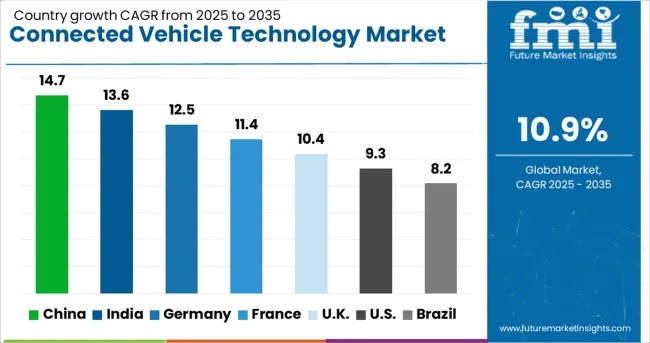
The global connected vehicle technology market is entering a high-growth phase, driven by rapid advancements in vehicle-to-everything (V2X) communication, 5G connectivity, and artificial intelligence–enabled automotive architectures. The market is estimated to be valued at USD 39.8 billion in 2025 and is projected to reach USD 112.0 billion by 2035, expanding at a robust compound annual growth rate (CAGR) of 10.9% over the forecast period.
During the first half of the outlook period (2025–2030), the market is expected to grow from USD 39.8 billion to USD 66.8 billion, contributing USD 27.0 billion, or 43.2%, of the total forecasted growth. This phase is being fueled by accelerated deployment of connected infotainment systems, real-time navigation, cloud-based telematics, and the standardization of embedded connectivity modules across passenger and commercial vehicles. Strong adoption of digital cockpits and over-the-air (OTA) software updates is also reshaping how vehicles are upgraded and managed across their lifecycle.
The second half of the forecast period (2030–2035) is projected to generate an incremental USD 46.2 billion, representing 56.8% of total market expansion. This acceleration reflects the rapid commercialization of autonomous driving features, large-scale rollout of advanced driver-assistance systems (ADAS), and deeper integration of AI-driven vehicle control platforms. Annual market increments are expected to rise from USD 5.4 billion in the early years to USD 9.2 billion by 2035, supported by growing electric vehicle (EV) penetration and the scaling of smart transportation infrastructure worldwide.
Subscribe for Year-Round Insights → Stay ahead with quarterly and annual data updates
https://www.futuremarketinsights.com/reports/sample/rep-gb-23448
V2X communication stands out as the dominant technology segment, accounting for 54.0% of total market revenue in 2025. This leadership is driven by V2X’s ability to enable real-time data exchange between vehicles, roadside infrastructure, pedestrians, and cloud networks. Its critical role in collision avoidance, lane-change assistance, blind-spot detection, and intelligent intersection management has positioned V2X as a foundation technology for both advanced safety systems and autonomous mobility. Growing investments in 5G-V2X testbeds, smart highway pilots, and national intelligent transport system (ITS) frameworks are accelerating adoption across urban and intercity road networks.
From a vehicle segmentation perspective, passenger cars are projected to account for 63.0% of total market revenue in 2025. Rising consumer expectations for seamless in-vehicle connectivity, integrated navigation, and personalized infotainment are driving OEMs to embed telematics control units and cloud-linked software architectures even in mid-range models. As vehicles increasingly operate as connected digital platforms, passenger cars are becoming core data nodes within broader mobility ecosystems, supporting remote diagnostics, software upgrades, and real-time vehicle-to-cloud interactions.
By application, safety and security solutions represent the largest share, contributing 27.0% of total market revenue in 2025. Regulatory mandates related to crash prevention, emergency response, and vehicle monitoring are accelerating integration of connected safety features. Systems such as automatic emergency braking alerts, predictive collision warnings, SOS calling, remote vehicle tracking, and anti-theft technologies are now embedded as standard or near-standard offerings in key automotive markets. AI-driven sensor fusion and real-time network-based analytics are further enhancing the reliability and responsiveness of these connected safety architectures.
Regionally, growth remains highly concentrated in Asia-Pacific, North America, and Europe. China is projected to lead global country-level growth, expanding at a CAGR of 14.7% from 2025 to 2035, supported by aggressive smart city investments, nationwide 5G deployment, and strong government backing for intelligent vehicle infrastructure. India follows with a 13.6% CAGR, driven by rapid urbanization, tightening vehicle safety regulations, and fast-growing demand for connected infotainment and telematics features. Germany is forecast to grow at 12.5% CAGR, reflecting its leadership in automotive engineering, ADAS innovation, and V2X integration. The United Kingdom and the United States are projected to grow at 10.4% and 9.3% CAGR, respectively, as mature markets accelerate adoption of autonomous driving capabilities and 5G-enabled connectivity.
The competitive landscape is defined by strong collaboration between semiconductor leaders, automotive system integrators, and cloud technology providers. Qualcomm continues to lead the market through advanced automotive-grade chipsets supporting 5G, V2X, and in-vehicle networking. Other prominent players include Aptiv, Cisco, Denso, Ericsson, Harman, Intel, Microsoft, NXP Semiconductors, and Waymo, each strengthening their positions through innovations in ADAS, cloud-based vehicle platforms, cybersecurity frameworks, and real-time data processing. Strategic partnerships between automakers, telecom operators, and software companies are accelerating deployment cycles and reducing time-to-market for next-generation connected features.
Recent product innovations highlight the fast-evolving nature of this ecosystem. Automakers are integrating voice-enabled AI assistants and conversational interfaces to enhance driver interaction, while partnerships in automated vehicle recognition and smart mobility software are expanding the functional scope of connected systems. At the same time, cybersecurity standards such as ISO/SAE 21434 are becoming integral to connected vehicle platform design, addressing data privacy and system resilience amid rising connectivity complexity.
As the automotive industry moves toward software-defined vehicles, autonomous fleets, and intelligent transport infrastructure, the connected vehicle technology market is positioned as a critical enabler of future mobility. Continued investments in 5G, edge computing, AI, and secure cloud architectures are expected to sustain double-digit growth through 2035. Stakeholders seeking deeper insights into technology roadmaps, regional opportunity mapping, and competitive benchmarking can explore the full market report for comprehensive strategic guidance.
About Future Market Insights (FMI)
Future Market Insights, Inc. (FMI) is an ESOMAR-certified, ISO 9001:2015 market research and consulting organization, trusted by Fortune 500 clients and global enterprises. With operations in the U.S., UK, India, and Dubai, FMI provides data-backed insights and strategic intelligence across 30+ industries and 1200 markets worldwide.




