The global automotive power distribution modules market is entering a strong expansion phase, driven by the accelerating shift toward vehicle electrification and intelligent electrical architectures. Valued at USD 8.0 billion in 2025, the market is projected to reach USD 13.6 billion by 2035, expanding at a compound annual growth rate (CAGR) of 5.4% during the forecast period. This growth reflects rising demand for efficient, compact, and thermally stable power management systems across electric, hybrid, and conventional vehicles.
Early-stage market expansion between 2025 and 2030 is expected to generate average annual revenue additions of USD 0.48 billion, supported by rising integration of safety-oriented electrical protection features such as overcurrent protection, fault isolation, and thermal monitoring. The latter half of the decade (2030 to 2035) is forecast to contribute USD 3.2 billion, representing 60.7% of the total market expansion, signaling stronger momentum as connected, autonomous, and software-defined vehicles continue to increase system-level power complexity.
Vehicle Electrification and Intelligent Power Management at the Core of Growth
The evolution of vehicle electrical architecture is the key force reshaping the market. Automakers are rapidly transitioning from traditional centralized wiring systems toward modular and zonal electrical architectures designed to reduce wiring weight, improve efficiency, and enable faster fault detection. Power distribution modules have become a foundational technology in this transformation by enabling real-time energy routing, dynamic load balancing, and high-speed fault response.
The rise in battery electric vehicles (BEVs) and hybrid electric vehicles (HEVs) has significantly intensified the demand for reliable power distribution systems. These vehicles require advanced management of voltage stability, heat dissipation, and switching performance to ensure battery safety and optimal vehicle operation. Regulatory mandates focusing on fuel efficiency and electrical safety have further accelerated OEM investments in scalable and intelligent power management platforms.
Subscribe for Year-Round Insights → Stay ahead with quarterly and annual data updates
https://www.futuremarketinsights.com/reports/sample/rep-gb-23457
Relays and Low-Voltage Modules Maintain Revenue Leadership
From a component perspective, relays are expected to capture 27.0% of total market revenue in 2025, positioning them as the dominant segment. Despite the emergence of semiconductor-based switching technologies, electromechanical relays continue to be widely used due to their durability, cost-effectiveness, and proven reliability in harsh automotive environments. Their ability to safely manage high-current loads ensures continued demand in both internal combustion engine (ICE) and hybrid vehicle platforms.
By module type, low-voltage power distribution modules are projected to account for 46.0% of total revenue in 2025. This leadership is attributed to the continued dominance of 12V electrical architectures across the global vehicle fleet. Low-voltage modules play a critical role in powering infotainment systems, lighting, safety electronics, sensors, and driver assistance functions. Their standardized design, compact size, and thermal efficiency have reinforced their role as essential components across passenger and light commercial vehicles.
Passenger vehicles are expected to represent 68.0% of total market revenues in 2025, reflecting high global production volumes and the continuous addition of electronic features in mass-market and premium vehicles.
Asia-Pacific Drives Growth as Europe and North America Accelerate Innovation
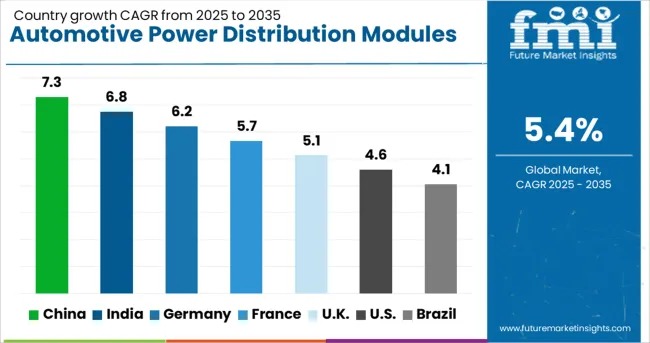
Asia-Pacific remains the primary engine of market growth, supported by large-scale vehicle production, rapid urbanization, and aggressive electrification policies. China is forecast to expand at a 7.3% CAGR, benefiting from strong domestic EV manufacturing capacity and government-backed EV infrastructure development. India follows at a 6.8% CAGR, supported by rising automotive output and policy-driven electrification initiatives.
Europe continues to serve as a global innovation hub, with Germany projected to grow at a 6.2% CAGR due to its leadership in electric drivetrains, power electronics, and sustainable mobility technologies. The United Kingdom and France are experiencing steady growth driven by carbon-neutral targets and increasing EV adoption. North America, led by the United States with a 4.6% CAGR, is witnessing consistent expansion based on rising EV penetration and regulatory pressure for greater energy efficiency.
Competitive Landscape Driven by Technology Leadership and Strategic Investment
The competitive landscape is shaped by global automotive technology leaders including Bosch, Continental, Denso, Eaton, Infineon, Lear Corporation, NXP Semiconductors, STMicroelectronics, TE Connectivity, and Valeo. These companies are investing heavily in miniaturization, higher power density, and semiconductor-based switching platforms to address the rising complexity of next-generation vehicles.
Recent industry advancements highlight the pace of transformation. Aptiv introduced zonal configurable power modules for software-defined vehicles, reducing wiring harness weight by up to 40% and enabling faster scalability for electric and autonomous platforms. Such innovations reflect the industry’s growing focus on zonal architectures and centralized computing models.
Long-Term Outlook
The automotive power distribution modules market is transitioning from conventional electrical control systems toward intelligent, software-driven power management ecosystems. As electric, connected, and autonomous vehicles become mainstream, power distribution modules will play an increasingly critical role in enabling vehicle safety, efficiency, and performance.
Manufacturers that successfully deliver compact, scalable, and digitally integrated solutions are expected to capture a disproportionate share of the USD 5.6 billion market opportunity over the next decade. With sustained regulatory pressure, rapid EV adoption, and accelerating innovation in semiconductor technologies, the market is poised for steady, long-term expansion through 2035.
About Future Market Insights (FMI)
Future Market Insights, Inc. (FMI) is an ESOMAR-certified, ISO 9001:2015 market research and consulting organization, trusted by Fortune 500 clients and global enterprises. With operations in the U.S., UK, India, and Dubai, FMI provides data-backed insights and strategic intelligence across 30+ industries and 1200 markets worldwide.