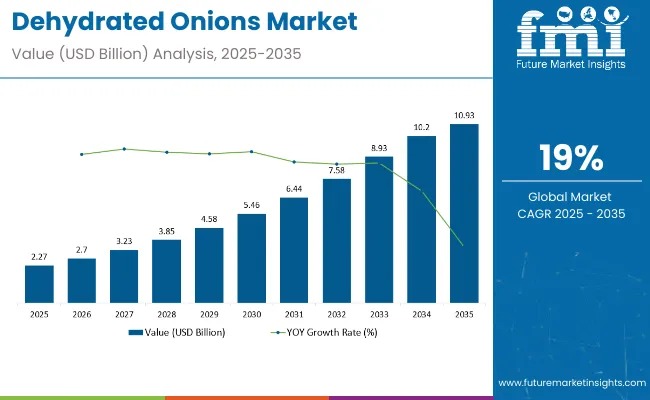
The global dehydrated onions market is entering a high-growth decade, valued at USD 2.27 billion in 2025 and forecast to surge to USD 10.93 billion by 2035, advancing at a robust 19% CAGR. This expansion represents an absolute value addition of USD 8.66 billion and total growth of 381.5%, positioning dehydrated onions as one of the fastest-growing segments within processed food ingredients.
Market momentum is being driven by structural shifts in global food consumption—rising demand for convenience foods, scalable food processing operations, and shelf-stable ingredients that deliver consistent flavor. Dehydrated onions are increasingly viewed not merely as substitutes for fresh onions, but as strategic inputs for industrial food production, foodservice, and retail applications.
Get Exclusive Access To Data Tables, Market Sizing Dashboards, And Analyst Insights. Request Sample Report!
India stands out as the most lucrative market, supported by its strong agricultural base, cost-efficient processing ecosystem, and dominant role in global onion exports. At the same time, China is emerging as the fastest-growing market, driven by urbanization, rising disposable incomes, and rapid adoption of processed and ready-to-cook foods.
Market Growth Trajectory Highlights
Between 2025 and 2030, the market is projected to expand from USD 2.27 billion to USD 5.2 billion, adding USD 2.93 billion, or 33.8% of total decade growth. This phase reflects accelerating penetration of dehydrated ingredients in soups, sauces, snacks, and seasoning blends.
From 2030 to 2035, growth intensifies, with the market rising from USD 5.2 billion to USD 10.93 billion, contributing USD 5.73 billion, or 66.2% of overall expansion. This period will be shaped by advanced drying technologies, clean-label innovation, and broader B2C channel adoption.
Why the Market Is Expanding Rapidly
Dehydrated onions address critical needs across modern food systems—long shelf life, concentrated flavor, reduced waste, and logistics efficiency. As consumers seek time-saving meal solutions without compromising taste, manufacturers increasingly rely on dehydrated onions to deliver consistency at scale.
Key demand drivers include:
- Rising consumption of ready-to-eat and ready-to-cook meals
- Growth of foodservice and institutional kitchens
- Preference for natural flavor enhancers over artificial additives
- Expansion of packaged foods across emerging markets
Segmental Insights: Where Demand Is Concentrated
Food processing dominates end-use, accounting for 67.7% of market share in 2025. Manufacturers value dehydrated onions for their ability to withstand industrial processing while maintaining flavor integrity, making them essential in mass-produced foods.
By form, granules lead with a 43% share, favored for their uniform texture, optimal rehydration, and ease of blending. Granules strike a balance between powders and larger flakes, offering precise flavor control for both industrial and household applications.
Regional Outlook: Asia-Pacific Leads the Growth Curve
- Asia Pacific remains the fastest-expanding region, led by India and China, supported by packaged food growth and foodservice expansion.
- North America shows steady demand from processed foods, fast food chains, and ready meals.
- Europe maintains stable growth, anchored in soups, sauces, seasoning blends, and premium clean-label ingredients.
China is projected to grow at a 14.5% CAGR through 2035, followed by Japan at 14.0% and the USA at 12.5%. These markets reflect rising reliance on shelf-stable ingredients amid busy urban lifestyles.
Opportunity Pathways Unlocking Future Value
The dehydrated onions market is supported by multiple revenue-generating pathways, collectively capable of unlocking USD 4.5–8.0 billion in incremental value by 2034–35, including:
- Clean-label and organic product lines
- Innovation across formats such as flakes, powders, and granules
- Geographic expansion into emerging markets
- Foodservice-focused, ready-to-use solutions
- Sustainability-driven processing and waste reduction
Competitive Landscape: Technology, Scale, and Supply Chain Control
Competition is defined by processing efficiency, quality consistency, and global reach. Leading players are investing in advanced drying technologies, sustainable sourcing, and direct B2B partnerships to strengthen margins and reliability.
Key market participants include Olam International, Jain Farm Fresh Foods Ltd, Daksh Foods Pvt. Ltd., Jiyan Food Ingredients, Natural Dehydrated Vegetables Pvt. Ltd., Real Dehydrates Pvt. Ltd., Earth Expo Company, Kisan Foods, Harmony House Foods, Inc., and Silva International Inc. Indian processors play a central role in global supply, while North American and European players focus on retail and foodservice channels.
Strategic Outlook
As food systems prioritize efficiency, waste reduction, and consistent ingredient performance, dehydrated onions are set to become a core component of global food manufacturing. The next decade will be defined by technology-led processing, clean-label positioning, and expanding global trade—solidifying dehydrated onions as a high-growth, high-impact ingredient category.