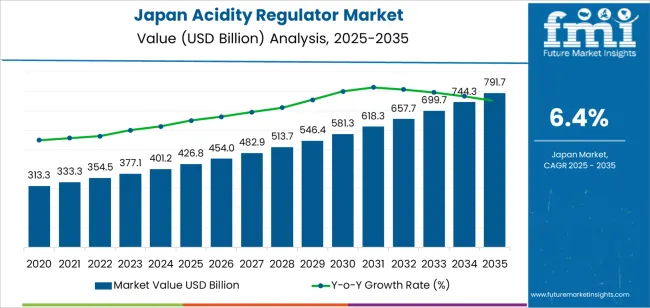
The Japan acidity regulator market, valued at USD 426.8 billion in 2025, is on track for significant expansion, with projections indicating it will reach USD 791.7 billion by 2035 at a compound annual growth rate (CAGR) of 6.4 percent over the forecast period. This substantial growth trajectory is being fueled by rising demand across food and beverage, pharmaceutical, and industrial applications, as well as a broader shift toward advanced technologies and cleaner, more natural solutions in ingredient formulation.
Acidity regulators play a vital role in controlling pH levels, enhancing flavor profiles, improving product stability, and extending shelf life in a wide range of products. In Japan—a country with one of the world’s most dynamic food processing sectors and discerning consumer base—these substances are indispensable in modern manufacturing. From carbonated beverages to condiments and dairy products, the use of acidity regulators has become deeply embedded in both traditional and contemporary product lines.
Market dynamics in Japan reflect both the strength of established players and the exciting potential for new entrants and technology innovators. Long-standing global manufacturers with robust supply chains and deep research capabilities have long dominated the market, supplying high-purity acidulants and tailored solutions to multinational and domestic food producers. Meanwhile, new and niche manufacturers are rapidly gaining attention by introducing specialized, clean-label, and bio-derived acidity regulators designed to meet evolving consumer preferences for transparency, health, and sustainability.
Driving Forces Behind Market Growth
The expanding processed and convenience food sectors in Japan remain primary drivers of acidity regulator demand. Manufacturers rely on acidulants not only for pH control and preservation but also to enhance taste and texture in products such as sauces, dressings, bakery goods, and confectioneries. Growth in beverage categories—especially functional and low-sugar drinks—is also contributing significantly to the demand profile.
Simultaneously, Japan’s pharmaceutical and nutraceutical industries are increasing their use of acidity regulators in medicinal formulations and supplements, where precise pH control can affect both efficacy and stability. Beyond food and pharmaceuticals, acidity regulators are finding emerging applications in personal care and industrial products, further broadening the market’s base.
Consumer trends in Japan are highly influential, with a clear movement toward clean-label, natural, and minimally processed ingredients. This shift is pushing manufacturers to innovate, creating new formulations that replace synthetic acidulants with naturally derived alternatives such as citric, lactic, and acetic acids—even as they maintain stringent quality and safety standards.
To access the complete data tables and in-depth insights, request a sample report here
Top Established Players and New Market Entrants
The industry continues to be shaped by major global companies with long histories of product development and supply excellence. Key incumbent organizations serve as anchors in the marketplace, providing a wide array of acidity regulator solutions tailored to diverse industrial needs. Their strong relationships with food, beverage, and pharmaceutical manufacturers have helped set the benchmark for product reliability, regulatory compliance, and formulation expertise.
At the same time, the market is witnessing the rise of innovative companies and new manufacturers that are transforming traditional approaches. These emerging players are leveraging biotechnology, fermentation processes, and green chemistry to produce specialty acidulants that align with consumer demand for natural, sustainable, and high-performance ingredients. Their entry into the market is expanding the competitive landscape and accelerating the pace of technological advancement.
Smaller innovators are also partnering with academic institutions and research groups to commercialize next-generation acidity regulators that enhance product functionality while reducing environmental impact. These collaborations are bringing fresh perspectives to formulation science and providing new avenues for growth—especially in niche categories such as plant-based foods, probiotic beverages, and premium artisanal products.
Regional and Sectoral Expansion Opportunities
Across Japan, varying regional dynamics are shaping unique opportunities. Major metropolitan areas with concentrated food manufacturing sectors continue to dominate consumption, while emerging industrial zones and rural processing hubs are increasing adoption of advanced acidity control solutions. Beverage manufacturers in urban centers are exploring new acidulants that support novel flavor profiles and extended shelf stability, while producers in other regions are integrating organic and clean-label options to better serve local consumer preferences.
The pharmaceutical industry’s growth, especially in functional and nutraceutical products, presents a promising avenue for acidity regulator applications beyond conventional food uses. Personal care and cosmetic brands are also experimenting with pH-balancing ingredients as part of demand for gentler, more effective formulations.
Outlook and Future Trends
Looking ahead, the Japan acidity regulator market is poised for steady and sustainable growth driven by innovation, consumer demand, and ongoing technological advancements. Established manufacturers with global reach are expected to continue bolstering their product portfolios, while new and agile entrants will pursue opportunities in specialized segments and emerging applications.
As the market evolves, collaboration, research investment, and responsiveness to regulatory standards and consumer tastes will define competitive success. Together, industry leaders and new challengers are shaping the next decade of growth, positioning Japan as a dynamic and influential market for acidity regulation solutions.