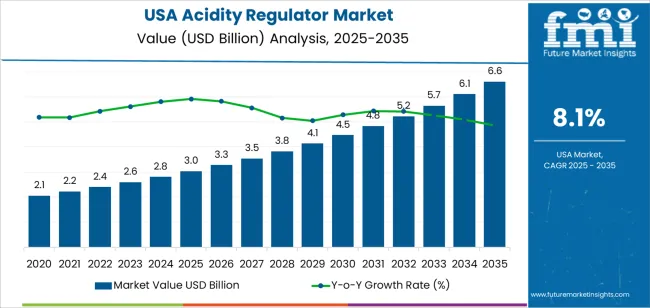
The United States acidity regulator market is projected to expand rapidly over the next decade, with industry value expected to climb from approximately $3.0 billion in 2025 to around $6.6 billion by 2035, reflecting a robust compound annual growth rate through 2035. This dynamic growth outlook underscores the essential role acidity regulators play across food & beverage, pharmaceutical, cosmetic, and related industries as manufacturers — both established and emerging — pursue innovation and market expansion.
Acidity regulators, commonly used to balance pH levels, enhance flavor stability, and extend product shelf life, have become integral in today’s production landscape. Increased consumer demand for processed foods and beverages, especially those with clean-label and natural ingredients, has further boosted their adoption across key applications. As companies respond to evolving regulatory requirements and prepare for future consumption trends, the market for acidity regulation solutions continues to strengthen.
Market Growth Driven by Demand for Quality and Convenience
The rising popularity of processed and convenience foods has significantly contributed to the increasing uptake of acidity regulators in the U.S. Food and beverage producers are relying on effective pH control agents not only to preserve quality but also to ensure safety and flavor consistency in products ranging from soft drinks and juices to sauces, dressings, bakery goods, and frozen meals. In parallel, the pharmaceutical sector’s need for controlled pH environments in drug formulations and effervescent tablets further propels demand.
This heightened focus on product performance and safety is playing out against a backdrop of heightened consumer interest in healthier alternatives. There is a noticeable shift toward natural, fermentation-derived acids — such as citric, lactic, and acetic acids — as consumers become more nutrition-savvy and increasingly avoid synthetic additives. This trend presents formidable opportunities for creators of innovative, plant-based, and “clean-label” acidity regulators.
Established Leaders and Innovative Entrants Shape Competitive Landscape
The U.S. acidity regulator market remains anchored by several established global and regional players recognized for their robust portfolios, extensive distribution networks, and commitment to product innovation. Key market leaders maintain strong production capabilities and continue to invest in research and development to stay ahead of evolving consumer preferences.
At the forefront, prominent companies such as Archer Daniels Midland Company, Cargill Incorporated, Tate & Lyle PLC, Jungbunzlauer Suisse AG, and Corbion N.V. have solidified their presence through diversified acidulant solutions tailored to meet stringent quality and regulatory standards required across multiple industries. These companies have been instrumental in expanding the availability of high-performance acidity regulators that deliver both functional benefits and alignment with modern food safety and labeling norms.
In addition to well-established manufacturers, the U.S. market is witnessing growing interest from new entrants and technology pioneers. These emerging players are shifting the market dynamics by introducing advanced production processes and novel formulations designed to enhance performance, sustainability, and clean-label appeal. Startups and technology-driven firms are experimenting with biotechnological approaches — such as fermentation-based acid production and precision pH control systems — that reduce environmental impact and support cost-effective manufacturing.
To access the complete data tables and in-depth insights, request a sample report here
Technological Advancements Fuel Industry Evolution
Innovation is a key differentiator in this market, with forward-looking companies exploring sophisticated manufacturing technologies and sustainable production methods. Developments in fermentation processes, improved extraction techniques, and bio-based acidulants are enabling producers to achieve higher yields while lowering energy usage and waste. These advancements not only improve cost competitiveness but also enhance the ability to meet growing demand from health-conscious consumers.
The trend toward multi-functional acidity solutions that offer improved flavor modulation, reduced usage levels without compromising effectiveness, and compatibility with natural ingredient strategies is gaining traction. This shift is fostering an environment where both established brands and new market entrants can compete effectively by offering niche, high-value products focused on specific applications — from beverage formulation to cosmetic pH stabilization.
Looking Ahead
With a projected surge in demand over the next decade, the U.S. acidity regulator market stands at an inflection point where quality, innovation, and sustainability converge. Established industry leaders are doubling down on R&D and expanded distribution, while innovative newcomers bring fresh perspectives and disruptive technologies that challenge traditional paradigms.