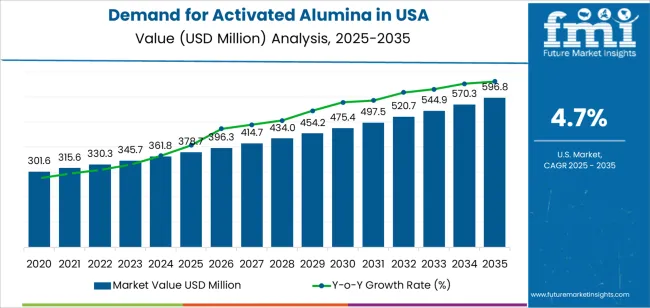
The United States activated alumina market is poised for substantial growth, with demand projected to expand from an estimated USD 378.7 million in 2025 to USD 596.8 million by 2035, reflecting strong industrial momentum and technological investment across key sectors. This surge in market value highlights an exciting opportunity for both long-established manufacturers and new market entrants to innovate, scale operations, and capture emerging applications in water treatment, refining, and advanced industrial technologies.
Activated alumina—a highly porous form of aluminum oxide prized for its adsorption and desiccation properties—continues to gain traction across multiple industries due to its versatility and effectiveness in filtration, moisture control, and contaminant removal. As environmental regulations tighten and industries seek more efficient and sustainable processes, the material’s unique characteristics are unlocking new commercial pathways and strategic collaborations.
Market Growth Anchored by Core Industrial Demand and Environmental Needs
Water treatment remains the leading end-use segment in the U.S., capturing the largest share of demand as cities, municipalities, and industrial water systems prioritize contaminant removal such as fluoride and heavy metals. Beyond water purification, activated alumina plays a critical role in natural gas dehydration, petrochemical processing, and air purification applications—making it a staple adsorbent in environmental management and industrial efficiency programs.
This expanding demand is not only fueling growth for traditional producers but also encouraging technological innovation in particle design, regeneration processes, and performance optimization. Manufacturers are increasingly focused on improving adsorption capacities, developing tailored pore structures, and enhancing regeneration efficiency to meet rigorous application requirements and reduce lifecycle costs.
Industry Players Embrace Innovation and Strategic Expansion
Market leaders such as BASF SE, Honeywell International Inc., Axens S.A., Sumitomo Chemical Co., Ltd., and Porocel Industries LLC are reinforcing their presence through product diversification, process improvements, and customer-centric solutions tailored to high-growth sectors. These established players are simultaneously advancing production technologies that enhance the effectiveness of activated alumina in demanding operating environments.
At the same time, innovative newcomers and technology-driven companies are entering the space with differentiated offerings—targeting niche applications in hydrogen purification, biogas treatment, and carbon capture support systems. These emerging manufacturers are leveraging digital monitoring systems and smart bed management tools to deliver enhanced performance, predictive maintenance capabilities, and superior sustainability profiles.
This blend of experienced incumbents and fresh, agile competitors is reshaping the market landscape, driving competition around value-added services, application engineering support, and customized adsorbent solutions.
To access the complete data tables and in-depth insights, request a sample report here
Technological Advancements Fuel Competitive Differentiation
One of the most compelling trends in the activated alumina market is the ongoing advancement in material science and processing techniques. Recent developments include engineered alumina grades with increased surface area and optimized pore distribution, which significantly boost adsorption efficiency and operational life. These improvements not only elevate performance for established applications but also open doors to new markets—particularly where high purity and precise moisture control are essential.
Additionally, regeneration technologies are gaining prominence. Manufacturers and technology providers are now offering activated alumina systems designed for repeated regeneration cycles, significantly reducing waste and operational costs. This regeneration focus aligns with broader sustainability efforts and is particularly attractive to water utilities, petrochemical plants, and industrial gas processors.
Regional Dynamics Highlight Opportunities Across the United States
While market growth is nationwide, certain regions are emerging as hot spots. The Western United States, with its stringent environmental regulations and robust industrial base, leads demand growth, followed closely by the South, Northeast, and Midwest. These regional dynamics reflect the interplay of industrial activity levels, regulatory environments, and investment in clean technology infrastructure.
Municipalities facing water quality challenges and refinery complexes in energy-intensive states are among the largest end-users, driving demand for high-performance adsorbents and desiccants. This regional diversity underscores the broad applicability of activated alumina and the varied opportunities available to companies that can align technical expertise with localized industrial needs.
Outlook: Collaboration, Innovation, and Market Expansion
As the U.S. activated alumina market continues its steady ascent, collaboration between established producers and innovative start-ups will be essential in capturing new growth avenues. Strategic investments in research, technology partnerships, and customer education on advanced alumina applications will further expand market reach and solidify activated alumina’s role in sustainable industrial processes.
Manufacturers poised to excel in this evolving landscape are those who combine deep industry experience with cutting-edge research and flexible production capabilities. Together, these attributes will not only meet growing industrial demand but also enable the development of next-generation solutions that address global environmental and operational challenges.