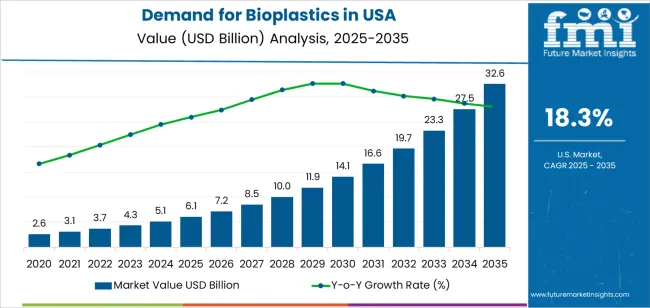
The United States bioplastics market is poised for substantial expansion, with demand expected to grow from approximately USD 6.1 billion in 2025 to an impressive USD 32.7 billion by 2035 at a strong compound annual growth rate. This surge reflects the accelerating shift in the manufacturing landscape toward renewable, plant-based plastics that reduce dependence on traditional petrochemicals, support environmental sustainability goals, and meet evolving consumer preferences for greener materials. Today’s announcement underscores the increasing importance of bioplastics across diverse sectors—from packaging and agriculture to automotive and consumer goods—as both veteran industry leaders and emerging players innovate to capture market opportunities and shape the future of sustainable materials.
Manufacturers who have established their presence in the bioplastics industry are already leading the charge. NatureWorks LLC continues to be a front-runner with its popular Ingeo biopolymer portfolio, which has found widespread adoption in packaging, food service, and agriculture applications. The company’s commitment to investment in advanced bio-based feedstocks and scalable production technologies has solidified its leadership position and set a benchmark for performance and sustainability. In parallel, global chemical giants such as BASF SE and TotalEnergies Corbion are expanding their bioplastics offerings with high-performance materials that balance environmental benefits with the functional demands of modern manufacturing.
TotalEnergies Corbion has distinguished itself with materials designed for food packaging and medical device applications, responding to both industry performance criteria and sustainability mandates. Meanwhile, Novamont S.p.A. and Mitsubishi Chemical Corporation continue to push the envelope with innovative production processes that leverage renewable resources, further contributing to circular economy solutions and waste reduction strategies. Together, these established manufacturers are shaping a competitive environment where sustainability and profitability go hand in hand.
At the same time, a new wave of manufacturers and technology innovators are entering the market, bringing fresh perspectives and breakthrough advancements. Startups and mid-sized firms are focusing on next-generation bioplastics with enhanced biodegradability, improved mechanical properties, and compatibility with existing processing equipment. Their efforts are complemented by strategic partnerships with research institutions and corporate sustainability programs that aim to accelerate commercialization and broaden application scopes. These emerging players are not just responding to market demand—they are creating new demand by introducing specialized formulations that address previously unmet needs in sectors like high-performance automotive components and specialty consumer products.
To access the complete data tables and in-depth insights, request a sample report here
Adoption of bioplastics is also rising rapidly due to a convergence of regulatory encouragement and corporate environmental commitments. Manufacturers across industries are increasingly aligning product strategies with net zero targets, adopting materials that can be traced back to renewable biomass and deliver lifecycle advantages over conventional plastics. This shift is further reinforced by local and federal policy frameworks that incentivize sustainable material use, reduce barriers to market entry, and support the build-out of composting and recycling infrastructure. These developments are creating fertile ground for both incumbents and newcomers to innovate and grow.
Market analysts highlight that while packaging remains the largest application segment—particularly for beverage bottles and flexible films—use cases for bioplastics are swiftly expanding into agriculture, textiles, consumer electronics, and automotive interiors. Innovations in biopolymer chemistry are enabling materials like bio-PET and bio-PE to rival their petroleum-based counterparts in performance, opening doors to new functional applications. At the same time, fully biodegradable alternatives are gaining traction where composting capability and environmental impact are primary purchase drivers.
The collective efforts of established manufacturers and new market entrants are contributing to a dynamic competitive landscape. Legacy players bring deep production expertise and global reach, while agile innovators introduce disruptive technologies and specialized products that accelerate adoption across industries. As supply chains adapt and renewable feedstock availability improves, cost efficiencies are expected to continue rising, making bioplastics a more accessible choice for a broader range of manufacturers.
Looking ahead, the United States bioplastics market stands at a pivotal moment. Collaboration among industry stakeholders, investment in cutting-edge R&D, and alignment with broader sustainability frameworks are collectively driving forward a future where bioplastics are an integral part of manufacturing and product development strategies. Established companies and ambitious newcomers alike have the opportunity to shape that future, delivering sustainable solutions that resonate with environmentally conscious consumers and meet the performance needs of modern industries.