

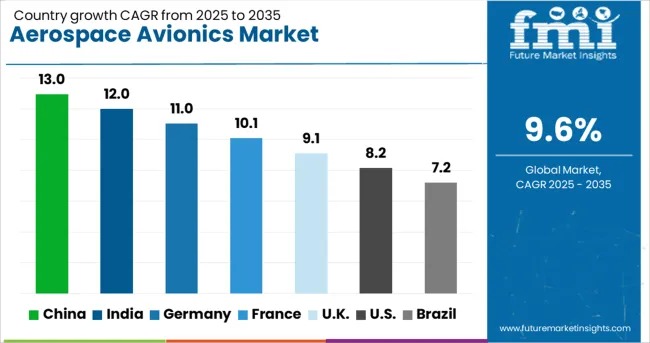
The global Aerospace Avionics Market is entering a high-growth phase, with total market value projected to rise from USD 52.1 billion in 2025 to USD 130.2 billion by 2035, expanding at a strong compound annual growth rate (CAGR) of 9.6% over the forecast period. This accelerated expansion reflects the aviation industry’s rapid shift toward fully digital cockpits, intelligent flight management, and real-time data-driven aircraft operations.
Between 2025 and 2030, the market is expected to increase from USD 52.1 billion to USD 82.3 billion, adding USD 30.2 billion in new value and capturing nearly 39% of the total decade-long opportunity. Annual market increments are forecast to rise steadily from USD 5.0 billion in 2025-2026 to USD 7.2 billion by 2029-2030, supported by strong commercial fleet modernization, military avionics upgrades, and next-generation navigation system deployments across major aviation markets.
Subscribe for Year-Round Insights → Stay ahead with quarterly and annual data updates
https://www.futuremarketinsights.com/reports/sample/rep-gb-23346
From 2030 to 2035, the market’s value expansion becomes significantly more aggressive, rising from USD 82.3 billion to USD 130.2 billion and contributing an additional USD 47.9 billion, accounting for approximately 61% of the total decade opportunity. The largest single-year value gain of USD 11.4 billion is expected between 2034 and 2035, driven by the introduction of highly integrated cockpit architectures, increased avionics content per aircraft, and the commercialization of semi-autonomous flight systems.
Flight Management Computers Anchor System-Level Demand
By 2025, Flight Management Computers (FMCs) are projected to command 21.0% of total market revenue, positioning them as the largest and most critical avionics system segment. FMCs have become central to modern aircraft operations, enabling advanced route optimization, fuel-efficient flight paths, automated throttle management, and real-time compliance with increasingly complex air traffic management protocols.
The integration of performance-based navigation (PBN), 4D trajectory management, and advanced auto-throttle and guidance logic has dramatically expanded the functionality of these systems. Airlines are increasingly prioritizing FMC upgrades as part of retrofit programs, recognizing their direct impact on operational cost reduction, fuel savings, and flight-path accuracy.
Commercial Aviation Emerges as the Core Growth Platform
The commercial aviation segment is forecast to account for 55.0% of total market share in 2025, underlining its role as the primary platform driving avionics investment. Rising global passenger traffic, particularly in Asia-Pacific and the Middle East, is forcing airlines to rapidly expand and modernize fleets, accelerating demand for high-performance avionics suites.
Aircraft manufacturers are embedding intelligent flight decks, satellite-based navigation, electronic flight bags (EFBs), and real-time aircraft health monitoring systems at the production stage. These advancements are enabling airlines to meet stricter global safety standards, reduce pilot workload, and enhance long-haul operational performance while improving fuel efficiency and emissions compliance.
Line-Fit Installations Dominate OEM-Driven Adoption
Line-fit avionics installations are projected to capture 63.0% of total market share in 2025, reflecting the growing preference for factory-installed, pre-certified avionics solutions. OEM-driven integration delivers cost efficiencies, reduces integration risks, and allows aircraft to achieve immediate airworthiness approval upon delivery.
Manufacturers are increasingly designing modular, upgradeable avionics architectures, allowing airlines to deploy future software and hardware enhancements without costly structural modifications. This strategy is strengthening supplier-OEM partnerships and accelerating the standardization of next-generation avionics across new aircraft programs.
Asia-Pacific and North America Lead Regional Expansion
North America continues to dominate technological leadership and early adoption, supported by large commercial and military fleets and a mature certification ecosystem. At the same time, Asia-Pacific has emerged as the fastest-expanding region, driven by rapid fleet growth and defense modernization in China and India.
China is projected to grow at a 13.0% CAGR, supported by domestic aircraft manufacturing expansion and heavy investments in indigenous satellite navigation systems. India follows with a 12.0% CAGR, fueled by regional air connectivity initiatives and defense cockpit modernization programs. Germany (11.0% CAGR), France (10.1% CAGR), and the United Kingdom (9.1% CAGR) are strengthening their positions through avionics innovation, exports, and participation in multinational aerospace programs. The United States, with a 8.2% CAGR, maintains steady growth across commercial, defense, and space platforms.
AI, Predictive Analytics, and Autonomous Capabilities Reshape Avionics Architecture
The avionics landscape is undergoing a structural transformation, with increasing integration of artificial intelligence, predictive diagnostics, and real-time data processing. Intelligent systems are now capable of anticipating component failures, optimizing flight paths dynamically, and supporting pilots with automated decision-assistance tools.
Lightweight, power-efficient avionics hardware is helping airlines achieve sustainability objectives, reducing overall aircraft energy consumption while maintaining performance gains. The rise of connected flight technologies, cloud-enabled maintenance platforms, and autonomous navigation algorithms is expanding both OEM and aftermarket upgrade cycles.
Aftermarket Upgrades Create Long-Term Revenue Stability
The robust expansion of retrofit programs and regulatory upgrade mandates is strengthening the aftermarket segment. Airlines and defense operators are investing in cockpit digitalization, communication system enhancements, and navigation compliance upgrades, ensuring predictable long-term revenue streams for avionics suppliers.
Personalize Your Experience: Ask for Customization to Meet Your Requirements
https://www.futuremarketinsights.com/customization-available/rep-gb-23346
Upgrades aligned with evolving global aviation regulations and next-generation air traffic management frameworks are creating sustained demand across narrow-body, wide-body, and regional aircraft fleets.
Competitive Landscape Defined by Innovation and Strategic Partnerships
The market remains highly competitive, led by global aerospace leaders including Honeywell, BAE Systems, Thales, L3Harris, Northrop Grumman, Garmin, Elbit Systems, Leonardo, and Safran. These companies are actively investing in modular avionics platforms, cybersecurity-hardened architectures, and long-term OEM partnerships to secure multi-year production and upgrade contracts.
Recent technological milestones, including AI-ready cockpit platforms and autonomous computing systems, are accelerating the commercialization of semi-autonomous aircraft and next-generation urban air mobility vehicles.




