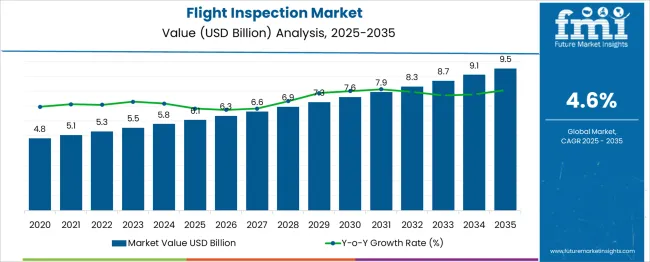
The global flight inspection market is projected to expand from USD 6.1 billion in 2025 to USD 9.5 billion by 2035, registering a compound annual growth rate (CAGR) of 4.6% over the forecast period. This evolution reflects a structural transformation in how navigation infrastructure is validated worldwide, as authorities and airport operators increasingly shift from manual, ground-centric checks to data-driven, airborne, and automated inspection architectures.
Market performance reveals a two-stage growth profile. From 2025 to 2030, the market grows from USD 5.8 billion to USD 7.3 billion, adding USD 1.5 billion in value—almost 40% of total incremental opportunity. This phase is characterized by consistent calibration programs, rapid airport expansion across emerging economies, and intensified compliance with International Civil Aviation Organization (ICAO) mandates. Average annual additions of USD 240 million highlight controlled and predictable growth with limited volatility.
From 2030 to 2035, the sector enters a steeper expansion phase, contributing USD 2.2 billion in new value—nearly 60% of total market growth. Annual incremental gains accelerate beyond USD 350 million by 2033–2035, supported by large-scale deployment of automation-based flight validation, GNSS (Global Navigation Satellite System) augmentation, and UAV-integrated inspection platforms. This late-stage acceleration marks a decisive shift toward real-time, high-frequency validation processes, particularly across congested air corridors and next-generation airports.
Subscribe for Year-Round Insights → Stay ahead with quarterly and annual data updates
https://www.futuremarketinsights.com/reports/sample/rep-gb-23371
Strategic Role in Aviation Infrastructure
Flight inspection remains a cornerstone of modern aviation safety. It contributes an estimated 8–10% of the aviation safety and navigation services market, ensuring compliance and operational integrity of Instrument Landing Systems (ILS), VOR, DME, and advanced satellite-based navigation aids. Within the dedicated flight inspection and calibration segment, it represents 40–45% of total value, reflecting the dominance of airborne calibration systems and flight-based validation services.
Despite growing interest in drone-based inspection, crewed aircraft continue to command 3–4% of the expanding UAS inspection market, retaining relevance for certified missions requiring the highest accuracy thresholds. In airport operations and infrastructure support services, flight inspection accounts for 6–7% of total activity, underscoring its criticality for operational reliability in high-traffic environments.
Systems Segment and Commercial Airports Lead Market Structure
By solution type, system-based platforms are projected to command 64.0% of market revenue in 2025, driven by strong demand for embedded, autonomous, and precision-driven inspection architectures. These systems integrate modular avionics, advanced sensors, and real-time analytics, enabling scalable, multi-mission capabilities across civil and defense applications. The shift away from purely service-based models reflects a structural preference for integrated inspection ecosystems that reduce human error and accelerate calibration cycles.
By end use, commercial airports are expected to hold 71.0% of total market share in 2025. This dominance is supported by continuous airport modernization programs and surging passenger and cargo volumes. High-traffic hubs require more frequent and precise calibration of ILS, runway alignment systems, and satellite navigation procedures, reinforcing long-term demand for flight inspection services and systems.
Regional Acceleration Shaped by Infrastructure Expansion
Asia-Pacific is emerging as the fastest-growing region. China, with a projected CAGR of 6.2%, is benefiting from aggressive airport construction, runway expansion, and national air safety initiatives. Investments in AI-enabled fault detection and real-time data transmission are accelerating the modernization of inspection fleets and calibration protocols.
India follows closely at a 5.8% CAGR, supported by regional connectivity programs and airport infrastructure upgrades. The country is deploying digital inspection platforms and cost-optimized system solutions to enhance coverage across new and existing airports.
In Europe, Germany is forecast to grow at 5.3% CAGR, anchored by strict EASA regulatory frameworks and early adoption of GNSS-based and semi-autonomous calibration systems. The United Kingdom, growing at 4.4%, is investing in Performance-Based Navigation (PBN) upgrades and UAV-enabled inspection platforms, while the United States, at 3.9% CAGR, continues to modernize under the FAA’s NextGen air traffic management program, with strong momentum in GBAS deployment and AI-assisted fault detection.
Technology-Driven Transformation Accelerates Competitive Differentiation
The market is undergoing rapid technological advancement. Modern flight inspection platforms now feature purpose-built aircraft, multi-sensor avionics suites, and cloud-connected analytics architectures that enable faster calibration cycles and real-time reporting. UAV-enabled systems are increasingly adopted for short-range validation tasks, reducing cost per mission and improving operational agility for smaller airfields.
Emerging concepts such as digital twin simulations are enabling predictive inspection planning, while modular inspection kits compatible with multiple aircraft platforms are enhancing deployment flexibility.
Personalize Your Experience: Ask for Customization to Meet Your Requirements
https://www.futuremarketinsights.com/customization-available/rep-gb-23371
Competitive Landscape Anchored by Precision and Compliance
The competitive environment is led by specialized aerospace and avionics companies including Saab, Aerodata, Cobham, Safran, Bombardier, Textron Aviation, ST Engineering, and Norwegian Special Mission. These players are focusing on system accuracy, regulatory compliance, and the integration of GNSS, ADS-B, and AI-driven analytics. Service providers such as Flight Calibration Services and Flight Precision continue to expand global footprints through long-term contracts with airport authorities and air navigation service providers.
Outlook
The next decade is expected to redefine the operational fabric of flight inspection through automation, digital integration, and UAV adoption. As global regulations tighten and airspace complexity increases, the market is transitioning from routine calibration to continuous, intelligence-driven validation frameworks. Companies aligning with real-time analytics, remote monitoring, and UAV-enabled inspection platforms are positioned to capture significant value as the sector moves into its high-growth acceleration phase.
The full market report delivers detailed forecasts, competitive intelligence, and region-specific insights across more than 40 countries, providing a comprehensive perspective on emerging opportunities, technology adoption curves, and strategic growth pathways within the global flight inspection ecosystem.
About Future Market Insights (FMI)
Future Market Insights, Inc. (FMI) is an ESOMAR-certified, ISO 9001:2015 market research and consulting organization, trusted by Fortune 500 clients and global enterprises. With operations in the U.S., UK, India, and Dubai, FMI provides data-backed insights and strategic intelligence across 30+ industries and 1200 markets worldwide.