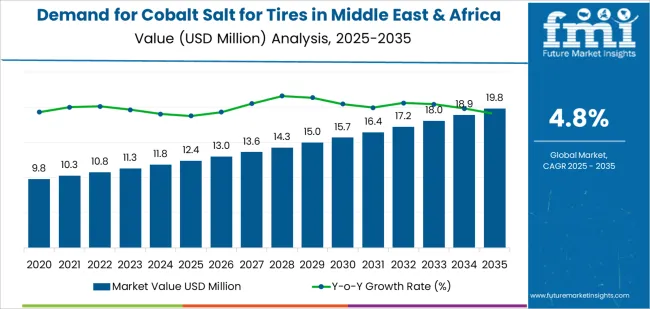
The market for cobalt salt used in tire manufacturing across the Middle East and Africa is set for a significant evolution, with demand forecast to surge sharply over the next decade. As the automotive sector in the region accelerates, both long-standing chemical producers and new technology innovators are identifying unprecedented opportunities to expand their businesses and deliver next-generation solutions to tire makers and automotive OEMs.
According to the latest industry outlook, the value of cobalt salt demand in the Middle East & Africa is projected to rise substantially by 2035, driven by rising automotive production, increasing consumer preference for performance-oriented tires, and expanding investments in advanced tire manufacturing infrastructure. This promising trajectory presents a rich landscape for manufacturers seeking to strengthen their market footprint and for new technology entrants looking to introduce disruptive innovations that enhance tire performance and manufacturing efficiency.
Market Growth Shifts Gears
The demand for cobalt salt products—from conventional compounds to emerging specialty configurations—is expected to grow meaningfully as regional markets shift toward premium automotive solutions. Passenger car tire applications, which now represent nearly half of total cobalt salt usage, underscore the rising emphasis on quality, safety, and longevity in tire performance. As everyday drivers, commercial fleets, and off-road vehicles proliferate across diverse geographies, tire manufacturers are responding with compound innovations that incorporate cobalt salt to optimize adhesion, durability, and climate adaptability.
This positive outlook is further amplified by the rapid modernization of tire manufacturing facilities across Middle Eastern and African automotive hubs. Countries such as the United Arab Emirates, Saudi Arabia, Qatar, and Israel are emerging as focal points for both demand growth and technological adoption. These markets are investing heavily in state-of-the-art production technologies, automated compound systems, and climate-adaptive materials that perform under extreme conditions—drawing on the unique benefits offered by cobalt salt chemistries.
Established Market Leaders Driving Stability and Innovation
Traditional chemical manufacturers with deep technical expertise and established supply chains continue to anchor the cobalt salt market in the region. Industry leaders are strategically positioning themselves through expanded distribution networks, collaborative partnerships, and advanced compound portfolios tailored for tire applications.
These seasoned players are leveraging their long-standing credibility to support major tire makers as they transition to more sophisticated compound systems. Their focus extends beyond basic supply, encompassing enhanced quality assurance programs, technical support services, and localized logistics frameworks that ensure seamless integration of cobalt salt products into existing manufacturing processes.
Importantly, established firms are reinvesting in research and development to refine cobalt salt formulations—improving features such as temperature tolerance, bonding strength, and compound compatibility. By doing so, they not only safeguard performance excellence but also lay the groundwork for next-generation product offerings that respond to evolving industry benchmarks.
To access the complete data tables and in-depth insights, request a sample report here
New Entrants and Technologies Accelerating Market Evolution
Alongside established companies, a new wave of manufacturers and technology innovators is entering the cobalt salt landscape, eager to capture emerging opportunities. These entrants are distinguished by their focus on advanced materials science, digitized manufacturing workflows, and specialized compound technologies that deliver enhanced performance attributes.
Innovation-oriented firms are also exploring tailored formulations designed for specific tire segments, including high-performance passenger vehicles, electric fleets, and heavy commercial vehicles. Their efforts to integrate data-driven analytics, automated blending systems, and catalytic enhancements are redefining how cobalt salt compounds contribute to tire quality, sustainability, and lifecycle performance.
The entry of such forward-thinking manufacturers not only injects fresh energy into the market but catalyzes competitive dynamics that benefit end users. By introducing disruptive solutions that optimize performance while addressing rising operational challenges—such as extreme heat resilience and fuel efficiency—these newcomers are reshaping expectations for what tire compound chemistry can achieve.
Strategic Outlook: Collaboration, Innovation, and Growth
As the cobalt salt for tires market advances, collaboration among chemical suppliers, tire OEMs, technology developers, and regional stakeholders will be vital to unlocking full market potential. Cross-industry partnerships can accelerate adoption of innovative compound technologies, streamline supply chains, and ensure robust performance standards across diverse operational environments.
Regulatory frameworks that emphasize safety, quality certification, and environmental performance also play an essential role in guiding market development. By aligning industry standards with cutting-edge material technologies, regional authorities can spur confidence among manufacturers and consumers alike, driving broader acceptance of upgraded tire compounds.
Looking ahead, investors and industry participants are encouraged to view this market not simply as a supplier ecosystem, but as a vibrant arena for technological advancement and sustainable growth. Opportunities abound for companies that can integrate deep chemical expertise with forward-looking engineering, agile manufacturing, and customer-centric service models.
Conclusion
The cobalt salt market for tire applications in the Middle East and Africa is more than a niche chemical segment—it is a strategic gateway to enhanced automotive performance and manufacturing innovation. With robust growth on the horizon, established manufacturers and new technology leaders alike have a chance to forge lasting value, push the boundaries of compound science, and drive the evolution of tire technology across one of the world’s most dynamic regions.