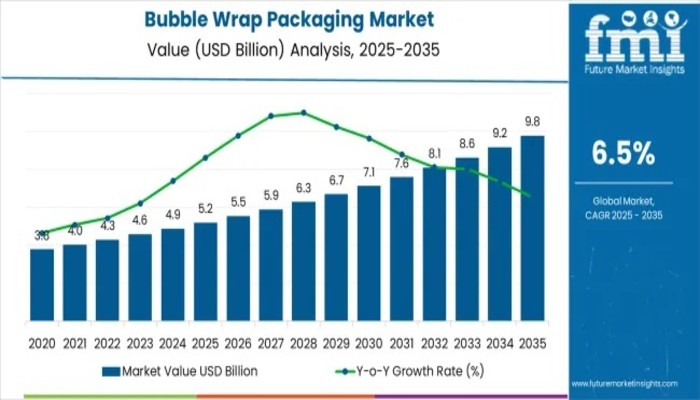
The global bubble wrap packaging market, valued at USD 5.2 billion in 2025, is poised for a transformative decade, projected to reach USD 9.8 billion by 2035 at a CAGR of 6.5%. The industry’s rapid evolution is being shaped by surging e-commerce shipments, heightened electronics protection needs, and rising demand for lightweight, cost-efficient cushioning materials across logistics, retail, and industrial supply chains.
With polyethylene (PE) commanding a 68% material share in 2025, and e-commerce & retail capturing 42% of application demand, bubble wrap continues to stand as one of the most critical protective packaging solutions worldwide. As global parcel volumes surge and businesses prioritize damage prevention, bubble wrap remains foundational to modern fulfillment ecosystems.
Discover Market Opportunities – Get Your Sample of Our Industry Overview Today!
A Decade of Strong Expansion (2025–2035)
Between 2025 and 2030, the market will rise from USD 5.2 billion to USD 7.3 billion, contributing nearly 45.7% of the decade’s growth, supported by increasing adoption of multi-layer bubble structures, anti-static materials, and automated packaging systems.
From 2030 to 2035, the sector will accelerate further to USD 9.8 billion, with 56.5% of the additional growth driven by advancements in biodegradable bubble wraps, high-barrier films, and widespread digitization of logistics operations.
Asia Pacific Leads Global Growth
Regionally, Asia Pacific dominates with over 40% share, driven by booming manufacturing, export activities, and the world’s fastest-growing e-commerce networks.
- India leads globally with a CAGR of 8.9%, fueled by logistics expansion and high-volume online retail.
- China follows with 7.8% CAGR, supported by massive online shopping consumption and advanced packaging automation.
- North America and Europe collectively account for nearly 45% of the market, benefiting from high-value electronics distribution, heavy warehouse automation, and stringent packaging performance standards.
Demand Drivers: E-commerce, Electronics, and Global Trade
The e-commerce boom remains the primary catalyst for global bubble wrap consumption. As online shopping escalates, businesses require reliable solutions to safeguard electronics, cosmetics, glassware, and fragile merchandise across long and complex supply chains.
The rise in cross-border trade amplifies this need. Industries shipping high-value or delicate goods rely heavily on bubble wrap for impact absorption, moisture protection, and transit durability, especially across multi-modal international logistics routes.
Electronics and specialty product manufacturers increasingly seek anti-static bubble wraps, while industrial sectors demand heavy-duty variants with enhanced puncture resistance. These trends are reshaping both product design and market dynamics.
Innovation and Competitive Landscape
Key players including Sealed Air Corporation, Pregis LLC, Storopack, Polyair Inter Pack Inc., and Smurfit Kappa are driving the next wave of product innovation.
Manufacturers are focusing on:
- Eco-friendly bubble wraps with biodegradable or recycled PE content
- Automated bubble dispensing and wrapping systems
- Multi-layer cushioning designs with enhanced air retention
- Customized bubble pouches, mailers, and protective sleeves
With nearly 30% of manufacturers investing in sustainable product lines, the industry is experiencing a shift toward circular packaging systems that maintain performance while reducing environmental impact.
Opportunity Pathways Shaping the Market
The decade ahead presents seven major revenue opportunities:
- Anti-static bubble wrap for electronics: USD 950M–1.4B potential
- Heavy-duty industrial bubble wrap: USD 700M–1.1B
- Automated dispensing & wrapping systems: USD 550M–850M
- Biodegradable & recycled-content wraps: USD 600M–950M
- Regional manufacturing expansion in APAC: USD 850M–1.3B
- Pre-cut pouches & bubble mailers: USD 500M–800M
- Multi-layer barrier bubble films: USD 450M–700M
These pathways illustrate how bubble wrap is shifting beyond a commodity product into a technology-driven, value-added packaging category.
Segmental Highlights
- Material Type: Polyethylene dominates due to flexibility, cost efficiency, and superior air retention.
- Application: E-commerce & retail account for 42% of global demand.
- Bubble Size: Medium-sized bubbles remain preferred across industrial and consumer shipments.
- End-use: Logistics, manufacturing, retail, and healthcare are the strongest adopters.
Automated wrapping compatibility and warehouse integration are further enhancing bubble wrap’s strategic importance for high-volume fulfillment centers.
Why FMI: https://www.futuremarketinsights.com/why-fmi
About Future Market Insights (FMI)
Future Market Insights, Inc. (FMI) is an ESOMAR-certified, ISO 9001:2015 market research and consulting organization, trusted by Fortune 500 clients and global enterprises. With operations in the U.S., UK, India, and Dubai, FMI provides data-backed insights and strategic intelligence across 30+ industries and 1200 markets worldwide.
Contact Us:
Future Market Insights Inc.
Christiana Corporate, 200 Continental Drive,
Suite 401, Newark, Delaware – 19713, USA
T: +1-347-918-3531
For Sales Enquiries: sales@futuremarketinsights.com
Website: https://www.futuremarketinsights.com
LinkedIn| Twitter| Blogs | YouTube