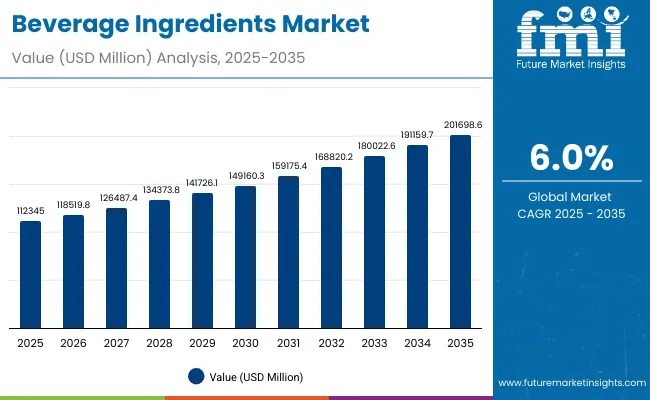
The global Beverage Ingredients Market is entering a decade of accelerated value creation, driven by rising health consciousness, clean-label reformulation, and functional science advancements. The market is projected to grow from USD 112,345.0 million in 2025 to USD 201,698.6 million by 2035, adding USD 89,353.6 million in new value and expanding nearly 1.8X over the forecast period. This growth reflects a steady CAGR of 6.0%, underpinned by strong adoption across functional beverages, RTD formats, dairy alternatives, and enhanced waters.
Between 2025 and 2030, the market is expected to add USD 36.8 billion, accounting for around 41% of total decade growth. This phase is characterized by widespread reformulation toward natural sweeteners, functional proteins, and clean-label ingredients. From 2030 to 2035, growth accelerates further, contributing USD 52.5 billion, or 59% of total expansion, as fermentation-derived ingredients, probiotics, and digitally enabled functional beverages scale globally.
Explore trends before investing – request a sample report today! https://www.futuremarketinsights.com/reports/sample/rep-gb-26649
Functional Ingredients Anchor Market Expansion
Functional ingredients represent the largest segment, accounting for 28.4% of market share in 2025, making them the backbone of beverage innovation. Proteins, probiotics, adaptogens, nootropics, and electrolytes are increasingly integrated into sports drinks, energy beverages, nutraceutical shots, and dairy alternatives. These ingredients respond directly to consumer demand for energy, immunity, gut health, and cognitive support, positioning beverages as lifestyle and wellness solutions rather than simple refreshments.
Enhanced waters and nutraceutical shots are among the fastest-growing applications, posting CAGR ranges of 6.2%–6.8%, while functional beverages overall continue to dominate new product launches. As science-backed formulations gain regulatory and consumer acceptance, functional ingredients are expected to remain central to product differentiation through 2035.
Plant-Based and Fermentation-Derived Sources Gain Ground
By source, plant-based ingredients lead with 38.1% share in 2025, driven by demand for vegan, natural, and sustainable formulations. Botanical extracts, fruit-derived flavors, herbal actives, and natural colors are replacing synthetic inputs across mainstream and premium beverages. Plant proteins from oat, soy, pea, and almond continue to support the global shift away from dairy, while stevia and monk fruit enable sugar reduction without compromising taste.
Fermentation-derived ingredients are scaling rapidly, particularly probiotics, bioactive compounds, and natural flavor enhancers. Together with plant-based sources, they are projected to exceed 44% of total revenue mix by 2035, reshaping sourcing strategies and R&D priorities for global manufacturers.
Regional Momentum Led by North America and Asia-Pacific
North America, led by the United States (6.2% CAGR), remains a high-value market driven by functional waters, nutraceutical shots, and AI-enabled formulation tools. The U.S. market alone is forecast to reach USD 48.8 billion by 2035, supported by innovation in personalization, protein fortification, and RTD beverages.
Asia-Pacific is the fastest-growing region. China (5.7% CAGR) and India (5.3% CAGR) are benefiting from functional beverage adoption, sugar-reduction policies, and expanding middle-class consumption. Functional teas, fortified waters, and dairy alternatives are gaining traction across urban and tier-2 markets.
In Europe, growth is anchored by clean-label compliance and sustainability leadership. Germany (6.6% CAGR) stands out as a hub for natural colors, probiotics, and fermentation-led innovation, while the UK and France continue to advance sugar-reduction reformulation using natural sweeteners.
Competitive Landscape Shifts Toward Functional Science
The Beverage Ingredients Market is moderately fragmented. Givaudan leads with nearly 12% market share, followed by Kerry Group, DSM-Firmenich, Symrise, and ADM. While traditional strengths lie in flavors and sweeteners, competitive advantage is increasingly tied to functional science, sustainability credentials, and co-creation capabilities.
Emerging players specializing in plant-based proteins, gut-health solutions, and bio-fermentation are gaining share. Digital tools such as AI-driven flavor mapping and personalized nutrition platforms are redefining innovation cycles, pushing incumbents toward ecosystem-based strategies rather than commodity-driven competition.
Key Market Drivers and Trends
Growth is primarily fueled by:
- Rising demand for health-focused and clean-label beverages
- Expansion of plant-based and low-sugar formulations
- Advances in fermentation, probiotics, and functional actives
- Integration of digital personalization and data-driven R&D
At the same time, challenges persist around high production costs, sourcing volatility, and regulatory complexity for health claims. Despite these hurdles, long-term outlook remains strong as functional beverages transition into everyday consumption categories.
Outlook
By 2035, the Beverage Ingredients Market will be defined by functionality, sustainability, and personalization. Functional beverages will continue to blur the line between nutrition and refreshment, while plant-based and fermentation-derived ingredients reshape supply chains. Companies that align scientific validation with consumer engagement and clean-label credibility will be best positioned to capture the next wave of growth in this evolving global market.