The global enzymes market is entering a phase of steady, innovation-led expansion, supported by rising adoption across food processing, pharmaceuticals, biofuels, and industrial manufacturing. Valued at USD 15.4 billion in 2025, the market is projected to reach USD 29.7 billion by 2035, registering a compound annual growth rate (CAGR) of 6.8% over the forecast period. This growth reflects a structural shift toward biologically efficient, low-energy, and environmentally responsible production systems.
Enzymes are increasingly favored for their ability to catalyze complex reactions under mild conditions, reducing processing time, chemical usage, and energy consumption. Their application has moved well beyond traditional food processing, with growing relevance in healthcare diagnostics, enzyme-based therapies, biofuel conversion, detergents, and advanced industrial biotechnology.
Explore trends before investing – request a sample report today! https://www.futuremarketinsights.com/reports/sample/rep-gb-24961
A defining factor behind market expansion is the food and beverage sector, which remains the largest consumer of industrial enzymes. Bakery, dairy, and brewing applications continue to rely on enzymes to enhance texture, flavor, shelf life, and processing efficiency. At the same time, consumer demand for clean-label and naturally processed foods has accelerated the replacement of synthetic additives with enzyme-based solutions, reinforcing long-term demand stability.
Beyond food applications, healthcare and pharmaceuticals represent a fast-evolving growth avenue. Enzymes are increasingly integrated into diagnostics, molecular testing, and targeted therapies, reflecting a broader shift toward precision medicine. In parallel, biofuel producers are leveraging enzymatic solutions to improve starch and cellulose conversion, enabling higher yields and reduced operational costs. These developments are supported by sustained investment in enzyme engineering, fermentation technologies, and protein optimization.
Market Snapshot: Enzymes Industry at a Glance
- Market Value (2025): USD 15.4 billion
- Forecast Value (2035): USD 29.7 billion
- Forecast CAGR (2025–2035): 6.8%
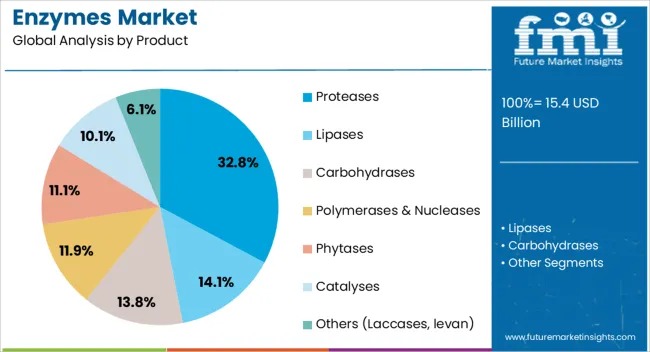
- Leading Product Segment (2025): Proteases (32.8% share)
- Largest Application Segment: Food & Beverage (27.4% share)
- Key Growth Regions: North America, Asia-Pacific, Europe
Proteases Lead Product Demand
Among product categories, proteases are expected to account for 32.8% of total market revenue in 2025, maintaining their position as the leading enzyme type. Their versatility across food processing, detergents, and pharmaceutical formulations has driven consistent demand. In food applications, proteases enable protein hydrolysis, texture improvement, and flavor development. In detergents, they enhance stain removal efficiency, while in pharmaceuticals they support peptide synthesis and therapeutic formulations.
Advancements in microbial fermentation and protein engineering have improved protease stability across varying temperature and pH conditions, expanding their industrial usability. Cost-effective production methods have further strengthened their competitive advantage, positioning proteases as a cornerstone of the global enzymes market.
Food & Beverage Remains the Largest Application
The food and beverage segment is projected to capture 27.4% of market revenue in 2025, underlining enzymes’ critical role in modern food processing. Enzymes are widely used in baking for dough conditioning, in dairy for lactose hydrolysis and flavor optimization, and in brewing to enhance fermentation efficiency. Sustainability goals and regulatory pressure to reduce chemical inputs have further encouraged enzyme adoption, as they enable cleaner processes and energy savings.
Ongoing innovation in food-grade enzymes tailored to specific formulations—such as plant-based products and functional foods—is expected to sustain this segment’s dominance over the forecast period.
Growth Drivers, Challenges, and Emerging Trends
Market growth is driven by broad industrial adoption, regulatory support for green technologies, and rising consumer preference for natural and efficient solutions. However, challenges remain. High production costs, stability limitations under extreme conditions, and complex regulatory pathways—particularly for therapeutic enzymes—can slow commercialization. Price sensitivity in cost-driven industries also restricts adoption in some developing markets.
At the same time, enzyme engineering is transforming competitive dynamics. Advances in biotechnology, AI-driven protein modeling, and biocatalysis are enabling highly specific, stable, and efficient enzyme variants. Demand is rising for enzymes that replace harsh chemicals in detergents, pulp processing, textiles, and leather treatment, reinforcing sustainability as a key differentiator.
Regional and Country-Level Momentum
Asia-Pacific is emerging as the fastest-growing region, led by China and India. China is projected to grow at a CAGR of 9.2%, supported by large-scale industrial production, biotech investments, and expanding biofuel capacity. India follows at 8.5% CAGR, driven by pharmaceutical manufacturing, nutraceutical demand, and government-backed bioenergy initiatives.
In Europe, Germany leads with 7.8% CAGR, benefiting from strong R&D infrastructure and advanced industrial biotechnology adoption. France and the UK show steady growth, supported by food processing, diagnostics, and sustainability-focused applications. The United States, while a mature market, continues to see stable demand from biofuels and pharmaceutical applications.
Competitive Landscape
The enzymes market is moderately consolidated, dominated by global leaders such as Novozymes, BASF, DSM, Chr. Hansen, and AB Enzymes, supported by strong R&D capabilities and global distribution networks. Mid-tier players including Amano Enzyme, Codexis, and Advanced Enzyme Technologies are gaining traction by targeting niche applications and customized solutions. Innovation, sustainability credentials, and application-specific expertise are emerging as the primary levers of competitive advantage.
As industries worldwide continue to prioritize efficiency, sustainability, and precision, enzymes are expected to remain central to next-generation manufacturing and healthcare solutions—positioning the global enzymes market for resilient, long-term growth.