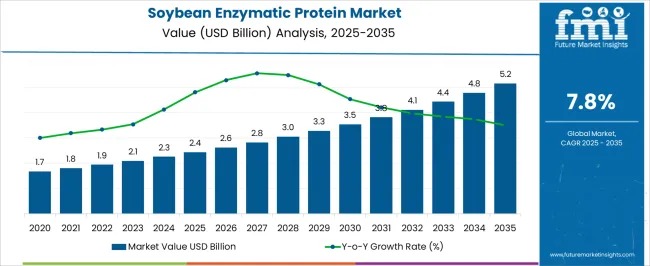
The global soybean enzymatic protein market is entering a decisive growth phase, driven by rising demand for plant-based nutrition, functional foods, and sustainable protein solutions. Valued at USD 2.4 billion in 2025, the market is projected to more than double to USD 5.2 billion by 2035, expanding at a steady CAGR of 7.8% over the forecast period. This growth reflects a clear transition from early experimentation toward mainstream adoption across food, beverage, and nutrition industries.
Between 2020 and 2024, the market progressed gradually from USD 1.7 billion to USD 2.4 billion as food manufacturers and ingredient suppliers tested enzymatic protein applications. During this early adoption phase, the focus remained on improving taste, texture, digestibility, and production scalability. By 2025, the market has reached a maturity threshold, signaling readiness for broader incorporation into everyday consumer products and large-scale commercial formulations.
Explore trends before investing – request a sample report today! https://www.futuremarketinsights.com/reports/sample/rep-gb-25450
From 2025 onward, the soybean enzymatic protein market moves into a scaling phase, followed by consolidation toward the end of the forecast period. By 2030, market value is expected to surpass USD 3.3 billion, supported by increased use in functional foods, protein-enriched beverages, dairy alternatives, and meat analogs. As enzymatic processing technologies become more standardized, manufacturers are shifting from proof-of-concept to volume-driven production, enabling cost efficiencies and wider distribution.
By 2035, growth moderates slightly as the market matures and established suppliers consolidate their positions. Smaller players are expected to align through partnerships or exit the market, reinforcing a more structured competitive landscape. Even so, the projected 7.8% CAGR highlights sustained demand and underscores soybean enzymatic protein’s role as a core ingredient in the evolving global protein ecosystem.
Market Snapshot and Performance Indicators
In 2025, the soybean enzymatic protein market stands at USD 2.4 billion and is forecast to reach USD 5.2 billion by 2035. Powdered soybean enzymatic protein leads by form, accounting for 54.6% of market revenue, due to its versatility, shelf stability, and ease of formulation. North America, Asia-Pacific, and Europe remain the most influential growth regions, supported by advanced food processing capabilities and strong consumer demand for plant-based nutrition.
Growth is influenced by several interconnected markets. Plant-based proteins contribute roughly 30% of overall momentum, while functional foods and beverages account for 20%. Nutritional supplements add 10%, with additional support from dairy alternatives, food processing equipment, and regulatory and quality assurance services. Together, these segments create a balanced growth environment rooted in both consumer demand and industrial capability.
Why Demand Is Accelerating
Soybean enzymatic protein is gaining traction as manufacturers respond to consumers seeking clean-label, non-GMO, and sustainable protein sources. Enzymatic processing improves solubility, digestibility, and flavor neutrality, making soybean proteins suitable for beverages, nutrition bars, bakery products, and fortified foods. These functional advantages allow brands to enhance protein content without compromising sensory quality.
Health and wellness trends are also reshaping demand. High-protein diets, interest in digestive health, and the shift toward plant-based eating patterns are accelerating adoption across developed and emerging markets. At the same time, ongoing investments in research and development are improving bioavailability and amino acid profiles, expanding application potential across both mass-market and premium nutrition products.
Segment-Level Insights
Powdered soybean enzymatic protein remains the preferred format for manufacturers due to its scalability and compatibility with diverse formulations. Its dominance is reinforced by demand from dietary supplements and protein-enriched beverages, where precision dosing and consistent quality are essential.
Food and beverages represent the leading application segment, capturing 38.9% of market revenue in 2025. Soybean enzymatic protein is widely used in dairy alternatives, baked goods, nutritional drinks, and meat substitutes, benefiting from its neutral taste and functional performance. Supermarkets and hypermarkets dominate distribution with a 46.2% revenue share, reflecting growing consumer access to protein-fortified foods in mainstream retail environments.
Regional and Country-Level Momentum
Asia-Pacific is the fastest-growing region, led by China and India with CAGRs of 10.5% and 9.8%, respectively. These markets benefit from expanding food processing infrastructure, rising health awareness, and increasing adoption of plant-based diets. In Europe, Germany maintains strong growth at 9.0% CAGR, driven by functional nutrition and regulatory clarity. The United States, while more mature, continues steady expansion at 6.6% CAGR, supported by sustained demand for clean-label and functional protein products.
Competitive Landscape
The market is shaped by global and regional suppliers focused on enzymatic processing innovation, scalability, and sustainability. Key players include Archer Daniels Midland Company, Cargill, Incorporated, DowDuPont Inc., Kerry Group, CHS Inc., Fuji Oil Co., Ltd., Wilmar International Limited, Ag Processing Inc., and Crown Soya Protein Group, among others. These companies are investing in advanced enzymatic technologies to enhance digestibility, functional performance, and nutritional value.
As plant-based nutrition becomes a permanent feature of global diets, soybean enzymatic protein is positioned as a foundational ingredient. Its transition from niche applications to mainstream food systems underscores a decade of opportunity for manufacturers, investors, and product developers seeking reliable, scalable, and sustainable protein solutions.