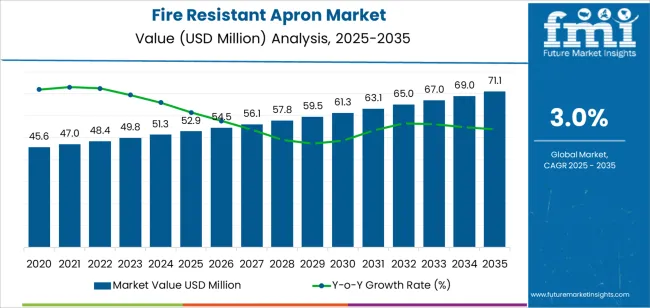
The global fire resistant apron market, valued at USD 52.9 million in 2025, is entering a new era of strategic growth and technological advancement as both long-standing industry leaders and ambitious new entrants seek to expand their footprint across key regional and industrial sectors. With increasing workplace safety regulations, heightened awareness of occupational hazards, and a surge in industrial activity, demand for advanced personal protective equipment (PPE) such as fire resistant aprons continues to rise — paving the way for innovation, collaboration, and market expansion.
The market’s positive trajectory is propelled by a growing emphasis on compliance with stricter safety standards in industries ranging from manufacturing and welding to chemical processing and food services. This regulatory environment encourages manufacturers to invest in next-generation apron designs that not only improve fire resistance and thermal protection, but also deliver greater ergonomic comfort for workers. These trends are shaping a dynamic competitive landscape in which traditional players and emerging technology-driven firms alike are repositioning their capabilities to capture share in this evolving market.
Industry Leaders Reinforce Market Presence and Product Innovation
Long-established PPE manufacturers such as Pelican Manufacturing, Ironcat Irontex, DuPont, and Lakeland Industries continue to define the core fabric of the fire resistant apron market with proven product portfolios rooted in material science and safety performance. These companies leverage decades of expertise in aramid-based textiles and advanced flame-resistant materials to meet the demanding requirements of industrial safety programs. Their product offerings, often certified to widely accepted safety norms, serve as benchmarks for quality, durability, and worker protection.
Incumbent leaders are increasingly focusing on product upgrades that combine superior thermal insulation with improved wearer comfort. This includes incorporating lighter composite layers, stretch-enabled fits, and breathable fabrics that support prolonged use without fatigue — a priority feature for workers in high-temperature environments.
In addition to performance improvements, many established players are investing in digital tools and enhanced supply chain frameworks that ensure faster delivery cycles and better customer service, particularly in regions with rapid industrial growth.
To access the complete data tables and in-depth insights, request a sample report here
Emerging Manufacturers Bring Fresh Perspectives and Agile Solutions
Alongside the dominant brands, a cohort of emerging manufacturers is gaining traction by embracing innovation and market responsiveness. Companies such as Ejoyous, NYOrtho, and newer regional producers are expanding production through flexible manufacturing models that prioritize price competitiveness and localized distribution.
These emerging players are also driving differentiation through specialized apron designs tailored for niche applications. For instance, lighter-weight heat-resistant aprons optimized for food service operations, or modular models that integrate with other PPE systems, are gaining attention from smaller enterprises and mid-tier industrial firms seeking effective, budget-friendly safety solutions.
Further, the adoption of blended materials such as treated cotton and advanced synthetic fibers, often at lower unit costs, is enabling these new entrants to appeal to price-sensitive buyers without compromising essential fire protection.
Regional Dynamics Highlight Asia-Pacific and Growing Markets
Geographically, the Asia-Pacific region has emerged as a major growth frontier, driven by rapid industrialization, rising safety standards, and expanding manufacturing sectors in economies such as China and India. This burgeoning demand offers significant opportunities for both established manufacturers expanding their regional presence and local producers scaling up operations to meet domestic needs.
Europe and North America remain mature markets with consistent demand anchored in regulatory compliance and recurring replacement cycles. However, these regions are also witnessing incremental adoption of advanced materials and ergonomic designs, reflecting shifts in workplace safety strategies. Meanwhile, smaller but strategically important markets in Latin America and Africa are gradually increasing their uptake of fire resistant aprons as part of broader occupational safety initiatives.
Technology and Innovation: A Key Differentiator Across Market Players
Across the competitive spectrum, innovation remains a central theme. From multi-layer aramid composites to treated fibers with enhanced moisture management, manufacturers are exploring technologies that provide balanced protection, comfort, and durability. Efforts to improve product flexibility and reduce wearer fatigue are particularly relevant in sectors where workers are exposed to prolonged heat and flame environments.
Additionally, digital manufacturing techniques and automated quality testing processes are enabling faster iteration of product lines, allowing firms to more rapidly respond to customer feedback and emerging safety requirements.
Collaborative Outlook and Strategic Partnerships
A notable trend shaping market dynamics is the rise of strategic partnerships between PPE producers, safety standards organizations, and industrial end-users. These collaborations aim to refine apron specifications, enhance compliance frameworks, and accelerate the adoption of best practices in workplace safety. By aligning product development with real-world safety challenges, manufacturers are better positioned to deliver solutions that resonate with both regulatory bodies and industrial buyers.
Looking Ahead: Continued Growth and Market Opportunity
As industries evolve and safety expectations rise, the fire resistant apron market stands poised for sustained growth. The interplay between established manufacturers, new market entrants, and ongoing technological innovation will continue to define competitive differentiation. With increased focus on worker welfare, ergonomic design, and global compliance, both seasoned and emerging players are positioned to contribute to a safer, more resilient industrial ecosystem.