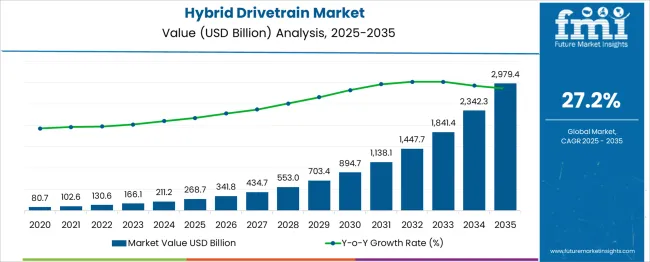
The global Hybrid Drivetrain Market is entering a decisive decade of transformation, marked by unprecedented growth, rapid technology maturation, and large-scale integration across vehicle segments. The market is estimated to be valued at USD 268.7 billion in 2025 and is projected to reach USD 2,979.4 billion by 2035, expanding at a powerful CAGR of 27.2% over the forecast period.
This growth trajectory reflects a steep and accelerating adoption curve. Between 2025 and 2030, the market is expected to add USD 626.0 billion, reaching USD 894.7 billion, driven by increasing deployment of hybrid drivetrains in passenger and commercial vehicles. Annual value increments are projected to rise from USD 73.1 billion in 2026 to approximately USD 191.3 billion in 2030, highlighting improving manufacturing scale, maturing component supply chains, and growing consumer acceptance.
From 2030 to 2035, the market is forecast to contribute an additional USD 2,084.7 billion, representing nearly 77% of total decade growth. Annual market expansion is expected to peak at USD 637.1 billion between 2034 and 2035, signaling deep penetration into mass-market models, strong OEM commitments, and cost competitiveness relative to conventional internal combustion engine (ICE) drivetrains.
Subscribe for Year-Round Insights → Stay ahead with quarterly and annual data updates
https://www.futuremarketinsights.com/reports/sample/rep-gb-23372
Hybrid Drivetrains as a Structural Growth Engine
Hybrid drivetrains are rapidly emerging as a strategic bridge between conventional combustion-based mobility and full electrification. While representing approximately 3.4% of the global automotive powertrain market, their influence continues to rise as regulatory pressure and consumer expectations shift toward lower-emission, higher-efficiency vehicles.
Within the electric and hybrid vehicle components sector, hybrid drivetrains account for around 4.1%, supported by growing production of hybrid sedans, SUVs, and light commercial vehicles. In the transmission and propulsion systems industry, the segment holds about 3.0% share, reflecting rising demand for integrated hybrid transmissions, electric motors, and power electronics.
Ongoing advancements in battery chemistry, power control electronics, and lightweight composite materials have significantly enhanced system efficiency, durability, and packaging flexibility. Multi-mode hybrid systems capable of seamlessly switching between electric and combustion operation, alongside highly efficient regenerative braking technologies, are reshaping performance benchmarks across vehicle categories.
Key Forces Driving Market Expansion
The expansion of the hybrid drivetrain market is primarily fueled by tightening global emission regulations, aggressive fuel efficiency targets, and sustained government incentives that support hybrid adoption. Hybrid vehicles are increasingly viewed as a practical decarbonization pathway, offering reduced emissions without the immediate infrastructure challenges of fully battery-electric vehicles.
Strong investments in energy management systems, regenerative braking, and intelligent control software are unlocking higher levels of performance and operational flexibility. Automakers and Tier-1 suppliers are accelerating collaborations to localize battery production and drivetrain assembly, reducing costs while increasing scalability across global platforms.
At the same time, the growing appeal of hybrids as a transitional technology has enabled broader consumer acceptance, particularly in markets where charging infrastructure remains limited.
Segment-Level Performance Insights
By level, Full Hybrid Electric Vehicles (Full HEVs) are projected to lead the market in 2025, accounting for 43.0% of total revenue. Their ability to deliver strong fuel efficiency without reliance on external charging infrastructure makes them highly attractive in both developed and emerging markets. Plugless operation and optimized energy recapture systems are supporting OEM prioritization across compact, mid-size, and utility vehicle classes.
By drivetrain architecture, Series-Parallel systems are estimated to command 49.0% market share in 2025. Their operational versatility, allowing electric-only, engine-only, or combined propulsion, provides superior adaptability across urban and highway driving conditions. This flexibility is accelerating adoption in SUVs and performance-oriented sedans.
By component, Plug-in Hybrid Electric Vehicles (PHEVs) are expected to hold 41.0% of the market in 2025, driven by their extended electric-only driving ranges and strong policy support in North America, Europe, and Asia-Pacific. Modular battery platforms and intelligent energy management software are strengthening the long-term competitiveness of this segment.
Regional Momentum and Country-Level Growth
Asia-Pacific continues to dominate both production and adoption, while Europe and North America maintain strong demand supported by emissions mandates and customer preference for efficient performance.
Country-level CAGR projections highlight rapid acceleration:
- China: 36.7% CAGR, driven by large-scale production and favorable low-emission policies
- India: 34.0% CAGR, supported by localized manufacturing and cost-effective hybrid platforms
- Germany: 31.3% CAGR, powered by premium vehicle innovation
- France: 28.6% CAGR
- United Kingdom: 25.8% CAGR
- United States: 23.1% CAGR
- Brazil: 20.4% CAGR
China’s market is benefiting from the expansion of hybrid bus networks and collaboration between OEMs and battery suppliers, while India is leveraging domestic production and technology partnerships to accelerate adoption across fleet and passenger segments.
Personalize Your Experience: Ask for Customization to Meet Your Requirements
https://www.futuremarketinsights.com/customization-available/rep-gb-23372
Competitive Landscape Shaped by Engineering Leadership
The competitive environment is defined by a combination of global OEMs and powertrain specialists investing in scalable, high-efficiency hybrid platforms. Industry leaders include Toyota Motor Corporation, Aisin Seiki, ZF Friedrichshafen, BorgWarner Inc., Continental AG, Denso, JATCO Ltd., Magna International, Hofer Powertrain, BAE Systems, Obrist Powertrain, and Punch Powertrain Nanjing.
OEMs and suppliers are focusing on modular hybrid architectures, lightweight system integration, and platform-specific drivetrain solutions to secure long-term positioning. Strategic partnerships and high R&D investments remain central to maintaining technological leadership in a highly competitive market.
Innovation Pipeline and Recent Developments
Between 2023 and 2025, the market has witnessed rapid innovation in compact and modular hybrid systems. In mid-2025, Horse Powertrain introduced a future-ready hybrid concept integrating engine, motor, and transmission into a single compact unit, enabling hybrid functionality on existing battery-electric platforms with minimal structural modifications.
During the same period, Hyundai Motor Group unveiled a next-generation dual-motor hybrid architecture delivering significantly higher efficiency and power compared to traditional ICE systems. These advancements illustrate the industry’s shift toward highly integrated, scalable, and platform-agnostic hybrid solutions.
Strategic Outlook
The Hybrid Drivetrain Market is transitioning from early-stage adoption to mass-market integration, creating a high-value growth environment across passenger, commercial, and industrial vehicle segments. As hybrid architectures evolve into a core component of future mobility strategies, the market is expected to unlock substantial opportunities in manufacturing, component innovation, and platform optimization.
The comprehensive market report offers in-depth quantitative forecasts, technology benchmarks, regional opportunity mapping, and competitive strategy insights, enabling stakeholders to evaluate expansion pathways and capitalize on the accelerating shift toward electrified powertrains.
About Future Market Insights (FMI)
Future Market Insights, Inc. (FMI) is an ESOMAR-certified, ISO 9001:2015 market research and consulting organization, trusted by Fortune 500 clients and global enterprises. With operations in the U.S., UK, India, and Dubai, FMI provides data-backed insights and strategic intelligence across 30+ industries and 1200 markets worldwide.