

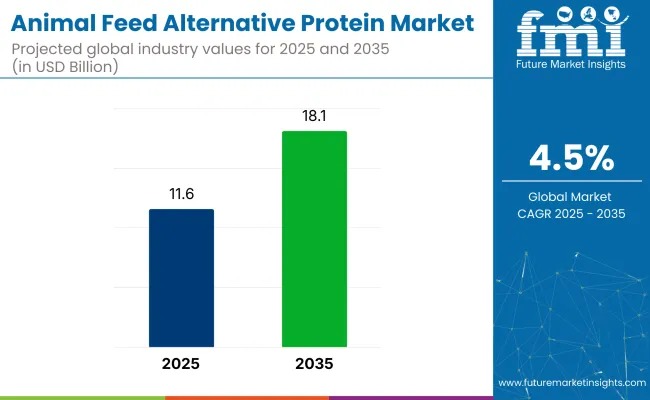
The global animal feed alternative protein market is projected to reach a value of USD 11.6 billion in 2025, with expectations of significant growth to USD 18.1 billion by 2035, reflecting a CAGR of 4.5% over the forecast period.
Explore trends before investing – request a sample report today!
Rising feed costs and increasing demand for sustainable livestock nutrition are the primary drivers behind this growth. Alternative proteins, including plant-based proteins, insect meal, and microbial proteins, are gaining traction as more cost-effective and environmentally responsible substitutes to traditional sources like soymeal and fishmeal.
Within the larger agricultural protein market, alternative proteins currently hold a 3-5% share, while in the plant-based protein segment for animal feed, their share rises to 10-12%, highlighting the gradual but steady adoption of sustainable feed solutions.
The sustainable agriculture sector sees alternative proteins making up 6-8% of the market, reflecting the growing global emphasis on reducing carbon footprints and environmental impact. Meanwhile, the food and beverage sector experiences a modest indirect contribution of 1-2%, due to the role of alternative feed proteins in the production of animal-based products.
One key milestone supporting this market’s expansion is the USDA’s commitment of USD 14.4 million in 2025 toward urban agriculture and innovative production methods. With traditional protein sources becoming increasingly expensive and environmentally taxing, the shift toward alternative protein solutions is gaining momentum.
Market Insights: Segments and Growth Drivers
- Feed Type: Plant-based proteins are expected to dominate, accounting for 35% of the market share in 2025. Soy, pea, and fava bean proteins are the top choices, valued for their cost-efficiency, scalability, and high digestibility.
- Livestock Segment: Poultry leads the adoption of alternative proteins, capturing 31% of the global market share in 2025, driven by high feed conversion efficiency and growing global demand for chicken meat and eggs.
- Form Factor: Pellets are anticipated to hold 30% market share, thanks to their ease of handling, uniform mixing, and consistent nutrient delivery, making them ideal for large-scale livestock and aquaculture operations.
The market is also witnessing technological advancements, including single-cell protein fermentation and microbial protein extraction, improving digestibility, feed conversion rates, and overall livestock performance.
Regional Market Analysis
- India: Leading the growth curve with a 5.0% CAGR, supported by expanding poultry and livestock sectors, coupled with a strong government push toward sustainable feed alternatives.
- China: Projected to grow at a 4.3% CAGR, fueled by R&D investment and initiatives in sustainable agriculture.
- United Kingdom: Forecast to reach 4.5% CAGR, backed by policies promoting net-zero emissions and sustainable farming practices.
- USA: Expected CAGR of 3.6%, driven by increasing adoption of plant-based proteins and regulatory support for alternative feed options.
- France: Steady growth at 2.9% CAGR, with the country’s sustainability-focused agricultural policies promoting insect meal and plant-based protein adoption.
The market dynamics reveal that both emerging economies like India and China and developed regions such as the UK and the USA are contributing to the sustained growth of animal feed alternative proteins globally.
Leading Players Driving the Market
The market is moderately consolidated, with key players including Archer Daniels Midland Company (ADM), Cargill, Inc., DuPont de Nemours, Inc., Nestlé Purina PetCare, Alltech, Inc., Calysta, Inc., Ÿnsect, Innovafeed, Protix, Unibio International, Novonesis Group, Skretting (Nutreco), and Corbion N.V. These companies are actively innovating to offer sustainable, nutrient-rich, and cost-effective protein solutions for livestock and aquaculture.
Recent developments include ADM’s re-scoping of its USD 300 million investment in February 2025, aligning production capacity with market demand to optimize efficiency in plant-based protein supply.
With rising feed costs, technological innovation, and sustainability mandates, the animal feed alternative protein market is set for steady growth over the next decade, offering lucrative opportunities for investors, manufacturers, and policymakers alike.


