

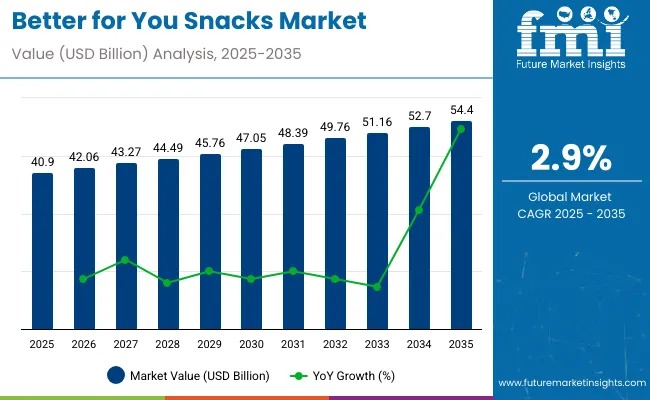
The global better-for-you snacks market is projected to grow from USD 40.9 billion in 2025 to approximately USD 54.4 billion by 2035, recording an absolute increase of USD 13.5 billion over the forecast period. This translates into a total growth of 33.0%, with the market expanding at a compound annual growth rate (CAGR) of 2.9% between 2025 and 2035.
The market’s growth is largely driven by shifting consumer preferences toward healthier eating options, increasing demand for low-calorie, high-protein, gluten-free, and functional snack alternatives, and rising awareness of lifestyle-related health issues. Millennials and Gen Z are particularly influential, seeking convenient, clean-label snacks that support holistic wellness beyond basic nutrition.
Explore trends before investing – request a sample report today!
Between 2025 and 2030, the market is expected to rise from USD 40.9 billion to USD 47.1 billion, contributing 45.9% of the overall growth for the decade. This phase will be fueled by:
- Rising health consciousness among younger consumers
- Demand for plant-based and protein-rich snacks
- Growing interest in clean-label and functional ingredients
From 2030 to 2035, the market is forecast to reach USD 54.4 billion, adding USD 7.3 billion, or 54.1% of the ten-year expansion. Innovation in natural sweeteners, plant proteins, and personalized nutrition solutions will define this phase. Sustainable packaging and functional ingredients such as probiotics and adaptogens will play a crucial role in shaping consumer preferences.
Market Drivers and Growth Trends
The better-for-you snacks market has evolved significantly since 2020, accelerated by the COVID-19 pandemic, which heightened focus on overall wellness, including mental and social health. Organic, non-GMO, and gluten-free snack options contributed to this transformational growth. Key growth factors include:
- Shifting consumer preferences for low-calorie, high-protein, and functional snacks
- Increased focus on transparency, ethical sourcing, and sustainability
- Investments by leading brands in R&D, product innovation, and strategic acquisitions
Segmental Insights
By Type: Savory snacks are projected to hold 30.5% of the market in 2025, supported by demand for lower-fat, high-protein, and plant-based alternatives. Notable product innovations include air-popped chips, roasted pulse snacks, and functional formulations fortified with protein, fiber, and probiotics.
By Sales Channel: Offline channels will account for 72.5% of market distribution, reflecting the importance of tactile product experiences, in-store promotions, and partnerships with wellness retailers. Supermarkets such as Walmart, Tesco, and Carrefour have expanded shelf space for better-for-you snack options, enhancing consumer engagement.
Regional Highlights
- India: Fastest-growing market with a CAGR of 9.5%, driven by urbanization, rising incomes, and a strong vegetarian culture.
- Brazil: CAGR of 6.0%, fueled by fruit, nut, and seed-based snacks and local manufacturing capabilities.
- China: 5.8% CAGR, supported by traditional health food practices, superfood trends, and digital commerce expansion.
- United States & South Korea: Both growing at 3.0% CAGR, driven by plant-based, functional snacks and e-commerce expansion.
- UK & Japan: Steady growth of 2.8%, focusing on clean-label, low-calorie, probiotic, and functional snack options.
Europe is expected to expand from USD 9.8 billion in 2025 to USD 12.9 billion by 2035 at a CAGR of 2.9%. Germany leads with a 24.5% share in 2025, followed by France, the UK, Italy, and Spain, with growing interest in plant-based snacks across Eastern and Nordic regions.
Competitive Landscape
The market features established manufacturers, health-focused snack brands, and startups emphasizing functional ingredients and sustainable production. Leading players include:
- Nestlé
- The Kellogg Company
- Unilever
- PepsiCo
- Mondelēz International
Other significant contributors are Hormel Foods Corporation, Dole Packaged Foods, Del Monte Foods, Select Harvests, and Monsoon Harvest, leveraging innovation, regional expertise, and product diversification to meet evolving consumer demands.
Market Opportunities and Stakeholder Roles
“Better-for-you” snacks sit at the intersection of convenience, health, and sustainability. Stakeholders can enhance market growth through:
- Governments: Standardizing labeling, offering R&D incentives, and promoting public procurement programs.
- Industry Bodies: Establishing certification programs, educating consumers, and supporting SME exports.
- OEMs & Food-Tech Players: Innovating texture, functional ingredient delivery, and flexible co-packing solutions.
- Suppliers: Scaling clean-label ingredients, ensuring traceability, and supporting application trials.
- Investors: Funding early-stage brands, supporting co-packing networks, and promoting ESG-aligned projects.
The global better-for-you snacks market represents a dynamic convergence of health, convenience, and sustainability. Continuous innovation, coupled with strategic investments and evolving consumer awareness, will shape the next decade of growth, offering substantial opportunities for stakeholders across the value chain.
