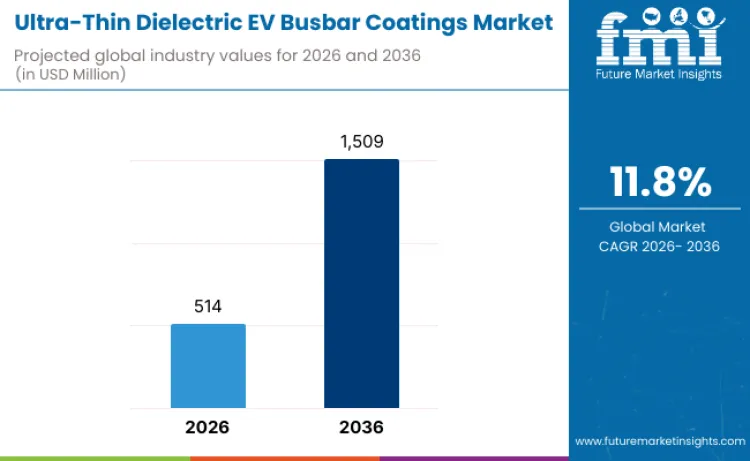
The global Ultra-Thin Dielectric EV Busbar Coatings Market is poised for robust expansion, with the industry valued at USD 514 million in 2026 and projected to surge significantly through 2036 as electrification accelerates across transportation sectors. This growth is being propelled by a convergence of rising electric vehicle (EV) adoption, heightened demand for safer and more efficient electrical components, and continuous technological innovation within the coatings landscape. As busbars play a critical role in managing power distribution within EV battery systems, advanced dielectric coatings are becoming indispensable for next-generation electric mobility solutions.
With a forecasted compound annual growth rate (CAGR) of 11.8%, the market reflects both rising confidence from legacy material manufacturers and growing interest from new entrants aiming to disrupt traditional approaches to dielectric insulation. As fleet electrification expands from passenger cars to buses, commercial vehicles, and specialty transport, manufacturers are channeling resources into product refinement and strategic expansion.
Established industry leaders such as AkzoNobel, PPG Industries, Axalta Coating Systems, Henkel, and 3M have long been acknowledged for delivering high-performance coating solutions with proven dielectric and thermal resistance properties. These companies continue to invest in R&D to meet evolving automotive standards and to integrate coatings that can withstand the higher voltages and tighter tolerances required in modern EV powertrains. Their broad global footprint and deep expertise in materials science have positioned them as cornerstones of market stability and innovation.
Alongside these established players, a new wave of technology-driven manufacturers and specialist chemical firms are entering the space, attracted by the expanding opportunities and urgent demand for next-generation materials. Companies such as SolEpoxy Inc., Electrolube (HK Wentworth Ltd.), and Momentive Performance Materials Inc. are bringing fresh perspectives and targeted innovations, particularly in fluoropolymer-free dielectric formulations that address regulatory and environmental challenges. These newer entrants are pushing boundaries in application techniques, formulation chemistry, and manufacturing efficiencies, challenging incumbents to elevate their offerings.
A significant trend shaping market dynamics is the shift toward fluoropolymer-free dielectric coatings, which currently hold a meaningful share of the overall market due to their environmental compliance and excellent electrical insulation characteristics. As automobile manufacturers place greater emphasis on sustainability, these next-generation coatings are gaining favor over traditional fluoropolymer materials, which may pose regulatory headwinds.
This shift creates fertile ground for new players specializing in sustainable, performance-driven materials to capture market share and drive innovation. Their contributions are particularly notable in enabling ultra-thin dielectric layers that balance insulation performance with minimal thickness—an essential combination for maintaining vehicle range and maximizing battery efficiency.
To access the complete data tables and in-depth insights, request a sample report here
Geographically, market expansion is strong across Asia, North America, and Europe, with countries like China, India, and the United States leading in both manufacturing capacity and growth trajectory. In China, aggressive electrification targets and government incentives are spurring rapid adoption of advanced coating materials, while in India, emerging EV infrastructure and regulatory push for clean mobility are driving demand. In the United States and Europe, OEMs and suppliers are collaborating more closely on tailored dielectric solutions to meet stringent safety, performance, and environmental standards.
Beyond traditional automotive segments, the rise of electric commercial vehicles and EV buses presents a considerable growth vector, prompting both established firms and emerging specialists to scale production and enhance application versatility. The transition toward compact, lightweight busbar systems with superior insulation performance is encouraging cross-industry partnerships and scaling of automated coating technologies.
Industry analysts highlight that market growth is not without technical and economic challenges. Formulating ultra-thin coatings that reliably deliver high dielectric strength while resisting thermal cycling and mechanical stress remains complex. Manufacturers must balance rigorous performance requirements with cost-efficient processes that can be seamlessly integrated into high-volume production lines. Nevertheless, the collective push from both long-standing leaders and agile newcomers underscores a shared commitment to overcoming these hurdles and shaping the future of EV power systems.
Looking ahead, the Ultra-Thin Dielectric EV Busbar Coatings Market is expected to continue its upward trajectory, characterized by collaborative innovation, meaningful technological advancements, and strategic positioning across global supply chains. As industry participants refine next-generation coating chemistries and expand application methods, the market is set to play a pivotal role in supporting the broader electrification imperative that is transforming the global automotive and commercial transport landscape.