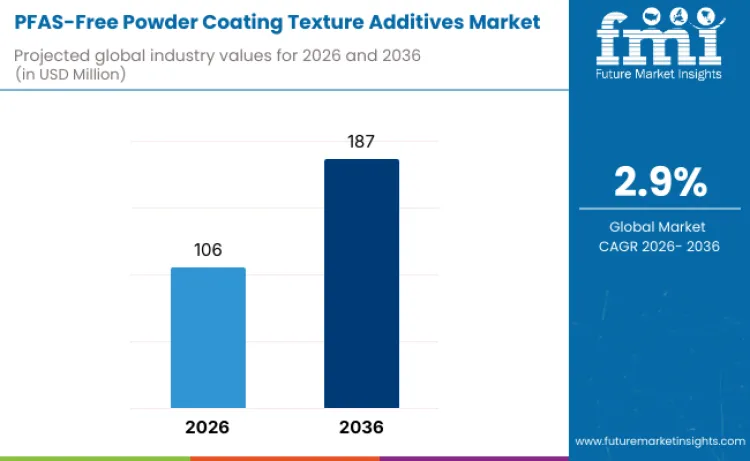
The global market for PFAS-free powder coating texture additives is on a strong growth trajectory, with the industry valued at USD 106 million in 2026. With increasing regulatory pressure around environmentally harmful chemical substances and growing demand for safer coating technologies, this sector is positioning itself as a key player in sustainable surface finishing solutions. As end-use industries scale up their adoption of eco-friendly materials, both established manufacturers and emerging innovators are gearing up to capture expanding market opportunities.
Powder coating texture additives play a pivotal role in the appearance, performance, and durability of coatings applied to everything from automotive parts to consumer appliances. Traditionally, many texture additives relied on fluorinated compounds such as PFAS (per- and polyfluoroalkyl substances) to achieve desirable surface finishes. However, with intensified scrutiny over the environmental and health impacts of PFAS, the switch to PFAS-free alternatives is accelerating across global markets.
Market Dynamics and Growth Outlook
The PFAS-free texture additives segment is being propelled by two major forces: tightening regulations on hazardous substances and a broader shift toward sustainability in industrial materials. Manufacturers and brand owners are increasingly prioritizing coating components that enhance aesthetics and performance without compromising environmental and regulatory compliance. As a result, demand for PFAS-free texture additives that can deliver matte finishes, smooth surfaces, and controlled gloss is rising across key sectors.
Beyond regulatory alignment, the broader powder coating market is itself experiencing significant expansion, driven by rising use in automotive, construction, industrial equipment, and consumer goods. The inherent advantages of powder coatings — such as low volatile organic compound emissions, excellent corrosion resistance, and high transfer efficiency — have made them a preferred choice in many high-demand applications. This backdrop creates fertile ground for the PFAS-free texture additives market to flourish as a natural extension of broader industry trends.
Innovation Across Established and Emerging Players
Leading chemical and materials companies are actively innovating in response to shifting market needs. Established players recognized for their technical expertise in specialty coatings are leveraging their deep R&D capacities to introduce next-generation PFAS-free additives that rival traditional technologies in performance.
At the forefront are firms with comprehensive portfolios of powder coating additives, offering solutions that balance regulatory compliance with performance demands. These companies are driving incremental improvements in surface texture control, gloss reduction, and application versatility while also investing in production scale-ups and global distribution networks. Their efforts not only support existing customers in transitioning away from legacy chemistries but also help educate and equip new adopters.
Simultaneously, newer entrants and smaller specialist manufacturers are making notable contributions by pushing the envelope on advanced chemistries and formulation approaches. These innovators bring agility and niche expertise, often collaborating closely with coating formulators and OEMs to tailor texture solutions for specific performance challenges. Their presence is expanding competitive dynamics and injecting fresh energy into the market.
Together, established multinational suppliers and ambitious emerging players are forming a dynamic ecosystem that fosters both incremental enhancement and disruptive breakthroughs. The interplay between legacy know-how and cutting-edge innovation is pushing the envelope on what PFAS-free powder coating texture additives can achieve.
To access the complete data tables and in-depth insights, request a sample report here
Strategic Expansion and Market Opportunities
Market participants are not only broadening their product portfolios but also strengthening partnerships with end users to integrate texture additives into new applications. For instance, automotive component manufacturers are exploring coatings that deliver both superior aesthetic appeal and durable surface protection without relying on regulated fluorochemistries. Likewise, furniture and consumer electronics producers are seeking texture additives that enhance visual and tactile qualities while meeting stringent sustainability criteria.
As sustainability becomes a core procurement criterion, companies investing in PFAS-free technologies are finding opportunities far beyond compliance. Environmental stewardship, corporate responsibility, and consumer preference for safer products are emerging as powerful market drivers in their own right. Manufacturers that can demonstrate both performance excellence and a genuine commitment to safer materials are gaining preference among brand owners and formulators.
These strategic shifts are encouraging new collaborations across the supply chain. Additive producers are working with resin manufacturers, coating formulators, and industrial users to co-develop systems optimized for specific textures and performance attributes. Such cross-industry initiatives are accelerating the learning curve for PFAS-free solutions and reducing barriers to adoption.
Future Outlook and Industry Impact
Looking ahead, the PFAS-free powder coating texture additives market is poised for continued expansion as regulatory frameworks evolve and industry confidence in sustainable alternatives grows. By driving innovation, fostering collaboration, and addressing emerging performance requirements, both seasoned and new manufacturers are positioning themselves to capture a larger share of the market.
The transition to PFAS-free technologies is more than a regulatory response — it reflects a broader commitment to environmental safety, product excellence, and long-term industry resilience. As end-use sectors increasingly embrace eco-conscious coatings, this segment is expected to play a central role in shaping the future of surface finishing worldwide.