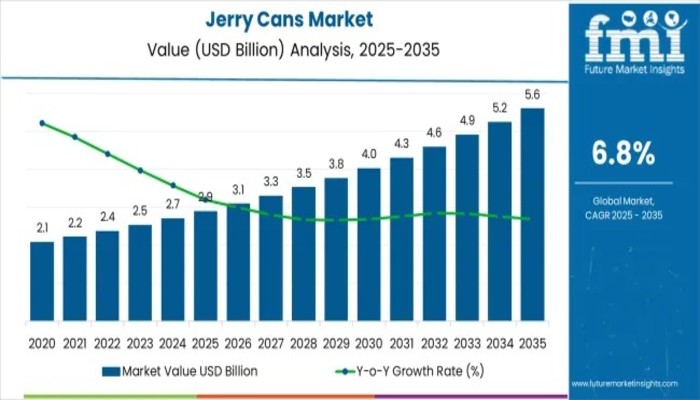
The global jerry cans market is entering a transformative decade, driven by industrial expansion, material innovation, and growing safety compliance across sectors. Valued at USD 2.9 billion in 2025, the market is projected to reach USD 5.6 billion by 2035, growing at a robust CAGR of 6.8%. According to Future Market Insights (FMI), this represents a near doubling of market value an impressive 93.1% total growth. Demand is surging across industrial, automotive, defense, and chemical sectors, as organizations prioritize safe, durable, and regulation-compliant containers for storing and transporting liquids.
Meaning: The Enduring Relevance of Jerry Cans
Originally developed for military operations, jerry cans have evolved into indispensable industrial assets. These portable containers are used for fuel storage, chemical handling, and water transportation, offering high mechanical strength, leak-proof design, and compliance with global safety standards. Modern jerry cans, made from materials like high-density polyethylene (HDPE) and metal alloys, combine durability with cost efficiency—making them vital in industrial operations, agricultural logistics, and emergency preparedness applications.
Discover Market Opportunities – Get Your Sample of Our Industry Overview Today!
Market Overview: A Growing Need for Safety and Durability
The jerry cans market is benefiting from industries’ growing emphasis on safe liquid handling, especially for hazardous materials. As manufacturers and logistics operators navigate stringent environmental and safety regulations, the demand for UN-certified containers with advanced chemical resistance and impact protection is rising sharply.
By 2030, the market is projected to reach USD 4.1 billion, marking a 44.4% rise over five years. Between 2030 and 2035, it is expected to add another USD 1.5 billion, driven by lightweight composite designs, tamper-evident closures, and smart tracking features.
Outlook: Industry Trends and Regional Momentum
The next decade will redefine the container industry, with the Asia-Pacific region leading global expansion. Countries like India (9.2% CAGR) and China (8.1% CAGR) are emerging as growth hotspots due to industrial infrastructure development, chemical production, and fuel distribution networks.
In North America, compliance-driven markets such as the United States (6.3% CAGR) continue to emphasize regulatory safety and military logistics modernization. Europe, led by Germany, France, and the UK, remains a hub for certified hazardous material containers and precision-engineered packaging systems.
Growth and Demand Drivers
Several factors are fueling the jerry cans market expansion:
- Industrialization and infrastructure development driving large-scale liquid transport.
- Rising automotive aftermarket activity, especially in emerging economies.
- Increased focus on safety compliance, with demand for UN-certified and tamper-proof cans.
- Technological innovation, including RFID-enabled tracking and IoT-integrated containers.
- Sustainability trends, with growing interest in recyclable HDPE materials and eco-friendly production.
HDPE continues to dominate the market, accounting for over 71% share in 2025. Its superior chemical resistance, strength-to-weight ratio, and cost efficiency make it the material of choice for both industrial and consumer-grade jerry cans.
Trends: Innovation and Smart Integration
The future of jerry cans lies in innovation and intelligence. Manufacturers are integrating smart tracking systems—such as RFID tags and IoT sensors—to provide real-time visibility into liquid inventories and supply chain management. Lightweight composite jerry cans are also gaining traction due to their enhanced portability and reduced transport costs.
Emerging application-specific opportunities include:
- UN-certified containers for hazardous chemicals (USD 720M–1.1B opportunity).
- Military-grade jerry cans for defense logistics (USD 580M–890M).
- Anti-static and composite jerry cans for safe fuel handling (USD 460M–800M).
- Smart jerry cans with IoT-enabled tracking (USD 380M–600M).
Competitive Landscape: Leading Players and Strategies
The global jerry cans market is highly competitive, with established players focusing on certification, innovation, and material performance. Mauser Packaging Solutions, Schutz Container Systems, Greif Inc., Time Technoplast Ltd., BWAY Corporation, and Barrier Plastics Inc. lead the landscape. These companies are advancing technologies such as barrier layer engineering, composite reinforcement, and automation-friendly designs to enhance durability and production efficiency.
As regulatory pressure intensifies and industries shift toward sustainable, certified, and smart liquid storage, competition will increasingly center on innovation, material science, and integrated logistics partnerships.
Why FMI: https://www.futuremarketinsights.com/why-fmi
About Future Market Insights (FMI)
Future Market Insights, Inc. (FMI) is an ESOMAR-certified, ISO 9001:2015 market research and consulting organization, trusted by Fortune 500 clients and global enterprises. With operations in the U.S., UK, India, and Dubai, FMI provides data-backed insights and strategic intelligence across 30+ industries and 1200 markets worldwide.
Contact Us:
Future Market Insights Inc.
Christiana Corporate, 200 Continental Drive,
Suite 401, Newark, Delaware – 19713, USA
T: +1-347-918-3531
For Sales Enquiries: sales@futuremarketinsights.com
Website: https://www.futuremarketinsights.com
LinkedIn| Twitter| Blogs | YouTube