

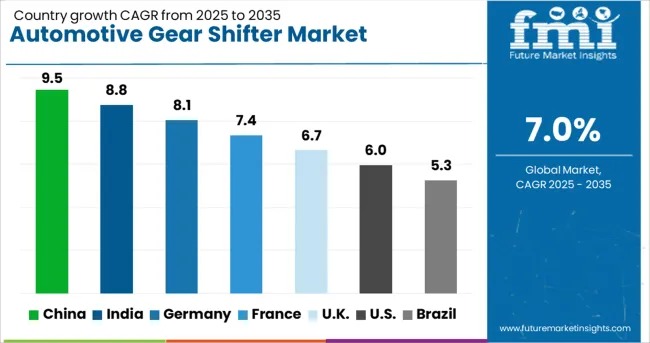
Global automotive component innovation continues to accelerate as the Automotive Gear Shifter Market enters a phase of sustained, technology-led expansion. The market is estimated to be valued at USD 15.7 billion in 2025 and is projected to reach USD 30.9 billion by 2035, advancing at a steady CAGR of 7.0% over the forecast period.
Unlike many cyclical automotive sub-segments, the automotive gear shifter market has demonstrated remarkable stability, with consistent annual gains and minimal volatility. Growth increments expand progressively from approximately USD 1.1 billion in the early forecast years to nearly USD 2.1 billion toward the latter part of the decade. This stable trajectory reflects the market’s foundational role within modern vehicles and its deep integration with evolving transmission technologies.
Subscribe for Year-Round Insights → Stay ahead with quarterly and annual data updates
https://www.futuremarketinsights.com/reports/sample/rep-gb-23277
Structural Role Within the Automotive Ecosystem
Gear shifters account for approximately 25-30% of the global automotive transmission systems market, underscoring their importance in enabling seamless power delivery across manual, automatic, and electric drivetrains. Within vehicle interior components, gear shifters represent 15-20%, driven by growing emphasis on human-machine interface (HMI) design, digital dashboards, and premium cabin experiences. In the broader automotive parts and accessories landscape, the segment contributes roughly 5-7%, highlighting its specialized yet indispensable function.
Electrification and Intelligent Design Fueling Demand
The market is being reshaped by the rapid adoption of electric and hybrid vehicles, which require new-shift paradigms and compact electronic architectures. Traditional mechanical linkages are progressively being replaced by electronic and shift-by-wire systems, delivering advantages such as reduced vehicle weight, enhanced packaging flexibility, and superior ergonomic design.
Manufacturers are increasingly integrating illuminated indicators, haptic feedback, and customizable interfaces to improve driver interaction. Gear shifters are no longer simple mechanical levers; they have become intelligent control modules embedded within larger vehicle ecosystems that include ADAS, infotainment, and digital cockpit platforms. These enhancements are transforming gear shifting from a functional necessity into a strategic design and technology differentiator.
Key Growth Drivers Supporting Market Momentum
Market growth is primarily driven by the expanding penetration of automatic and semi-automatic transmissions, rising consumer demand for driver comfort, and growing regulatory focus on fuel efficiency and safety. Automakers are prioritizing compact, electronically actuated shifter designs that reduce mechanical complexity while enabling smoother transitions and improved reliability.
The rise of urban mobility and increasing traffic congestion in major cities are accelerating the replacement of manual shifters with automatic variants, particularly in high-volume passenger vehicles. Additionally, OEMs are leveraging gear shifter innovation as a means to enhance brand identity through distinctive interior layouts and user-centric interfaces.
Segmental Performance Highlights
Automatic Gear Shifters are projected to account for 49.0% of total market revenue in 2025, making them the largest and most influential segment. Their growth is fueled by consumer preference for driving convenience and the rapid adoption of electronic actuation systems that support cleaner cabin design and optimized space utilization.
Passenger Cars dominate the market by vehicle type, contributing approximately 68.0% of total revenue. This leadership is driven by expanding urban populations, rising disposable incomes, and increasing demand for feature-rich vehicles equipped with advanced driver-assist technologies and digital displays.
By fuel type, Gasoline-powered vehicles hold an estimated 45.0% market share in 2025. Their dominance is supported by widespread fueling infrastructure, affordability, and manufacturing scalability, allowing standardized integration of gear shifter platforms. At the same time, hybrid and electric platforms are steadily influencing next-generation shifter architecture and electronic control strategies.
Strong Regional Growth Patterns
Global demand is expanding across all major automotive regions, with Asia-Pacific emerging as the fastest-growing hub due to rising vehicle production, urbanization, and technology adoption.
Country-level growth forecasts highlight strong momentum:
China is expected to grow at a 9.5% CAGR, driven by large-scale vehicle production and rapid adoption of automated and electronic shifting systems.
India is projected to expand at an 8.8% CAGR, supported by domestic manufacturing initiatives and rising demand for fuel-efficient and feature-rich vehicles.
Germany is forecast to grow at an 8.1% CAGR, fueled by premium vehicle production and strong adoption of automated manual transmissions.
France is expected to register a 7.4% CAGR, while the United Kingdom is projected at 6.7% CAGR.
The United States market is anticipated to grow at a 6.0% CAGR, driven by gradual advancements in both mechanical and electronic shifting technologies.
North America, Europe, and Asia-Pacific remain the most attractive regional markets, supported by established OEM bases and expanding innovation ecosystems.
Personalize Your Experience: Ask for Customization to Meet Your Requirements
https://www.futuremarketinsights.com/customization-available/rep-gb-23277
Competitive Landscape Driven by Technology Leadership
The market remains moderately consolidated, with leading players focused on electronic integration, lightweight materials, and system reliability.
Key companies shaping the competitive environment include ZF Friedrichshafen AG, Continental AG, Ficosa International, Getrag (a Magna company), GHSP, GKN Automotive, KOSTAL Group, Kongsberg, Orscheln Products, and SIGNATA. These manufacturers are investing heavily in shift-by-wire platforms, compact electronic modules, and intuitive user interfaces to strengthen long-term market positioning.
Recent developments between 2023 and mid-2025 have seen rapid migration toward rotary dials, joystick-style selectors, and touch-sensitive panels. While these innovations have enhanced aesthetics and functionality, they have also created industry-wide discussions around the need for greater standardization and user familiarity.
Long-Term Outlook
The Automotive Gear Shifter Market is positioned for sustained expansion as electrification, digitalization, and ergonomic design converge. Ongoing investment in connected vehicle technologies, intelligent transmission control, and human-machine interfaces will continue to unlock new growth opportunities.
The comprehensive market report delivers detailed quantitative insights, competitive strategies, regional forecasts, and strategic recommendations designed to support informed business decisions and long-term planning. Stakeholders seeking to capitalize on the transformation of transmission and interior vehicle systems are encouraged to explore the full report for a deeper, data-backed understanding of emerging opportunities across this high-growth market.
Why Choose FMI: Empowering Decisions that Drive Real-World Outcomes: https://www.futuremarketinsights.com/why-fmi
About Future Market Insights (FMI)
Future Market Insights, Inc. (FMI) is an ESOMAR-certified, ISO 9001:2015 market research and consulting organization, trusted by Fortune 500 clients and global enterprises. With operations in the U.S., UK, India, and Dubai, FMI provides data-backed insights and strategic intelligence across 30+ industries and 1200 markets worldwide.




