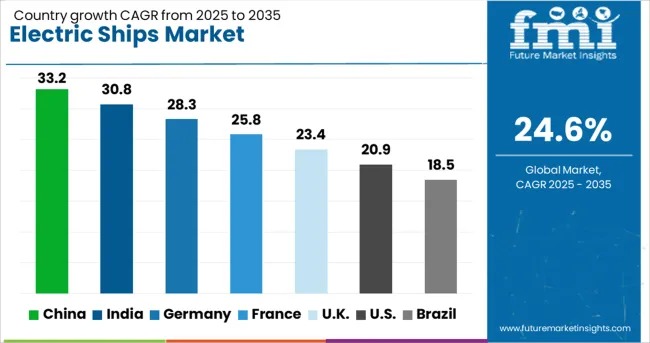
The global electric ships market is entering a transformative growth phase, reflecting a structural shift in maritime transportation as the industry rapidly transitions toward zero-emission and low-carbon propulsion systems. The market is estimated to be valued at USD 6.5 billion in 2025 and is projected to reach USD 58.8 billion by 2035, expanding at a robust compound annual growth rate (CAGR) of 24.6% over the forecast period.
This extraordinary expansion is underpinned by year-on-year acceleration in both absolute and percentage growth. Between 2025 and 2026, the market is expected to add USD 1.6 billion, maintaining a high-growth trajectory into 2027 with an additional USD 2.0 billion. From 2028 onward, annual gains are forecast to exceed USD 3 billion, culminating in a sharp rise from USD 30.4 billion in 2032 to USD 37.9 billion in 2033, reflecting intensified global adoption of hybrid and fully electric propulsion platforms.
Early-stage market development between 2025 and 2029 will contribute approximately USD 9.2 billion, representing about 21% of total market expansion, while the period from 2030 to 2035 is expected to generate USD 43.1 billion, accounting for 73% of overall growth. This back-loaded growth curve is characteristic of high-impact technology transitions, where infrastructure development, regulatory clarity, and fleet modernization investments unlock exponential scaling.
Subscribe for Year-Round Insights → Stay ahead with quarterly and annual data updates
https://www.futuremarketinsights.com/reports/sample/rep-gb-23287
Electrification Reshaping the Maritime Value Chain
Electric ships are rapidly expanding beyond niche applications, now representing approximately 2.5% of the global maritime transportation market and 4.2% of the shipbuilding industry. Within the marine propulsion systems segment, electric and hybrid technologies have achieved an estimated 11.8% share, driven by new vessel construction and large-scale retrofitting projects. The integration of electric shipping within renewable energy ecosystems remains at an early stage, accounting for 1.4% of clean energy technology applications, signaling substantial long-term potential.
Leading technology introductions, such as large-capacity battery-electric ferries, are redefining operational benchmarks. Notably, 129-meter all-electric vessels equipped with 45,000 kWh battery systems have demonstrated the commercial viability of fully electric maritime transport. Strategic investments by major system providers are accelerating advances in energy storage, ultra-fast charging, hydrogen-assisted propulsion, and AI-enabled power management, strengthening the foundation for mass adoption.
Electric Propulsion Dominates Power Source Segment
Electric propulsion is forecast to command 66.0% of the market share in 2025, establishing it as the dominant power source across vessel categories. The segment’s leadership is fueled by lower operating costs, near-zero noise emissions, simplified mechanical architecture, and rising pressure to comply with global decarbonization standards. Expanding port-side charging infrastructure and modular battery-swapping solutions are further reducing operational constraints.
Power generation systems, including fuel cells, solar-integrated units, and auxiliary generators, are projected to account for 34.0% of system-level market share by 2025. These technologies enhance operational resilience, enabling real-time energy balancing and extended voyage capabilities.
Manned vessels continue to lead market adoption, representing 72.0% of operational share in 2025, due to regulatory frameworks, complex navigational environments, and the immediate feasibility of retrofitting existing fleets. While autonomous shipping remains an emerging frontier, crewed electric vessels are expected to dominate near-term deployments.
Asia-Pacific and Europe Drive Global Momentum
Asia-Pacific and Europe are emerging as primary engines of growth, supported by aggressive policy frameworks and large-scale infrastructure investments. China is projected to lead global adoption with a 33.2% CAGR, supported by government-backed shipbuilding initiatives and rapid electrification of coastal and inland fleets. India is forecast to follow closely with a 30.8% CAGR, driven by inland waterway modernization and large-scale ferry electrification programs. Germany, the United Kingdom, and the United States are also accelerating adoption through fuel efficiency mandates, port electrification strategies, and fiscal incentives.
Across key regions, electric ferries, inland cargo vessels, and short-sea shipping platforms are achieving measurable operational cost reductions through lower fuel consumption and minimal maintenance requirements. Hybrid-electric architectures are being increasingly deployed for medium-distance routes, offering a balanced pathway toward full electrification.
Technological Innovation Unlocks Long-Term Scalability
Advancements in lithium-ion and next-generation solid-state battery technologies are extending vessel range and improving safety performance. Modular propulsion units, lightweight hull designs, and predictive AI-driven energy management systems are redefining vessel efficiency. Governments are introducing targeted subsidies, zero-emission mandates, and port electrification programs to support deployment at scale.
Recent industry milestones highlight the pace of innovation. In May 2025, a 130-meter fully electric ferry equipped with a 40 MWh battery system was launched, setting a new benchmark for large-scale vessel electrification. High-speed electric hydrofoil ferries are now achieving near-zero emission operations while maintaining commercial viability, signaling the next phase of maritime mobility.
Personalize Your Experience: Ask for Customization to Meet Your Requirements
https://www.futuremarketinsights.com/customization-available/rep-gb-23287
Competitive Landscape Intensifies as Strategic Investments Accelerate
The competitive environment is shaped by global shipbuilding leaders and marine technology innovators expanding production capacity, strengthening technology pipelines, and securing long-term strategic partnerships. Major players are pursuing joint ventures with battery manufacturers, port authorities, and energy infrastructure developers to create fully integrated electric marine ecosystems.
With tightening emission regulations, declining battery costs, and expanding charging infrastructure, the electric ships market is positioned to evolve from early adoption to mainstream deployment over the next decade. The convergence of regulatory support, technological breakthroughs, and operational cost advantages is expected to reshape global shipping, presenting significant opportunities across commercial, defense, passenger, and cargo maritime segments.
The comprehensive market report delivers in-depth quantitative forecasts, regional strategies, competitive intelligence, and technology benchmarking, offering critical insights into this rapidly accelerating market.
Why Choose FMI: Empowering Decisions that Drive Real-World Outcomes: https://www.futuremarketinsights.com/why-fmi
About Future Market Insights (FMI)
Future Market Insights, Inc. (FMI) is an ESOMAR-certified, ISO 9001:2015 market research and consulting organization, trusted by Fortune 500 clients and global enterprises. With operations in the U.S., UK, India, and Dubai, FMI provides data-backed insights and strategic intelligence across 30+ industries and 1200 markets worldwide.