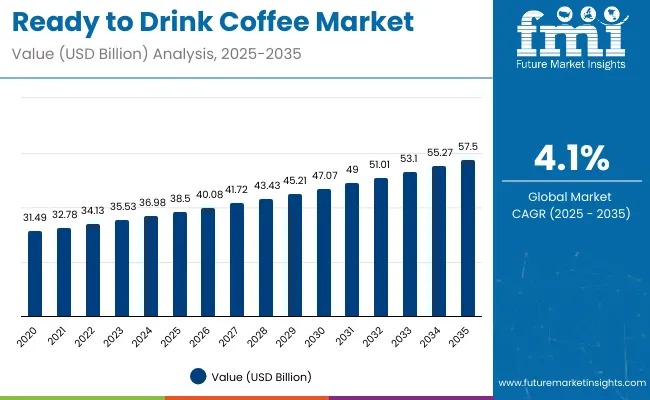
The global Ready-to-Drink (RTD) coffee market is witnessing steady growth, reflecting evolving consumer preferences for convenient, on-the-go beverages. Valued at USD 38.5 billion in 2025, the market is projected to reach USD 57.5 billion by 2035, registering a compound annual growth rate (CAGR) of 4.1%. Over the forecast period, the sector is expected to add an absolute dollar opportunity of USD 19.0 billion, demonstrating 1.49 times growth.
The market’s expansion is fueled by urbanization, rising disposable incomes, and the increasing popularity of specialty coffee variants such as cold brew, nitro coffee, and functional blends enriched with protein or probiotics. Leading players—including Nestlé, The Coca-Cola Company, PepsiCo, Unilever, and Suntory Holdings Limited—are leveraging innovation, sustainability, and global distribution networks to consolidate market share and cater to health-conscious consumers.
To Explore Detailed Market Data, Segment-Wise Forecasts, and Competitive Insights, Request Sample Report!
The RTD coffee landscape is dominated by the regular (caffeinated) segment, which accounts for 95% of market share. Espresso-based beverages represent the most lucrative variety, commanding a 37% share in 2025 due to their robust flavor and higher caffeine content. These segments appeal to both traditional coffee enthusiasts and younger, urban consumers seeking quick energy boosts without compromising on taste.
Innovation is a key driver shaping the market’s trajectory. Functional RTD coffee offerings now include ingredients like antioxidants, probiotics, and plant-based components. Brands are increasingly introducing cold brew, nitro coffee, sugar-free, and plant-based variants to satisfy evolving consumer demands for health-oriented, sustainable, and premium products.
Key Market Drivers Include:
- Rising consumer demand for convenient, ready-to-consume coffee options.
- Health-conscious trends driving adoption of functional and clean-label beverages.
- Premiumization through specialty, organic, and ethically sourced coffee blends.
- Expansion of modern retail and e-commerce channels enhancing accessibility.
Regionally, Asia Pacific and Western Europe are projected as high-growth markets. India leads with a CAGR of 4.2%, driven by urbanization, increasing disposable incomes, and an emerging coffee culture. China follows with a 3.0% CAGR, reflecting the growth of café culture, modern retail networks, and premium RTD offerings. In mature markets such as Germany, Japan, the United Kingdom, and the United States, growth is moderate, ranging from 2.2% to 2.9%, emphasizing health-consciousness, ethical sourcing, and product quality.
Country Highlights:
- India: Rapid adoption of premium espresso-based and flavored RTD coffee, supported by retail and e-commerce expansion.
- Germany: Strong demand for sugar-free, organic, and plant-based options; eco-friendly packaging reshapes consumer loyalty.
- United States: Cold brew, nitro, and functional variants dominate new launches; online retail penetration supports wide distribution.
- China: Urban lifestyle shifts, café culture adoption, and modern retail expansion drive growth.
- Japan: Canned RTD coffee remains dominant; focus on low-calorie, sugar-free, and functional beverages.
- United Kingdom: Ethical, plant-based coffee products gain traction; convenience and premiumization influence demand.
- Brazil: Integration of traditional coffee culture with modern RTD formats; specialty flavors and improved logistics enhance consumption.
The competitive landscape is marked by intense rivalry among global and regional players. Companies focus on expanding product portfolios, introducing novel flavors, functional formulations, and sustainable packaging. Strategic partnerships with retailers and e-commerce platforms are enhancing market reach, while smaller regional players differentiate through niche offerings and localized flavors targeting millennials and Gen Z consumers.
Looking ahead, the RTD coffee market is set to evolve with continuous product innovations, sustainability initiatives, and the growing influence of health-conscious consumers. Espresso-based beverages, functional blends, and specialty cold brews are expected to remain key growth drivers, while premium, organic, and ethically sourced offerings will define brand differentiation and consumer loyalty globally.
With an absolute growth opportunity of USD 19.0 billion over the next decade, the RTD coffee market is positioned to maintain its critical role within the global beverage sector, combining convenience, taste, and wellness to meet modern lifestyle demands.