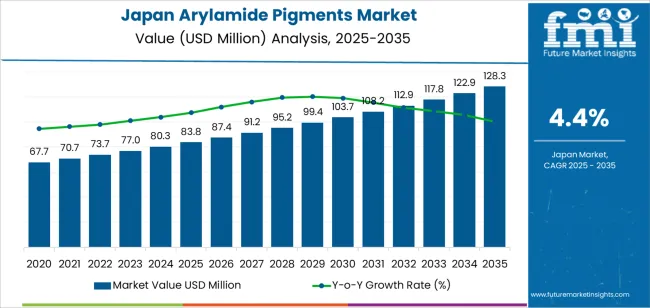
The Japan arylamide pigments market demonstrated robust performance in 2025 with a valuation of USD 83.8 million, and is poised for significant growth with projections reaching USD 128.3 million by 2035. This sustained expansion reflects growing demand across automotive coatings, specialty plastics, textiles, and printing applications, underpinned by shifting industry requirements toward high-performance, durable pigments with superior color strength and stability.
The latest industry analysis highlights a compound annual growth trajectory as manufacturers — both established industry leaders and emerging innovators — seek expansion opportunities in Japan’s competitive pigment landscape. With stringent quality expectations and emphasis on performance metrics, companies are investing in technology upgrades, customized solutions, and strategic partnerships to capture rising demand across multiple end use sectors.
Market Dynamics Favor Innovation and Expansion
Japan’s arylamide pigments market is evolving beyond traditional applications, benefitting from rising adoption in advanced coatings for electric vehicles, high-end plastics, and premium consumer goods. Growth in the automotive coatings and electronics sectors has particularly accelerated demand for pigments that exhibit excellent heat resistance, lightfastness, and chemical stability. These new application areas are attracting both multinational pigment producers and agile domestic firms aiming to broaden their product portfolios and strengthen market presence.
In response to customer needs for vivid, long-lasting color and compliance with stricter environmental and performance regulation, several market players are integrating cutting-edge dispersion and formulation technologies into their manufacturing processes. This focus on innovation has helped companies improve consistency, reduce waste, and deliver tailored pigment solutions for specific industry challenges.
Established Players Driving Market Leadership
Leading global chemical and pigment producers continue to shape Japan’s arylamide landscape with comprehensive product offerings and strong distribution networks. Industry titans such as BASF SE, Clariant AG, Sun Chemical Corporation, DIC Corporation, and Heubach GmbH have reinforced their strategic positions through investments in localized production capacity and enhanced technical support services.
These established firms bring decades of formulation expertise and global supply chain reach, enabling them to serve sectors ranging from automotive refinishing to high-quality printing inks. Their commitment to R&D is allowing them to introduce improved pigment grades that combine attractive aesthetics with enhanced durability — particularly in applications where long-term performance is a critical purchasing driver.
In coatings and plastics markets, for instance, the shift toward durable colorants with superior weather resistance is creating opportunities for premium arylamide pigments that can outperform conventional alternatives. Leading players are thus expanding their product suites with offerings that meet evolving industry standards and end-user preferences.
New Entrants and Emerging Innovators Energizing Competition
While established companies maintain a strong foothold, a new wave of agile players and specialty manufacturers is making its mark by focusing on niche segments and bespoke solutions. These emerging entrants are investing in process optimization and specialized pigment technologies that address application-specific demands such as eco-friendly formulations and enhanced pigment dispersion in sustainable materials.
By embracing digital technologies in research, product development, and customer engagement, new manufacturers are positioning themselves to challenge traditional players in select product categories. Their efforts to introduce ultra-high performance pigments, combined with flexible manufacturing protocols, enable them to serve emerging end-use markets like advanced packaging, premium textiles, and specialty industrial coatings.
This influx of innovation is reshaping competitive dynamics, as small and medium sized enterprises leverage specialized expertise to offer differentiated pigment products that cater to evolving customer expectations and regulatory landscapes.
End-Use Sectors Fueling Demand
Demand for arylamide pigments in Japan is broadening across several end-use industries. The printing inks sector remains a major contributor, driving demand for vibrant and stable pigments essential for high-quality graphic applications. Meanwhile, the paints and coatings segment is witnessing increased uptake of arylamide pigments due to their ability to enhance aesthetic appeal and durability in architectural and industrial finishes.
Plastics manufacturers are also turning toward advanced pigment solutions to support color consistency and performance in demanding consumer goods, automotive interiors, and electronic enclosures. Such diversification across end-use industries is creating a stable, multi-pillar growth foundation for the broader arylamide pigments market.
Technology and Sustainability as Growth Enablers
Sustainability and compliance are central to future market expansion. Manufacturers are increasingly focusing on pigment formulations that reduce volatile organic compounds (VOCs), improve environmental footprint, and comply with regional and international standards. These efforts include development of waterborne and solvent-free systems, which are gaining traction as regulatory pressure and customer preferences shift toward greener alternatives.
Advanced dispersion technologies, digital simulation tools, and data-driven quality monitoring systems are becoming integral to manufacturing workflows, allowing companies to enhance pigment performance while reducing cycle times and production costs. Such technological integration is expected to spur further innovation as competition intensifies and customer demand for tailored pigment solutions grows.
Outlook and Strategic Imperatives
Looking ahead, the Japan arylamide pigments market is positioned for steady growth driven by continuous innovation, strategic expansion by key industry players, and evolving application demand across diverse end-use industries. Manufacturers that adeptly combine advanced technology with customer-centric product strategies will lead the way in capturing new opportunities, fostering sustainable growth, and delivering value throughout the pigment supply chain.
As competition heats up and market boundaries expand, collaboration, agility, and a forward-looking approach to product development will be essential to succeeding in this dynamic and high-potential industry.