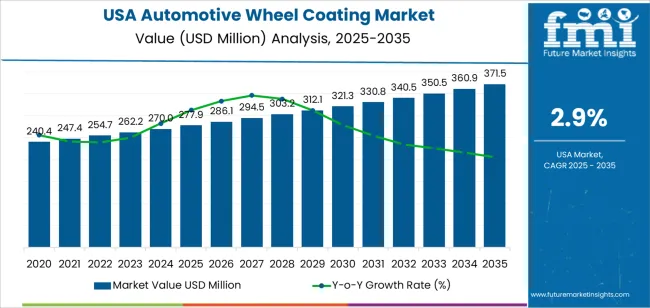
The United States automotive wheel coating market is poised for sustained expansion, with industry value forecasted at USD 277.9 million in 2025 and projected to reach USD 371.5 million by 2035. This growth trend underscores the increasing importance of superior wheel protection and aesthetic finishes among both original equipment manufacturers (OEMs) and aftermarket service providers. The expanding market reflects strong consumer demand for wheel coatings that not only enhance visual appeal but also deliver robust protection against corrosion, road salts, UV exposure, and everyday wear — making wheel coatings an indispensable part of the modern automotive landscape.
As the American automotive industry accelerates toward greater production volumes, a shift toward high-performance coatings is becoming more evident. This evolution creates compelling opportunities for both established players and innovative newcomers to expand their footprints and lead the industry into a new era of advanced coating technologies.
Market Dynamics: Performance, Protection, and Innovation
The wheel coating ecosystem is increasingly shaped by consumer expectations for wheels that look premium for longer. Modern coatings serve a dual purpose: they elevate aesthetics and extend lifespan by shielding wheel surfaces from environmental and mechanical stresses. Growth in the market is being driven by OEMs who integrate advanced coatings into production lines and a vibrant aftermarket segment where customization and refurbishment trends are reaching new heights. Increased adoption of alloy and composite wheels in contemporary vehicle models has heightened the need for sophisticated coating systems that can adhere effectively to diverse substrates while resisting corrosion and mechanical degradation.
Dealers, wheel manufacturers, and automotive OEMs are investing more in coatings that not only meet regulatory requirements — such as reduced volatile organic compound (VOC) emissions — but also offer enhanced durability and aesthetic versatility. From matte and gloss finishes to ceramic and nano-enhanced formulations, the spectrum of wheel coating technologies is expanding rapidly. These advancements enable manufacturers to differentiate their offerings, aligning with consumer desires for personalization and premium performance.
Key Opportunities for Established and New Market Players
For long-standing industry leaders, the US wheel coating market presents a platform to extend product portfolios and refine solutions that can adapt to evolving automotive design trends. Firms with strong R&D capabilities are already exploring water-borne and low-VOC technologies that align with stricter environmental standards while delivering superior finish quality.
At the same time, the market offers fertile ground for new entrants and emerging manufacturers. Innovative businesses focusing on advanced materials — such as ceramic, polymeric, and nano-composite coatings — are attracting attention for their ability to offer higher scratch resistance, improved chemical and thermal stability, and striking finishes. These developments are opening new niches and enabling smaller players to compete effectively by offering targeted solutions that appeal to OEMs, aftermarket specialists, and customization workshops alike.
The future of wheel coatings in the United States is not simply about incremental improvements — it’s about transformative innovation. From smart coatings that self-heal minor damage to formulations optimized for electric vehicle (EV) wheel designs, the next decade promises unparalleled evolution. This is a space where research investment, material science breakthroughs, and a keen focus on sustainability converge to define competitive advantage.
Advancing Technologies Shaping the Competitive Landscape
Several product types are leading market demand, with primers playing a crucial role by ensuring adhesion and base-layer integrity across diverse coating systems. Beyond primers, base coats and topcoats deliver the glossy and protective layers that define end-user satisfaction. Meanwhile, material innovations — such as acrylic enamel — continue to capture significant market share due to their balance of durability and aesthetic appeal.
One notable trend is the shift toward powder and water-borne coating technologies. These formats offer enhanced environmental compliance and reduced curing times, making them attractive to high-volume production facilities and eco-conscious buyers. Simultaneously, experimental approaches involving nano-infused additives and hybrid polymer systems are creating coatings that outperform traditional finishes in resistance to abrasion, oxidation, and moisture.
Such technological progress presents a chance for emerging manufacturers to challenge traditional market hierarchies. By leveraging agile development cycles and strategic partnerships, newer companies can synchronize their innovations with the needs of both OEMs and aftermarket service providers.
Regional Demand Fuels Local Growth Initiatives
Across the United States, wheel coating demand varies by region, with areas boasting strong automotive manufacturing and customization cultures leading the charge. From the bustling manufacturing hubs of the Midwest to the expansive automotive markets of the South and West, regional growth contributes to a broader national uptick in coating adoption. This diversified demand supports supply chain expansion, localized production initiatives, and collaborative ventures between coating formulators and wheel producers.
Conclusion
The United States automotive wheel coating market’s robust trajectory — backed by a projected rise from USD 277.9 million to USD 371.5 million over the next decade — illustrates the combined influence of performance requirements, aesthetic expectations, and technological innovation. For established leaders and new entrants alike, the evolving landscape presents abundant opportunities to grow, innovate, and redefine standards within the industry.
Manufacturers ready to harness cutting-edge technologies and align with market trends will be best positioned to capture value and drive the next chapter of growth in automotive wheel coatings.