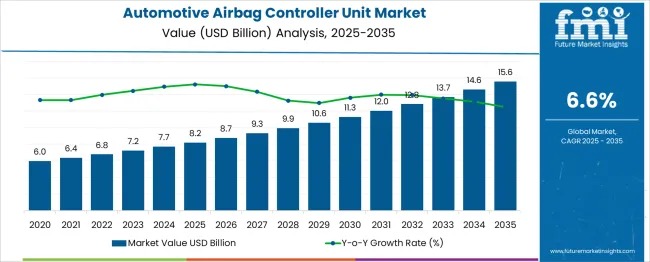
The global automotive airbag controller unit market is entering a decisive decade of growth, advancing from USD 8.2 billion in 2025 to USD 15.6 billion by 2035, at a robust CAGR of 6.6%. Strengthened by expanding vehicle safety regulations, rising EV production, and widespread integration of multi-airbag architectures, the market is experiencing significant technological acceleration across both developed and emerging automotive hubs.
The first half of the forecast period (2025-2030) delivers a value jump from USD 8.2 billion to USD 11.3 billion, contributing 42% of total incremental expansion with a five-year multiplier of 1.38x. Industry momentum intensifies from 2030 onward, adding USD 4.3 billion in incremental gains as premium vehicles, EVs, ADAS-equipped models, and autonomous platforms boost the need for advanced crash management electronics. Annual market increments escalate from USD 0.5 billion in early forecast years to USD 1.0 billion by 2035, reinforcing the sector’s long-term resilience.
Subscribe for Year-Round Insights → Stay ahead with quarterly and annual data updates
https://www.futuremarketinsights.com/reports/sample/rep-gb-23185
Escalating Safety Mandates and Electrification Fuel Market Progress
Global safety regulations continue to evolve rapidly, making airbag controller units central to modern passive safety architecture. Governments across Asia-Pacific, Europe, and the Americas have expanded mandates for multi-airbag systems, resulting in higher installation rates per vehicle and increased controller sophistication.
Modern automotive platforms-especially electric and connected vehicles-rely heavily on software-driven ECUs, real-time crash logic, and multi-sensor fusion to detect collision intensity and deploy airbags with millisecond precision. This transition toward intelligent safety electronics, combined with OEM commitment to zero-fatality mobility goals, positions controller units as a critical element of future vehicle design.
Strong Positioning Across Automotive Electronics Ecosystem
Airbag controller units represent a sizable proportion of adjacent automotive technology markets:
• 10-12% share within global automotive safety systems
• 4-5% in automotive electronics
• 25-28% of passive safety components
• 6-7% within automotive control modules
• 2-3% in ADAS electronics
These contributions highlight the controller unit’s multipronged relevance across safety, electronics, and control domains. As ADAS and autonomous systems expand, embedded intelligence and predictive safety algorithms within airbag controllers are expected to play an increasingly synergistic role.
Segmental Insights: Frontal Airbags and Basic Controllers Lead 2025 Landscape
Frontal Airbags – 42% Revenue Share in 2025
Frontal airbags remain the dominant type segment, driven by global regulatory requirements and high incidence of front-end collisions. Mature deployment technology, improved crash sensing, and cost efficiencies have allowed broad penetration across all vehicle categories, including compact and mid-range segments.
Basic Technology – 47% Market Share
The basic technology segment retains leadership in 2025 due to its widespread adoption in cost-sensitive passenger vehicle categories. Reliable deployment capabilities, simpler integration, and regulatory compliance make basic controllers the preferred solution in emerging markets with rapidly rising vehicle ownership.
Passenger Vehicles – 65% of Market Revenue
The passenger vehicles segment benefits from heightened consumer safety awareness, expanding global middle-class populations, and government mandates for multi-airbag systems. Continuous upgrades to occupant protection systems in SUVs, sedans, and crossover vehicles further strengthen this segment’s prominence.
Regional Growth: Asia-Pacific Leads, Europe and North America Innovate
The market demonstrates diverse regional growth patterns:
• China (8.9% CAGR) leads global expansion with rising passenger vehicle production and large-scale EV deployment.
• India (8.3% CAGR) is propelled by stringent dual-airbag mandates and surging SUV sales.
• Germany (7.6% CAGR) benefits from luxury vehicle manufacturing and advanced safety integration in EVs.
• UK (6.3% CAGR) and USA (5.6% CAGR) show steady adoption driven by premium vehicle demand and ADAS readiness.
Asia-Pacific remains the largest growth engine, while Europe continues to set global benchmarks in intelligent, software-enhanced safety systems.
Personalize Your Experience: Ask for Customization to Meet Your Requirements
https://www.futuremarketinsights.com/customization-available/rep-gb-23185
Competitive Landscape: Technology Integration Sets New Benchmarks
The automotive airbag controller unit market is moderately consolidated, with leading manufacturers accelerating innovation in sensor fusion, integrated software, and lightweight architecture. Key companies include:
Bosch
• Bosch
• ZF Friedrichshafen AG
• Denso Corporation
• Continental AG
• Aptiv PLC
• Hyundai Mobis
• Veoneer Inc.
• Mitsubishi Electric Corporation
Bosch continues to lead global market influence, supported by advanced safety electronics and established OEM relationships. Suppliers are intensifying focus on AI-enabled crash prediction, OTA-capable ECUs, biodegradable housings, and blockchain-secured diagnostics, reflecting the industry’s shift toward sustainable and intelligent safety platforms.
Recent innovations include Autoliv’s BernoulliTM Airbag Module, recognized in April 2025 for enabling larger airbags with a smaller inflator at over 30% reduced costs, and ZF LIFETEC’s heel/floor airbag, enhancing lower-limb protection for EV and autonomous vehicle cabin architectures.
Outlook: A USD 7.4 Billion Growth Window Anchored in Intelligent Safety
From 2025 to 2035, the automotive airbag controller unit market adds USD 7.4 billion in new value, reshaping OEM and supplier strategies worldwide. As vehicles become smarter, lighter, and more connected, controller units will evolve from crash-response components into fully integrated safety intelligence systems.
Across global markets, the combination of regulatory pressure, technological advancement, and electrification ensures that airbag controller units remain a cornerstone of next-generation automotive safety.
About Future Market Insights (FMI)
Future Market Insights, Inc. (FMI) is an ESOMAR-certified, ISO 9001:2015 market research and consulting organization, trusted by Fortune 500 clients and global enterprises. With operations in the U.S., UK, India, and Dubai, FMI provides data-backed insights and strategic intelligence across 30+ industries and 1200 markets worldwide.