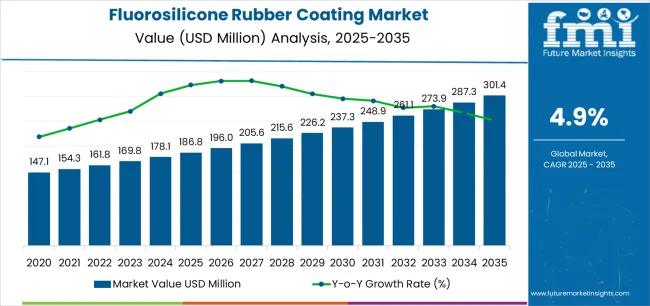
The global fluorosilicone rubber coating market is forecasted to grow significantly from an estimated USD 186.8 million in 2025 to USD 301.4 million by 2035, reflecting a robust upward trajectory driven by technological innovations, expanding industrial demand, and strategic market expansion initiatives by both established and emerging players. This sustained growth underscores the increasing adoption of advanced protective coating solutions that deliver exceptional thermal and chemical resistance for diverse applications across aerospace, automotive, electronics, and industrial sectors.
Fluorosilicone rubber coatings have long been recognized for their superior performance in extreme environments, and recent advancements in formulation technologies are further elevating their appeal. As industries increasingly prioritize durability and reliability, manufacturers are innovating rapidly to deliver high-performance coating solutions that meet evolving standards for temperature resistance, chemical protection, and long-term operational integrity.
Market Growth Driven by Evolving Industrial Needs
The fluorosilicone rubber coating market’s expansion is anchored in several key industrial trends. Aerospace manufacturers continue to rely on these coatings to protect critical components subjected to high temperatures, aggressive fuels, and corrosive environments. At the same time, the automotive sector — particularly electric vehicles (EVs) — demands advanced materials that ensure performance and longevity in battery systems and high-temperature subsystems.
Electronics and electrical industries are integrating fluorosilicone coatings to enhance the reliability and lifespan of components exposed to fluctuating operating conditions. These broadening use cases are prompting manufacturers to scale production capabilities and deepen engagement with end-users seeking tailored protective solutions.
Established Leaders Pave the Way with Strategic Vision
The competitive landscape is led by established chemical and polymer companies that have built robust platforms for fluorosilicone technologies. Industry giants such as DOW and Momentive Performance Materials continue to invest in research and development, refining high-temperature resistant formulations and expanding global distribution networks to better serve strategic markets.
Daikin Industries and Shin-Etsu remain influential through extensive chemical expertise and integrated coating solutions tailored for high-value applications. Wacker Chemie, Henkel, 3M, and PPG Industries are also expanding their footprint by enhancing product portfolios that blend performance with environmental sustainability and cost efficiency.
These seasoned manufacturers are not only reinforcing their existing market positions but also actively exploring partnerships, licensing agreements, and technology exchanges that accelerate innovation. Their efforts to standardize manufacturing processes and optimize supply chains are helping reduce lead times and ensure consistent quality across large-scale industrial needs.
New and Emerging Players Drive Competitive Innovation
Alongside established players, emerging manufacturers and specialized chemical producers are gaining traction by leveraging nimble development strategies and focused technology roadmaps. Companies such as KINYOSHA and Yada Fenghui are gaining recognition for their ability to craft niche fluorosilicone variants that meet stringent industrial performance criteria.
These newer entrants emphasize agility and customization, enabling them to respond swiftly to bespoke client requirements in growing sectors like EV production lines, precision electronics, and advanced aerospace projects. Their integration of digital process controls and automated quality systems supports scalable production without sacrificing performance.
Smaller chemical innovators are also collaborating with research institutions to explore next-generation fluorosilicone formulations that push the boundaries of current material capabilities. Such partnerships are vital for capturing emerging opportunities and addressing gaps in markets where traditional solutions may not fully align with modern performance expectations.
Technological Advancements Fuel Market Opportunity
Innovation remains the lifeblood of the fluorosilicone rubber coating market. Advances in polymer chemistry, enhanced curing techniques, and reinforced thermal management technologies are enabling new coating systems that outperform conventional alternatives. These advancements are particularly valuable in sectors where reliability under extreme conditions is non-negotiable.
Manufacturers are also exploring environmentally conscious formulations that minimize volatile organic compounds (VOCs) while enhancing performance. Such sustainable technology initiatives align with industry trends that prioritize regulatory compliance and eco-friendly production practices.
Digitalization and Industry 4.0 capabilities are being integrated into manufacturing operations to improve consistency, traceability, and product quality. These investments not only enhance operational efficiency but also support data-driven insights that inform product development roadmaps.
Strategic Outlook and Future Directions
Looking ahead, the fluorosilicone rubber coating market is poised for continued expansion as global industries accelerate modernization efforts and demand resilient coating solutions. Strategic initiatives such as geographic expansion into emerging markets, increased private-label development, and targeted aerospace and automotive programs are expected to shape competitive dynamics.
Manufacturers that effectively balance innovation, quality control, and customer responsiveness are likely to excel. The convergence of advanced materials science and global industrial growth is creating fertile ground for partnerships that unlock new applications and strengthen market penetration.
With a strong foundation in high-performance protective coatings and a thriving ecosystem of both legacy and forward-thinking companies, the fluorosilicone rubber coating sector is charting a path of sustainable growth and technological excellence.