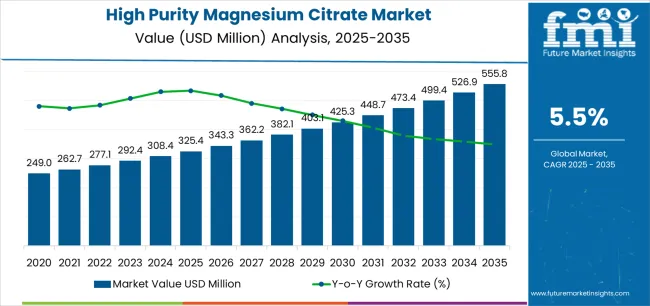
The global high purity magnesium citrate market is on a strong growth trajectory, with the market valued at USD 325.4 million in 2025 and projected to climb to USD 555.8 million by 2035, reflecting a significant compound annual growth rate (CAGR) of 5.5% over the forecast period. This expansion is driven by increasing demand for high-grade magnesium citrate in pharmaceutical, nutraceutical, and functional food applications, coupled with expanding health awareness and technological innovations that are reshaping industry standards and opportunities.
High purity magnesium citrate, known for its superior bioavailability and consistent efficacy, has become a cornerstone ingredient in dietary supplements, therapeutic formulations, and food fortification solutions. The evolving market landscape is ripe with opportunities for both established manufacturers and newer entrants who are leveraging advanced technologies and strategic expansions to capture growth across key regions including North America, East Asia, and Western Europe.
Market Drivers and Industrial Momentum
The demand for high purity magnesium citrate is being propelled by several key trends. Rising health consciousness among global consumers is increasingly driving demand for premium dietary supplements that deliver enhanced nutritional benefits. In particular, the nutrient supplement segment accounts for the largest share of market demand, with consumers and healthcare professionals placing a high value on products that offer enhanced bioavailability and consistent quality.
Pharmaceutical applications of high purity magnesium citrate are also accelerating as regulatory environments tighten quality standards and demand for pharmaceutical-grade mineral compounds increases. This shift offers substantial opportunities for manufacturers who can meet stringent compliance and documentation requirements, positioning themselves as trusted suppliers to major pharmaceutical and nutraceutical companies.
In addition, manufacturers are integrating cutting-edge purification and quality control technologies into their production processes. These technologies ensure higher levels of product purity, facilitate precise particle size distribution, and support consistent dissolution performance — all of which are critical factors for specialist applications in therapeutic and functional food products.
Established Players Strengthen Leadership Through Innovation
Several established companies are driving market growth through expanded product portfolios, innovation in manufacturing processes, and extended geographical reach. Leading suppliers have deep-rooted distribution networks and established quality assurance frameworks that support their presence in multiple regions.
These established players are doubling down on technological advancements to optimize manufacturing efficiency and product performance. Their investments in quality-by-design approaches, enhanced purification systems, and real-time monitoring solutions are creating significant value for customers who require premium-grade magnesium citrate tailored for critical applications.
In addition, these legacy manufacturers are increasingly adopting value-based pricing models and offering comprehensive service packages that combine product quality with technical support, documentation, and regulatory compliance assistance. These value-added services strengthen customer relationships and make it easier for supplement and pharmaceutical companies to scale production without disruption.
New Entrants and Emerging Manufacturers Drive Innovation
Alongside traditional players, a cohort of emerging manufacturers and technology innovators is reshaping the competitive landscape. These new entrants are focusing on niche segments, custom formulations, and advanced bioavailability enhancements that differentiate their offerings in an increasingly sophisticated market.
Start-ups and mid-sized companies are leveraging digital platforms and agile supply chain strategies to reach global customers more effectively. Their ability to rapidly iterate on product formulations — including specialty grades and custom blends — enables them to cater to specific customer needs, such as effervescent tablets, liquid delivery systems, and combination supplements that integrate magnesium citrate with complementary ingredients like zinc and vitamin D.
In addition, these emerging manufacturers are emphasizing sustainable production methods and eco-friendly sourcing practices, aligning with a growing trend among buyers who prioritize environmental responsibility as part of their purchasing criteria.
Technological Advancements and Integration
Across the spectrum of market players, technological innovation remains a cornerstone of future growth. Advanced purification technologies, real-time quality tracking, and smart manufacturing systems are enabling companies to achieve higher purity levels and consistent performance. These advancements not only elevate product quality but also help manufacturers streamline operations, reduce waste, and improve scalability.
Manufacturers are also incorporating automation and digital integration, using systems that connect ERP platforms with quality monitoring tools to ensure end-to-end oversight. These technologies provide significant advantages in regulatory environments where traceability, batch control, and documentation are critical.
Geographical Expansion and Regional Growth
Market expansion is gaining momentum in East Asia, North America, and Western Europe, where strong health infrastructure and investments in supplement industry modernization support robust demand. Emerging markets, particularly in India and China, are registering accelerated adoption rates due to increased pharmaceutical investments and expanding consumer health markets.
Regional dynamics are reshaping investment patterns as companies establish local production facilities, regional distribution centers, and collaborative research partnerships to better serve localized demand. These strategies not only enhance supply chain resilience but also enable tailored product offerings that comply with regional regulatory standards.
Outlook and Future Opportunities
The high purity magnesium citrate market is poised for long-term growth as both established and new manufacturers innovate and expand their capabilities. With a rising global focus on preventative health, quality nutritional supplements, and pharmaceutical-grade ingredients, the industry is set for continued transformation. Market participants who embrace technological innovation, sustainable practices, and customer-centric solutions are likely to lead in capturing expanding opportunities across diverse application segments.
As consumer preferences evolve and demand for high-quality nutritional ingredients increases, the high purity magnesium citrate market will remain at the forefront of health-focused product development and industrial advancement.