The global waterless cosmetics market is entering a transformative growth phase as sustainability, innovation, and conscious consumerism redefine the beauty and personal care industry. Waterless cosmetics—encompassing solid bars, powders, balms, oils, and concentrated formats—are rapidly gaining acceptance for their eco-friendly profile, longer shelf life, and high-performance formulations.
Market Outlook: 2025 to 2035
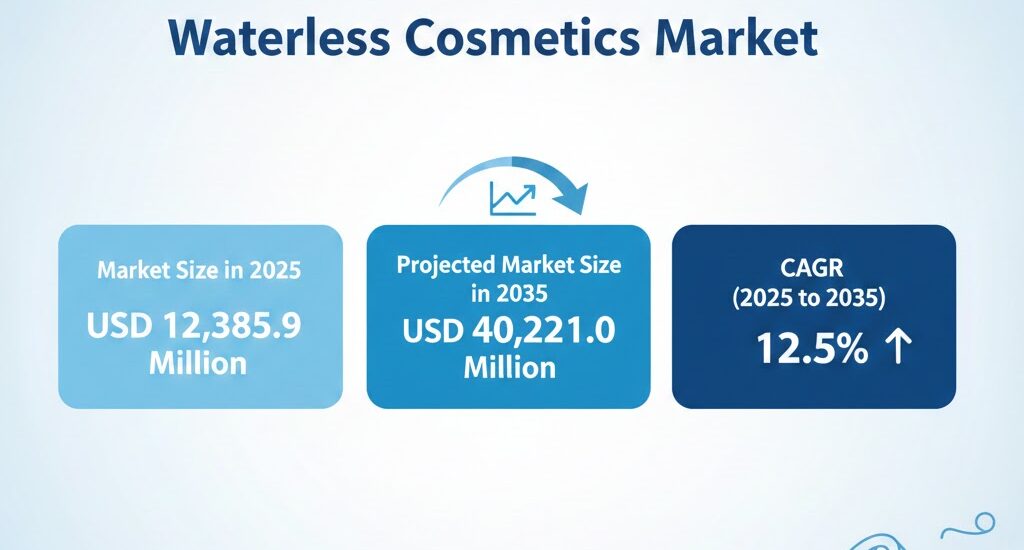
- The waterless cosmetics market is valued at USD 12,385.9 million in 2025
- Expected to reach USD 40,221.0 million by 2035
- Growing at a robust CAGR of 12.5% (2025–2035)
This growth reflects a fundamental shift toward green beauty, clean labels, and water conservation, positioning waterless cosmetics as a long-term solution rather than a niche trend.
Subscribe for Year-Round Insights → Stay ahead with quarterly and annual data updates – https://www.futuremarketinsights.com/reports/sample/rep-gb-12748
Why Waterless Cosmetics Are Gaining Momentum
Waterless beauty products are redefining how consumers perceive efficacy and sustainability. Key advantages include:
- Reduced water consumption and lower environmental footprint
- Concentrated active ingredients for enhanced performance
- Minimal or biodegradable packaging, supporting zero-waste goals
- Improved portability and travel-friendliness
- Longer shelf life with fewer preservatives
As global ESG initiatives gain traction, waterless formulations align seamlessly with climate-conscious lifestyles and regulatory expectations.
Regional Market Trends Shaping Growth
North America: Sustainability Meets Retail Innovation
North America remains a dominant market, supported by:
- High consumer awareness of clean beauty
- Strong retail and DTC infrastructure
- Growing concerns over water scarcity in the U.S. and Canada
Solid shampoos, powdered cleansers, and waterless skincare products are gaining traction across mass and premium retail channels.
Europe: Regulation-Driven Adoption
Europe continues to be a vital market due to:
- Strict environmental regulations
- Strong sustainability focus
- Consumer preference for low-impact beauty
Countries such as Germany, the UK, and France are leading adoption, supported by the EU Green Deal and circular economy initiatives.
Asia-Pacific: Fastest-Growing Market
Asia-Pacific is the fastest-growing region, driven by:
- Rapid urbanization and rising disposable incomes
- Advanced beauty ecosystems in China, Japan, and South Korea
- Strong demand for compact, innovative, and ethical beauty products
This region is also at the forefront of product innovation and technology integration.
Challenges Impacting Market Expansion
Despite strong growth prospects, the market faces certain challenges:
- Formulation complexity due to the removal of water
- Consumer skepticism in regions accustomed to water-based products
- High R&D and manufacturing costs, especially for premium formulations
Educating consumers on the benefits of anhydrous products remains critical for wider adoption.
Emerging Opportunities Fueling the Next Growth Phase
The future of the waterless cosmetics market is rich with opportunity, including:
- Rising demand for sustainable and clean-label beauty
- Innovation in solid, powder, stick, and balm-based formats
- AI-driven personalization and custom formulation technologies
- Multipurpose and minimalist beauty routines
AI-enabled diagnostics and biotech-sourced ingredients are empowering both established brands and emerging manufacturers to scale innovation while enhancing brand loyalty.
Market Shifts: 2020–2024 vs. 2025–2035
Key Transformations Ahead:
- Stricter green certifications and water footprint disclosures
- Expansion from indie brands into mass-market, luxury, and dermatology-led segments
- Growth of AI-based skin mapping, smart refills, and IoT-enabled packaging
- Evolution toward customized active pods and biotech-infused solid serums
These shifts are redefining competitive dynamics and encouraging new technology-driven entrants.
Country-Wise Growth Highlights (CAGR 2025–2035)
- USA: 12.7% – Driven by water conservation awareness and DTC expansion
- UK: 12.3% – Zero-waste beauty and vegan formulations gaining popularity
- European Union: 12.5% – Regulation-led adoption and multifunctional formats
- Japan: 12.4% – Minimalist skincare culture and solid-state innovation
- South Korea: 12.7% – Leadership in dehydrated and high-efficacy formulations
Key Segments of the Waterless Cosmetics Market
By Product Type:
- Skincare
- Hair Care
- Cosmetics
- Others
Skincare leads the market, holding 46.8% share in 2025, driven by solid cleansers, balm moisturizers, face oils, and powdered exfoliants.
By Consumer Orientation:
- Men
- Women
- Unisex
The women’s segment dominates with 60.7% share, supported by strong adoption of clean beauty and eco-luxury routines.
By Sales Channel:
- Online Retail
- Specialty Stores
- Hypermarkets/Supermarkets
- Department Stores
- Others
By Price Range:
- Economy (Below USD 30)
- Mid-Range (USD 30–60)
- Premium (Above USD 60)
By Region:
- North America
- Europe
- Asia-Pacific
- Latin America
- Middle East & Africa
Competitive Landscape: Innovation at the Core
The waterless cosmetics market features a dynamic mix of global leaders and emerging clean-beauty innovators.
Market Share Highlights:
- L’Oréal Group: 18–22%
- Procter & Gamble: 12–16%
- Unilever: 10–14%
- Beiersdorf AG: 8–12%
- Pinch of Colour: 4–7%
- Other Players: 30–40%
Key Players Driving Innovation:
- L’Oréal Group: AI-formulated powder cleansers and solid shampoo bars
- P&G: Waterless body wash sheets and concentrated skincare pastes
- Unilever: Solid conditioners and powder-to-liquid cleansers
- Beiersdorf AG: Dry cleansing tablets and refillable solid moisturizers
- Pinch of Colour: Luxury balm-serum hybrids and waterless makeup
Emerging brands such as Ethique, LUSH, HiBAR, SBTRCT, Everist, and Beauty Kitchen are also reshaping the market with zero-waste and refillable solutions.
Outlook for Manufacturers and Innovators
The waterless cosmetics market from 2025 to 2035 presents significant expansion opportunities for both established brands and new manufacturers. Companies investing in AI-powered formulation, sustainable packaging, biotech ingredients, and personalization technologies are well-positioned to capture future growth.
As consumers increasingly prioritize efficacy, ethics, and environmental responsibility, waterless cosmetics are set to become a cornerstone of the global beauty industry.
Why FMI: https://www.futuremarketinsights.com/why-fmi
About Future Market Insights (FMI)
Future Market Insights, Inc. (FMI) is an ESOMAR-certified, ISO 9001:2015 market research and consulting organization, trusted by Fortune 500 clients and global enterprises. With operations in the U.S., UK, India, and Dubai, FMI provides data-backed insights and strategic intelligence across 30+ industries and 1200 markets worldwide.
Contact Us:
Future Market Insights Inc.
Christiana Corporate, 200 Continental Drive,
Suite 401, Newark, Delaware – 19713, USA
T: +1-347-918-3531
For Sales Enquiries: sales@futuremarketinsights.com
Website: https://www.futuremarketinsights.com
LinkedIn| Twitter| Blogs | YouTube