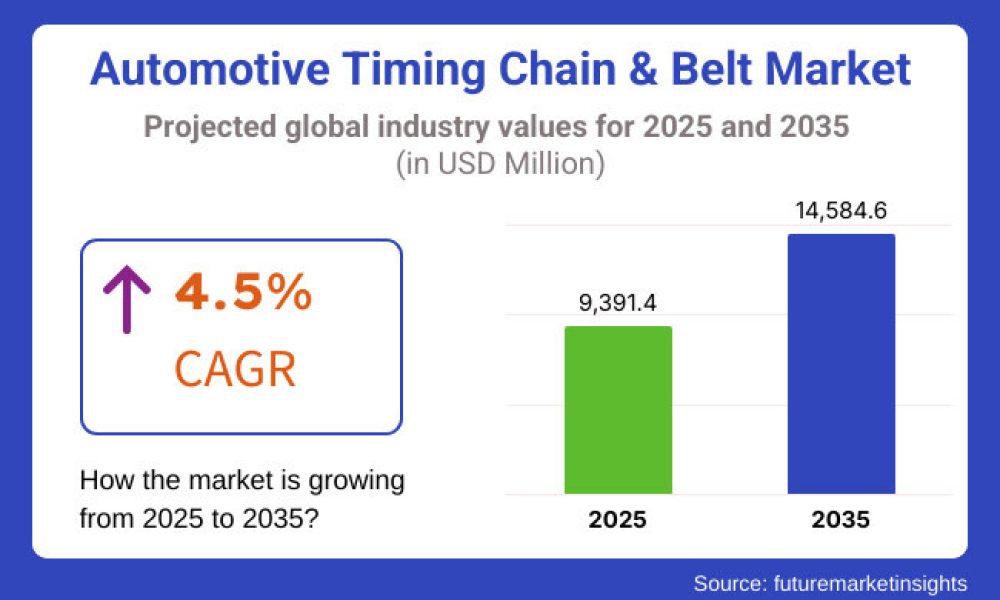
The Global Automotive Timing Chain & Belt Market is projected to expand from USD 9,391.4 million in 2025 to USD 14,584.6 million by 2035, registering a CAGR of 4.5%, according to the latest market outlook. Rising demand for fuel-efficient, low-maintenance engine components, coupled with rapid technological advancements in high-durability materials, is driving this market’s expansion across major automotive hubs including the USA, Europe, APAC, and Saudi Arabia.
Market Dynamics
The market is undergoing a significant transformation with manufacturers shifting from traditional rubber-based belts to high-strength polymer composites and metal-reinforced chains. These next-generation components are designed to enhance engine durability, reduce friction losses, and extend maintenance cycles, supporting both internal combustion engines (ICEs) and hybrid vehicles.
The demand is further amplified by stricter emission norms and government initiatives promoting lightweight and efficient automotive components. Automakers are now focusing on timing systems with reduced noise and higher thermal resistance, ensuring compliance with sustainability goals without compromising performance.
Subscribe for Year-Round Insights → Stay ahead with quarterly and annual data updates https://www.futuremarketinsights.com/reports/sample/rep-gb-6132
Regional Insights
North America (USA & Canada):
The U.S. market continues to expand with steady production of light trucks and high-performance vehicles. Timing chains dominate due to their superior reliability and compatibility with direct injection engines. The aftermarket sector is thriving as consumers increasingly prefer durable replacements and longer-life products.
CAGR (2025–2035): 3.8%
Europe (UK, Germany, France, Italy):
European automakers are adopting lightweight timing belts to meet Euro 7 emission norms. Strong OEM presence in Germany, France, and the UK drives R&D in low-friction and recyclable components. The region’s well-regulated aftermarket further sustains growth, as vehicle lifespans extend.
CAGR (2025–2035): 4.5%
Asia-Pacific (China, India, Japan, South Korea):
APAC leads globally, with China, India, Japan, and South Korea propelling growth through industrialization, vehicle ownership rise, and technological advancements. Japan and South Korea’s strong hybrid vehicle base enhances demand for precision-engineered timing components.
CAGR (2025–2035): 4.0%+
Saudi Arabia & Middle East:
The Gulf automotive sector is expanding rapidly, led by infrastructure investments and rising SUV and commercial vehicle sales. The region’s extreme heat conditions favor durable, heat-resistant timing chains, while Africa’s emerging markets offer strong aftermarket potential.
CAGR (2025–2035): ~4%
Key Market Drivers
- Engine Efficiency & Durability: Rising preference for timing chains over belts in premium vehicles due to reduced wear and failure risks.
- Emission Regulations: Stricter fuel economy standards pushing adoption of low-friction timing systems.
- Hybrid Vehicle Adoption: Sustains market relevance as hybrid engines continue using timing mechanisms.
- Aftermarket Expansion: Growth in used car ownership and affordable maintenance solutions in emerging economies
Challenges
- EV Penetration: Electric vehicles, which lack timing components, are reducing long-term demand for ICE-specific parts.
- Raw Material Price Volatility: Fluctuations in steel, rubber, and polymer prices continue to impact production costs.
- Supply Chain Constraints: Geopolitical tensions and logistics disruptions delay component availability.
Opportunities
- Material Innovation: Use of carbon-fiber-reinforced composites, self-lubricating chains, and wear-resistant coatings is boosting performance.
- Aftermarket Growth in Emerging Economies: Expanding vehicle ownership and local manufacturing in Asia, Latin America, and Africa open new revenue streams.
- Circular Economy Practices: Increased focus on eco-friendly and recyclable timing systems supports sustainability.
Market Segmentation
- By Product Type:
- Chain Segment dominates due to strength and low maintenance.
- Belt-in-Oil (BIO) systems gaining traction for fuel efficiency and reduced CO₂ emissions.
- By Engine Type:
- Gasoline inline engines lead due to widespread passenger vehicle use.
- Diesel V-engines remain preferred for heavy-duty commercial applications.
- By Vehicle Type:
- Passenger cars dominate in volume.
- Heavy Commercial Vehicles (HCVs) rely on high-durability timing chains.
- By Sales Channel:
- OEMs drive growth through advanced technology integration.
- Aftermarket thrives on replacement demand for aging vehicles.
Checkout Now to Access Industry Insights: https://www.futuremarketinsights.com/checkout/6132
Competitive Landscape
The global market is moderately consolidated, with major players focusing on material innovation and hybrid compatibility:
- BorgWarner Inc. – Leader in advanced timing chains emphasizing low noise and high durability. (Market Share: 15–20%)
- Continental AG – Develops high-performance belts with advanced polymer technology. (12–16%)
- Schaeffler AG – Specializes in precision-engineered lightweight chain systems. (10–14%)
- Gates Corporation – Offers wide OE and aftermarket belt portfolios. (8–12%)
- Dayco Products LLC – Focuses on thermal-resistant belts and hybrid engine applications. (5–9%)
Together, these companies are shaping the next generation of timing chain and belt technologies, aligning with fuel efficiency, emission reduction, and durability demands.
Outlook
Despite the long-term challenge posed by full EV adoption, the Automotive Timing Chain & Belt Market remains essential to the hybrid and ICE ecosystem. With innovations in lightweight materials, friction-reducing coatings, and smart engine synchronization, the industry is poised for steady growth across APAC, Europe, the USA, and Saudi Arabia through 2035.
Why Choose FMI: Empowering Decisions that Drive Real-World Outcomes: https://www.futuremarketinsights.com/why-fmi
About Future Market Insights (FMI)
Future Market Insights, Inc. (FMI) is an ESOMAR-certified, ISO 9001:2015 market research and consulting organization, trusted by Fortune 500 clients and global enterprises. With operations in the U.S., UK, India, and Dubai, FMI provides data-backed insights and strategic intelligence across 30+ industries and 1200 markets worldwide.