

The global beverage packaging industry is undergoing a quiet but powerful transformation, driven by sustainability goals, changing consumer lifestyles, and the need for operational efficiency. Among the packaging formats gaining strong traction, foldable and compressible beverage cartons stand out as a smart, future-ready solution.
Designed to minimize waste, optimize storage, and reduce transportation costs, these cartons are increasingly becoming the preferred choice for beverage manufacturers worldwide. Between 2025 and 2035, the foldable/compressible beverage carton market is expected to expand significantly, reflecting both environmental priorities and evolving consumption patterns.
Subscribe for Year-Round Insights → Stay ahead with quarterly and annual data updates – https://www.futuremarketinsights.com/reports/sample/rep-gb-5315
Meaning and Concept of Foldable/Compressible Beverage Cartons
Foldable or compressible beverage cartons are packaging solutions primarily made from paperboard-based materials, often combined with thin layers of polymers or aluminum for barrier protection. Their defining feature lies in their ability to fold flat or compress after use, significantly reducing volume during storage, transport, and disposal.
This functionality makes them particularly attractive in a world focused on waste reduction, recycling efficiency, and lower carbon footprints. Beyond sustainability, these cartons also offer excellent printability, brand visibility, and consumer convenience.
Market Outlook (2025 to 2035)
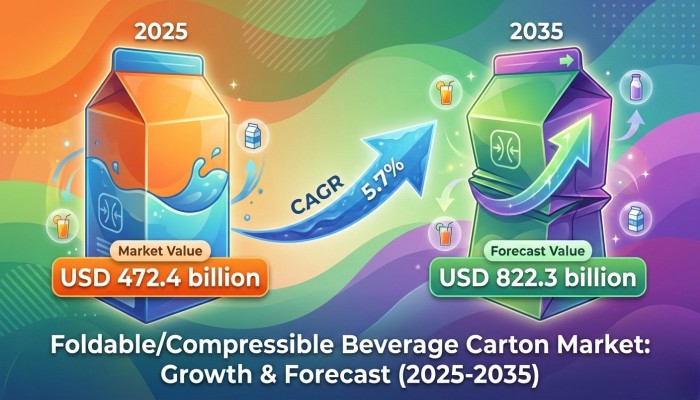
The foldable/compressible beverage carton market is estimated to be valued at USD 472.4 billion in 2025 and is projected to reach USD 822.3 billion by 2035. This robust expansion represents a compound annual growth rate (CAGR) of 5.7% over the forecast period. Growth is expected to remain steady throughout the decade, supported by rising packaged beverage consumption, regulatory support for eco-friendly packaging, and continuous innovation in carton materials and design.
North America, Europe, and Asia-Pacific are anticipated to remain the key growth regions, with Asia-Pacific leading in volume expansion due to population growth, urbanization, and rising disposable incomes.
Market Overview
Foldable and compressible beverage cartons have become widely recognized for their versatility and functional advantages. They are used extensively across dairy products, juices, energy drinks, soups, and other liquid food categories. Compared to rigid packaging formats like glass bottles or plastic containers, these cartons generate less waste, require less storage space, and are easier to transport.
Rising household incomes and expanding retail distribution networks have increased the consumption of packaged beverages, particularly in emerging economies. Additionally, these cartons align well with sustainability initiatives, as they are recyclable and often made from renewable raw materials. However, fluctuations in raw material availability and pricing may pose challenges to market stability in certain regions.
Growth Drivers
Several factors are fueling the growth of the foldable/compressible beverage carton market. A major driver is the increasing demand for sustainable packaging solutions as both consumers and regulators push back against single-use plastics. Beverage manufacturers are actively seeking packaging that supports recyclability, reduces environmental impact, and enhances supply chain efficiency.
Technological advancements have also played a crucial role. Innovations in multilayer paperboard structures and advanced barrier coatings have improved shelf life and product safety, making cartons suitable even for sensitive and perishable beverages. Moreover, foldable designs reduce logistics costs by improving pallet efficiency and lowering fuel consumption during transportation.
Demand Dynamics
Demand for foldable/compressible beverage cartons is closely linked to lifestyle changes and consumption habits. Busy urban consumers increasingly prefer ready-to-drink and portion-controlled beverages, which are well-suited to carton packaging. The 500–1000 ml capacity segment, accounting for 34.2% of market revenue in 2025, reflects this preference for convenient, single-serve or small family-size formats.
Dairy products represent the largest application segment, holding 38.1% of the market share in 2025. Milk, flavored dairy drinks, and yogurt beverages benefit significantly from carton packaging due to its superior protection against light and oxygen, helping preserve freshness and nutritional value.
Key Trends Shaping the Market
One of the most prominent trends in the foldable/compressible beverage carton market is the growing dominance of paper and paperboard as raw materials. This segment is expected to account for 32.6% of market revenue in 2025, driven by its biodegradability, recyclability, and compatibility with renewable sourcing.
Another key trend is lightweighting and material optimization. Manufacturers are investing in research to reduce material usage while maintaining strength and barrier performance. Digital printing and enhanced design customization are also gaining momentum, enabling brands to improve shelf appeal and communicate sustainability credentials more effectively.
Regionally, Asia-Pacific is emerging as the fastest-growing market, with China and India recording CAGRs of 7.7% and 7.1% respectively. Expanding middle-class populations, rapid urbanization, and growing demand for packaged beverages are central to this momentum.
Competitive Landscape
The foldable/compressible beverage carton market is moderately consolidated, with several global and regional players competing on innovation, sustainability, and production efficiency. Leading companies include Tetra Pack Group, Stora Enso AB, WestRock, Visy Industries, ELOPAK, Ingersoll Paper Box, SIG Holding AG, and TigerPress. These players are actively investing in advanced manufacturing technologies, renewable materials, and strategic partnerships to strengthen their market positions.
Competition is increasingly centered on developing high-performance cartons that balance sustainability with cost efficiency and functionality. Companies that can deliver recyclable, lightweight, and high-barrier solutions at scale are expected to gain a competitive edge over the coming decade.
Why FMI: https://www.futuremarketinsights.com/why-fmi
About Future Market Insights (FMI)
Future Market Insights, Inc. (FMI) is an ESOMAR-certified, ISO 9001:2015 market research and consulting organization, trusted by Fortune 500 clients and global enterprises. With operations in the U.S., UK, India, and Dubai, FMI provides data-backed insights and strategic intelligence across 30+ industries and 1200 markets worldwide.
Contact Us:
Future Market Insights Inc.
Christiana Corporate, 200 Continental Drive,
Suite 401, Newark, Delaware – 19713, USA
T: +1-347-918-3531
For Sales Enquiries: sales@futuremarketinsights.com
Website: https://www.futuremarketinsights.com
LinkedIn| Twitter| Blogs | YouTube




