

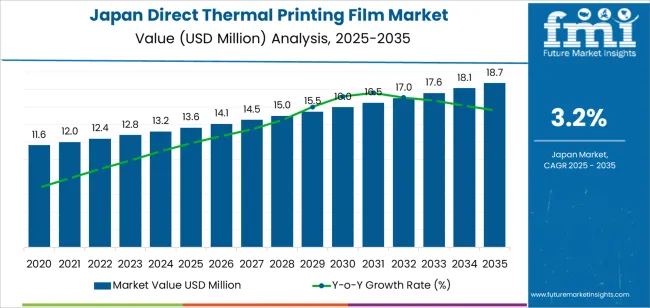
The direct thermal printing film market in Japan is poised for steady expansion over the coming decade, driven by rising demand across retail, logistics, healthcare, and industrial sectors. As Japan’s economy continues modernizing and e-commerce strengthens its foothold, innovative material technologies and expanding footprints by both established and new manufacturers are reshaping the landscape of thermal film solutions.
Direct thermal printing film — a substrate that enables high-quality printing without the need for ink, ribbon or toner — is finding broader adoption due to its cost-efficient, low-maintenance operation and compatibility with automated labeling systems. Traditionally a staple for price tags, shipping labels, and receipts, these films are now gaining ground in sophisticated applications such as traceability labeling, flexible packaging, and automated supply chain systems.
Market Outlook: Stable Growth Fueled by Multi-Sector Demand
Industry analysts project sustained growth for direct thermal printing film in Japan through 2035. The market is expected to benefit from the nation’s advanced retail infrastructure, which heavily relies on barcode and point-of-sale systems, as well as the expanding logistics network tied to e-commerce and last-mile delivery services. With businesses increasingly prioritizing operational efficiency and sustainability, demand for high-performance thermal films is accelerating. This expanding demand presents ample opportunity for firms across the spectrum — from seasoned industry leaders to innovative new entrants — to scale operations and introduce cutting-edge solutions.
Established Players Reinforcing Leadership with Innovation
Several well-known manufacturers have maintained strong positions in the Japanese direct thermal printing film arena. These companies combine deep experience in material science and global distribution networks with continuous investments in product development.
-
UPM Raflatac, Inc. continues to hold a substantial market presence, leveraging its global portfolio of label materials and strong partnerships with converters and printing specialists.
-
Ricoh Company, Ltd. integrates advanced coating technologies that enhance durability and print clarity — traits increasingly demanded by enterprise and industrial users.
-
Diversified Labeling Solutions, Inc., McCourt Label Company, and Stylerite Label Corporation remain significant contributors, offering custom film types and service models tailored to regional needs.
These established firms are not just maintaining their existing market share — they’re actively innovating, expanding product lines and refining thermal film technologies to meet evolving user expectations for performance and environmental sustainability.
Emerging Manufacturers and New Technologies Driving Market Dynamism
Beyond the traditional market leaders, a range of emerging manufacturers and specialty film producers are injecting fresh competition and technological diversity into the sector. These companies are exploring innovative material formulations and disruptive business strategies that appeal to new segments:
-
Some rising players are pioneering biodegradable and sustainable film substrates, addressing growing corporate commitments to reduce plastic waste and carbon footprints.
-
Others are developing high-strength, scratch-resistant thermal films designed for demanding industrial environments where print durability and resistance to moisture and abrasion are critical.
-
A wave of technology-focused entrants is leveraging digital manufacturing and AI-enhanced quality control systems to shorten production cycles, reduce defect rates, and customize film properties for niche applications.
This infusion of fresh energy into the marketplace not only enhances competition but also accelerates overall technological progress. By offering differentiated film coatings or targeting specialty applications — such as temperature-sensitive logistics labels or advanced food packaging — newer manufacturers are carving niche opportunities while contributing to broader industry innovation.
Technology Trends: Performance and Sustainability in Focus
A key trend driving both incumbent and new manufacturers is the focus on improved printing performance and sustainability. Advances in top-coated polypropylene and polyester films now deliver greater resistance to environmental stresses while enabling sharper image quality — features increasingly important for logistics, healthcare, and retail sectors that demand reliable barcode readability and long-lasting information retention.
Alongside performance enhancements, there is growing emphasis on environmental sustainability. Manufacturers are developing recyclable and plant-based substrates that offer comparable technical properties to traditional films but with reduced environmental impact. These innovations align with corporate sustainability goals and emerging regulatory expectations around packaging waste.
Business Expansion and Market Opportunity
As demand for direct thermal printing film broadens across industry verticals, both established manufacturers and new entrants are strategically expanding their footprints. Investments in local production capacity, enhanced distribution partnerships, and tailored customer service offerings are becoming common. Companies are positioning to not only serve traditional retail and logistics demand but also penetrate emerging applications such as smart packaging, connected supply chains, and on-demand printing services.
This dynamic environment presents a compelling landscape for strategic collaboration, joint ventures, and technology alliances. Firms that can combine innovative material science with efficient production and responsive customer engagement are well-placed to capitalize on the market’s expansion.
Looking Ahead
With steady demand growth projected over the next decade, Japan’s direct thermal printing film market offers strong opportunities for manufacturers of all sizes. By embracing technological innovation, sustainability, and customer-centric business models, both established leaders and newer market players are contributing to a more efficient, adaptable, and forward-looking printing ecosystem.




