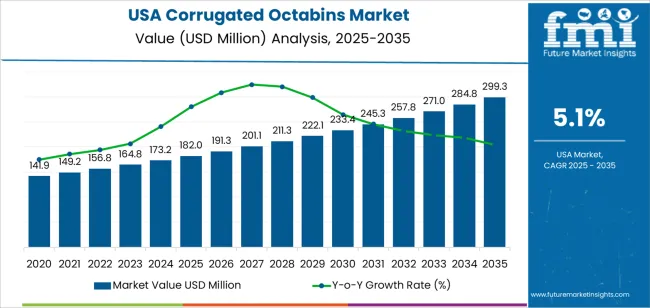
The U.S. corrugated octabins market is entering a period of sustained expansion, driven by rising demand from diverse industries such as food & beverage, pharmaceuticals, and logistics. With a projected value growth from approximately $182 million in 2025 to over $300 million by 2035, this resilient packaging segment presents exciting opportunities for both established industry leaders and innovative new manufacturers seeking to scale their operations and adopt next-generation technologies.
Corrugated octabins — large, octagonal fiberboard containers designed for bulk storage and transportation — are increasingly replacing traditional packaging formats like wooden crates and plastic bins across the American supply chain. Their appeal lies not just in strength and versatility, but also in efficiency and environmental friendliness. By combining high load capacity with ease of handling and recyclability, these containers have become essential tools for companies aiming to streamline logistics while meeting growing sustainability expectations.
Market Momentum: Why Corrugated Octabins Are on the Rise
The corrugated octabins market reflects changing priorities in the American economy. E-commerce growth and expanding retail distribution channels have heightened the need for packaging solutions capable of handling large volumes with minimal damage and cost. This is especially true for industries reliant on bulk materials — from food ingredients to industrial components — where traditional boxes fall short in capacity and performance.
One key trend driving market adoption is the emphasis on eco-friendly practices. As businesses respond to regulatory pressures and consumer demand for greener solutions, corrugated octabins — made primarily from recyclable cardboard — are increasingly the packaging format of choice. Their ability to be reused, collapsed for storage, and reintegrated into recycling streams provides a compelling sustainability edge over heavier, less adaptable alternatives.
Product and Segment Trends
In the U.S. market, single-wall corrugated octabins have emerged as the dominant format, capturing a significant share due to their balance of strength, lightweight design, and cost efficiency. These models are especially favored where durability needs are high but heavy-duty multi-wall construction isn’t required.
Meanwhile, standard corrugated octabins remain the most widely used product type overall, thanks to their adaptability in applications ranging from food and beverage storage to chemical handling. Their simple yet robust design supports a wide array of packing needs — making them a go-to solution for companies that value reliability without excessive complexity.
Beyond traditional designs, manufacturers are introducing discharge, self-assembly, telescopic, and free-flow base variants — each offering unique advantages in ease of assembly, access to contents, and integration with automated systems. These innovations help businesses tailor packaging to specific products and workflows, boosting operational efficiency on the warehouse floor and in transit.
Technological Advancements Fuel New Opportunities
Technology is rapidly reshaping how corrugated octabins are designed and deployed. Forward-thinking manufacturers are integrating new materials and features to enhance performance under diverse conditions. For example, moisture-resistant coatings extend durability in humid environments, while integrated pallet bases and handles simplify material handling. Some companies are even incorporating RFID tracking to support smarter inventory control — a major advantage for logistics-intensive sectors.
These advancements are opening doors for new market entrants and seasoned producers alike. Startups with innovative structural designs or sustainable material solutions find plenty of space to differentiate themselves. At the same time, established players are expanding their portfolios to include smart packaging features that align with modern supply chain requirements.
Regional Growth and Sector Demand
Across the United States, demand for corrugated octabins is growing consistently. The West leads with the fastest growth rate, propelled by its robust agricultural, food processing, and export activities — all of which benefit from efficient bulk packaging solutions. The South follows closely, driven by thriving manufacturing and logistics hubs. Meanwhile, the Northeast and Midwest continue to show solid uptake as industries in these regions modernize operations and focus on high-performance packaging strategies.
Notably, the food and beverage sector stands out as a major end-user, accounting for more than half of octabin demand. Businesses operating in this space rely on bulk packaging that ensures product safety, meets stringent hygiene standards, and supports sustainable supply practices. Pharmaceuticals and construction industries also contribute to the sector’s diverse demand profile.
A Competitive Landscape Ripe with Possibility
The U.S. corrugated octabins market showcases a mix of global leaders and agile innovators. Well-established firms have significant presence and distribution reach, serving a broad range of industrial customers. Their ongoing investments in product quality and sustainable practices help set industry benchmarks.
At the same time, emerging manufacturers eager to carve out a niche are bringing fresh ideas to the table. Whether focused on advanced material science, tailored customization, or digital integration with warehouse systems, these new players are energizing the competitive landscape — and expanding the market’s collective potential.
Looking Ahead
With projected sustained growth through 2035, the corrugated octabins market represents a dynamic intersection of traditional packaging needs and modern technological innovation. As demand continues to rise alongside broader trends in sustainability and supply chain optimization, both established brands and forward-looking newcomers are well positioned to thrive — delivering solutions that balance performance, cost efficiency, and environmental stewardship.
About the Market: The United States corrugated octabins market is projected to grow at a steady pace over the next decade, driven by expanding e-commerce activity, regulatory focus on packaging waste reduction, and increasing adoption of high-capacity, reusable container formats. Its evolution underscores broader shifts in how businesses manage bulk goods in an era of heightened logistical demands and sustainability priorities.