

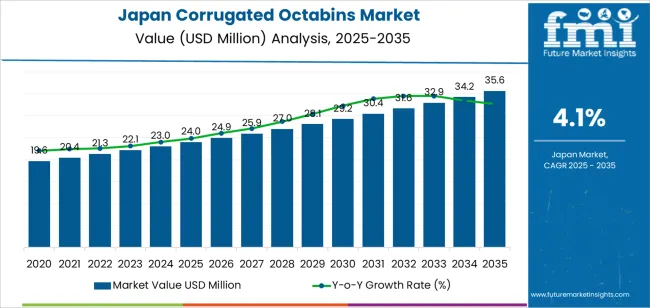
The Japan corrugated octabins market is on the brink of notable growth and transformation as both established producers and emerging innovators step up efforts to expand their footprint and introduce new technologies. With escalating demand across industries such as food and beverage, pharmaceuticals, chemicals, and construction materials, corrugated octabins are gaining prominence as a versatile, sustainable, and cost-effective bulk packaging solution.
Corrugated octabins are uniquely positioned to meet the evolving needs of modern supply chains. Designed to transport and store powders, granules, and semi-bulk materials, these eight-sided containers offer exceptional strength, improved pallet compatibility, and lighter operational costs compared to traditional rigid intermediate bulk containers. Manufacturers and logistics providers are increasingly turning to these solutions to enhance efficiency across domestic and export shipments, particularly in regions with dense industrial activity.
Market Growth Backed by Rising Adoption Across Key Industries
The market’s upward trajectory is driven by several converging factors. Japan’s food and beverage sector remains the largest consumer of corrugated octabins, with bulk ingredients, additives, and grains being routinely packaged for transportation and storage. At the same time, pharmaceutical companies are embracing these containers for their hygienic properties and reliability in handling sensitive materials. Building and construction industries, too, see growing octabin use for dry mixes and aggregates that require secure, efficient containment.
Domestic manufacturers recognize the strategic advantages offered by corrugated octabins. Lightweight yet robust, these containers align with Japan’s focus on sustainability and lean logistics, helping companies reduce shipping weight, optimize warehouse space, and minimize handling time. The recyclability of corrugated materials further amplifies appeal amid tightening environmental goals and regulatory pressures on packaging waste.
Regional Demand Reflects Diverse Industrial Landscapes
Across Japan, regional demand patterns vividly illustrate how diverse industry clusters are shaping the market. Industrial and agricultural hubs in Kyushu & Okinawa are experiencing particularly strong uptake, driven by agricultural cooperatives and chemical producers seeking reliable packaging for both domestic distribution and export. Dense manufacturing zones such as the Kanto region, encompassing Tokyo and neighboring prefectures, benefit from robust logistics networks where stackable corrugated octabins improve warehouse operations and product handling workflows.
In Kinki, Chubu, and Tohoku, steady industrial activity—from automotive supply chains to electronics manufacturing—is reinforcing steady demand. Even in smaller production centers throughout the rest of Japan, local manufacturers and food processors are integrating corrugated solutions into their packaging inventories to boost operational resilience and support evolving supply-chain practices.
Established Leaders and Emerging Players Drive Innovation
The competitive landscape is dynamic, with both legacy companies and newer entrants contributing to market momentum. Established global packaging leaders are leveraging decades of expertise to refine product designs, enhance performance characteristics, and strengthen relationships with Japanese industrial buyers. These firms are continually adapting offerings to meet localized needs—whether through advanced moisture-resistant coatings, reinforced board structures for heavy loads, or designs compatible with automated filling systems.
Alongside these well-known players, innovative manufacturers—particularly regional and niche producers—are making inroads by focusing on customization and technology integration. These companies are introducing solutions such as self-assembly octabins that reduce storage volume, free-flow base designs that aid controlled discharge, and telescopic formats that offer adjustable containment based on product dimensions. Their agility and willingness to tailor products to specific end-use scenarios are fostering fresh competition and expanding the palette of available options for buyers.
Technology Trends Transforming Bulk Packaging
Technological advancement remains a cornerstone of the market’s evolution. Enhanced materials engineering is enabling corrugated octabins to deliver higher compression strength and better resistance to environmental stressors without significantly increasing weight. This has particular relevance for industries handling delicate powders or long-distance exports, where packaging integrity is paramount.
Automation compatibility is another key trend: manufacturers are designing octabins that seamlessly integrate with high-speed filling and palletizing lines. This shift not only improves throughput but also supports the broader movement toward Industry 4.0 practices within Japanese manufacturing ecosystems.
Environmental considerations continue to drive product development as well. With an increasing focus on circular economy principles, manufacturers are enhancing recyclability, reducing reliance on non-renewable inputs, and creating designs that facilitate easier breakdown, reuse, or repurposing at the end of service life.
Looking Ahead: Expanding Opportunities and Market Potential
As the Japan corrugated octabins market scales through the decade ahead, stakeholders across the value chain are poised to benefit from growth opportunities. Demand is expected to broaden not only in traditional industries but also across emerging sectors that value efficient, sustainable packaging. The convergence of regional demand strength, technological innovation, and competitive dynamism suggests a robust future for both established leaders and ambitious new players ready to expand their businesses in this evolving market.
With continuous adaptation and investment in next-generation solutions, the corrugated octabins space in Japan is prepared to deliver greater value, efficiency, and environmental performance to manufacturers and supply chain operators alike.




