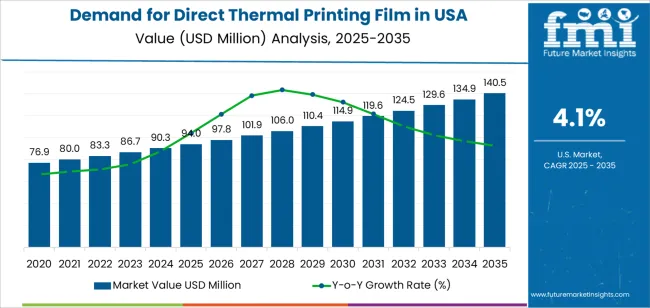
As demand surges for efficient, ink-free labeling solutions, established industry leaders along with innovative new manufacturers are stepping up — leveraging new technologies and expanded capacity to meet growing demand in the U.S. and beyond. According to a recent market forecast, the U.S. direct thermal printing film market is set to rise from USD 94.0 million in 2025 to an estimated USD 140.3 million by 2035, at a steady CAGR of 4.1%.
Market Growth Driven by Retail, Logistics, Healthcare
The rising popularity of direct thermal printing film is rooted in its core strengths: cost-effectiveness, speed, and simplicity. Ideal for printing shipping labels, barcode tags, product labels, and POS receipts, these films are increasingly adopted across retail, e-commerce, logistics, warehousing, and healthcare industries where rapid, high-volume printing is essential. As businesses strive for streamlined operations and reduced maintenance, ink-free, ribbon-free thermal printing is becoming a go-to solution.
The shift toward automation, supply-chain tracking, and demand for flexible, on-demand labeling has further propelled adoption. In sectors like food packaging, pharmaceuticals, and cold-chain logistics, the ability to print sharp, durable labels without additional consumables has become a distinct competitive advantage.
Materials & Specifications: Polypropylene Dominates, Balanced Film Thickness Matters
Material-wise, polypropylene (PP) holds a commanding share of demand, capturing roughly 74% of the market. Its strong printability, moisture and chemical resistance, and durability make it a preferred choice for a wide range of applications — from retail labels to industrial shipping tags.
Thickness also plays a key role. Films in the 76–100 micron range remain the most popular, offering a balanced mix of flexibility, durability, and reliable print quality — critical for labels that must survive handling, transport, and variable storage conditions without degrading or tearing.
Established Names and Their Expanding Footprint
Legacy manufacturers are leveraging their deep portfolios and global infrastructure to reinforce their leadership in this expanding market. Firms with proven track records are broadening product lines, integrating improved coatings, and offering linerless solutions designed for high-speed, high-volume production lines. Their focus remains on durability, print clarity, and scalability — attributes that meet the growing needs of large-scale retail, logistics, and packaging players.
These companies are investing in robust supply chains, material consistency, and compliance-ready products that satisfy regulatory and environmental requirements, thereby reinforcing confidence among large buyers in food, healthcare, and industrial packaging segments.
New(er) Manufacturers & Specialty Producers Accelerate Innovation
At the same time, smaller and newer manufacturers — including specialty film producers — are gaining ground by introducing advanced material formulations and targeted solutions. These firms often focus on niche needs: customized thermal films for specific industrial or regional requirements, coatings designed for enhanced print longevity, or tailored products aimed at emerging sectors such as e-commerce fulfillment, cold-chain logistics, and medical labeling.
By focusing on agility and innovation, these new entrants are addressing gaps left by larger players — such as flexible packaging demands, small-batch runs, or quick turnaround requirements — and are positioned to grow as demand diversifies.
Technology Advancements Open New Opportunities
The evolution of direct thermal printing film technology continues to reshape the competitive landscape. Innovations in coating chemistries, material substrates, and integration with automated printing systems are enabling films that offer sharper images, better resistance to humidity and abrasion, and improved shelf life of printed material. Some new lines feature enhanced thermal sensitivity and improved image stability — crucial for barcodes, shipping labels, and variable data printing in sectors like logistics and healthcare.
These advances lower the barrier for manufacturers to enter the market: film producers no longer need extensive legacy infrastructure to compete. Instead, by focusing on advanced materials and niche applications, newer firms can carve out meaningful market share and attract clients looking for flexibility, customization, and modern technology.
A Growing Market — and Growing Opportunity
With U.S. demand projected to rise steadily over the next decade, the direct thermal printing film market represents a compelling opportunity for both established players and agile newcomers. As industries increasingly demand fast, reliable, and cost-efficient labeling solutions — whether for retail products, shipping, or healthcare — the adoption of thermal printing film is poised to accelerate.
The stage is set for a dynamic shift: large manufacturers expanding capacity and product range, smaller producers innovating to meet niche demands, and technology driving fresh momentum in quality, sustainability, and adaptability.
Manufacturers and stakeholders looking to capitalize on this trend should consider not just production scale — but also flexibility, technological innovation, and the ability to meet evolving industry needs.