

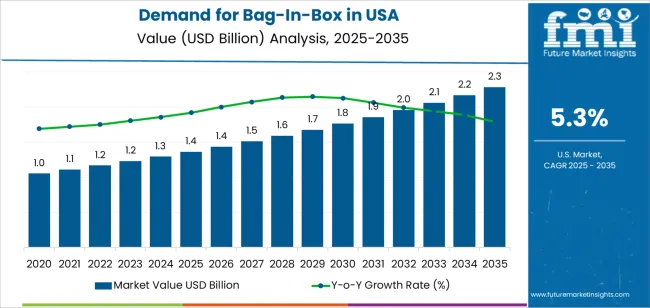
As the US market for bag-in-box (BIB) packaging charts a strong growth trajectory, industry veterans and up-and-coming players alike are positioning themselves to ride the wave — bringing new technologies, expanded capacities and fresh innovation to meet a rising demand. According to a recent market outlook, the US BIB segment is projected to grow from US$ 1.4 billion in 2025 to US$ 2.3 billion by 2035.
At the heart of this growth lies a shift in how beverages, liquid food products, household liquids, and industrial fluids are packaged, transported and dispensed. The traditional heavy containers are increasingly giving way to lightweight, flexible-bag-in-carton solutions that offer cost-efficiency, hygiene, convenience, and sustainability.
Established Leaders Reinforce Their Stronghold
Several long-standing packaging powerhouses remain central to this transformation, leveraging their scale, deep experience, and proven technologies. Firms such as Smurfit Kappa, DS Smith, Liquibox, Scholle IPN and Mondi are prominently featured among the market’s “top players.” Their offerings span flexible bags, multi-layer barrier bags, aseptic/sterile-lined bags, pre-formed industrial liners and specialty formats tailored for specific end-uses.
These established players are not standing still; many are ramping up investments to improve barrier films that prevent oxygen and light ingress, extending the shelf-life of sensitive liquids like wine, juices, dairy alternatives, sauces or syrups. Enhanced inner-liner durability and advanced dispensing valves are being rolled out, addressing long-standing issues of spoilage, leakage, and spillage.
Moreover, these companies are strengthening their supply-chain responsiveness by expanding regional production capabilities — thus cutting lead-times and enabling efficient delivery to beverage producers, foodservice operators, and industrial liquid manufacturers across various US regions.
New and Niche Manufacturers Gear Up to Expand
Alongside the established giants, a fresh wave of new or smaller manufacturers and converters is emerging — aiming to carve out niches by offering customized, flexible, and sustainable packaging solutions to smaller brands, craft beverage producers, and specialty liquid manufacturers.
Such newcomers are tapping into demand from rising segments: craft wines, cold-brew coffees, dairy-free beverages, condiments and sauces, cleaning solutions, and bulk industrial liquids. Unlike legacy players, these agile firms offer bespoke packaging capacities (often 1–10 litres), customized film specifications, and compatibility with various filling systems — including semi-automated or compact filling lines.
These newer entrants are also embracing sustainability more aggressively. Many are testing recyclable-film structures, lighter bag constructions, and lower-impact outer cartons. This makes them especially attractive to environmentally conscious brands, smaller producers, or direct-to-consumer e-commerce players who prioritize low waste, easy storage, and efficient transport.
Innovation and Technology Drive the Next Phase
A key driver of this growth is ongoing innovation in packaging technology. High-barrier films that protect oxygen-sensitive contents and improved flexible bag materials are enabling BIB usage in a wider variety of products — from wines, juices and cold-brews to dairy-alternatives, sauces, industrial fluids, and cleaning agents.
Dispensing technology is also moving forward: refined taps and fitments now allow smoother pouring, reduced leaks and user-friendly operation — critical in wine-on-tap programs, beverage-dispensing machines, and bulk-dispensing foodservice lines.
Meanwhile, enhanced fill-line automation, leak-resistant design, and compatibility with long-distance transport make BIB packaging an increasingly attractive alternative even for large-scale producers and institutional users. For small brands and niche producers, simpler filling systems are becoming more accessible — lowering the barrier to entry for flexible-packaging adoption.
Growing Adoption Across Diverse Applications
While beverages remain the core — accounting for roughly 40% of BIB demand in the US — the use of bag-in-box packaging is expanding across many other applications. Liquid foods, dairy alternatives, sauces, syrups, oils, cleaning solutions, and even certain industrial fluids are increasingly being packed in BIB formats.
Flexible bags (as opposed to rigid containers) now capture about 60% of the product-type share, reflecting broad industry preference for lighter, adaptable, and cost-efficient formats. The benefits are clear: reduced shipping weight, lower storage footprint, easier handling, extended shelf life, and improved environmental metrics.
In foodservice, restaurants, cafeterias, institutional kitchens and contract manufacturers are shifting toward bulk dispensing systems — drawn by convenience, efficiency, and reduced waste. On the retail and e-commerce front, BIB packaging offers improved durability in transit and convenience for end-users.
A Sustainable, Scalable Future
As consumer expectations evolve — toward convenience, freshness, sustainability and efficient transport — BIB packaging is emerging as a preferred solution. The combined forces of established industry players scaling up capabilities and new entrants offering flexible, sustainable, and niche-specific solutions are set to accelerate growth.
For large beverage producers, food-service companies or industrial liquid manufacturers — as well as smaller craft or niche brands — the expanding BIB market presents real opportunities. Whether investing in advanced barrier films, customized bag-in-box formats, automated or compact filling lines, or eco-friendly materials, stakeholders across the value chain are aligning around a common goal: deliver high-quality liquid products efficiently, sustainably and conveniently.
As US demand steadily climbs toward the projected US$ 2.3 billion by 2035, the next decade could well mark the mainstreaming of bag-in-box as the go-to packaging solution for a wide range of liquid products.




