

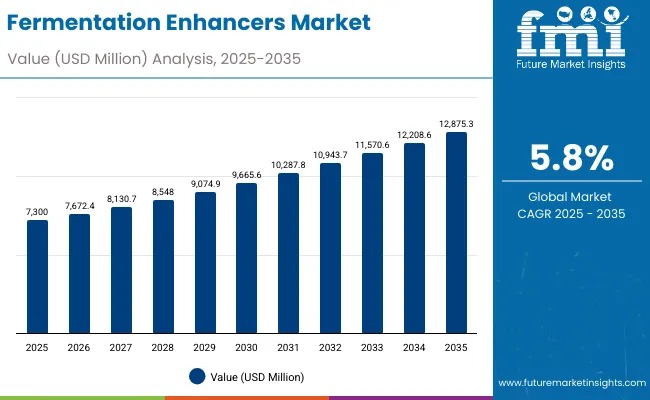
The global fermentation enhancers market is set to grow from USD 7,300.0 million in 2025 to USD 12,875.3 million by 2035, marking an absolute increase of USD 5,575.3 million and a steady CAGR of 5.8%. The rapid expansion is fueled by biotechnology modernization across pharmaceuticals, food production, and industrial manufacturing—sectors where fermentation performance directly impacts yield consistency and cost efficiency.
Between 2025 and 2030, the market is projected to reach USD 9,670 million, accounting for 42.4% of the decade’s growth, driven by the shift from conventional fermentation to advanced enhancement platforms. From 2030 to 2035, accelerated adoption of enzyme-based systems and automated control technologies will contribute the remaining 57.6% of expansion, solidifying fermentation enhancers as a cornerstone of precision bioprocessing.
Explore trends before investing – request a sample report today! https://www.futuremarketinsights.com/reports/sample/rep-gb-28556
Rising Demand for Precision Fermentation Drives Market Momentum
Producers in pharmaceutical manufacturing, food & beverage processing, and industrial biotechnology are increasingly relying on fermentation enhancers to ensure productivity and quality. Even a 1% improvement in fermentation efficiency can improve overall yield by up to 15%, illustrating the substantial financial upside.
The modernization of global biotechnology ecosystems—ranging from monoclonal antibody production to bioethanol processing—demands controlled, nutrient-optimized, and enzyme-regulated fermentation conditions. This transition is replacing basic nutrient systems with high-performance enzyme formulations capable of regulating metabolic pathways in real time.
Key Market Highlights (2025–2035)
- Market Value 2025: USD 7,300.0 million
- Market Forecast 2035: USD 12,875.3 million
- CAGR: 5.8%
- Leading Product Type: Enzyme-based enhancers (28% market share)
- Top Applications: Food & beverage fermentation (35%)
- Fastest-Growing Regions: South Asia & Pacific, Europe, North America
- Key Players: Novonesis (Novozymes), DSM-Firmenich, Lallemand, Chr. Hansen, Kerry Group
Technology Transformation Accelerates Market Adoption
Precision fermentation is now fundamental to biologics manufacturing, advanced vaccine production, and therapeutic protein synthesis. Regulatory frameworks in pharmaceutical markets have heightened the need for consistent processing parameters—conditions achievable only through high-efficiency enhancers.
Enzyme-based enhancers have emerged as the industry’s preferred solution, supported by:
- Advanced catalytic optimization
- Controlled release mechanisms
- Integrated pH, oxygen, and nutrient regulation
- Compatibility with automated bioreactor systems
This product segment alone accounts for 28% share, reflecting its superior performance in complex fermentation environments.
Segment Snapshot: What’s Driving the Market Structure
By Product Type
- Enzyme-based enhancers – 28% share (2025)
Efficiency-focused, used across pharmaceuticals and industrial fermentation. - Yeast nutrients – 20% share
Essential in food processing, dairy fermentation, and bioethanol production. - Microbial growth promoters – 16% share
Supporting rapid biomass generation in biotech and agriculture.
By Source
- Synthetic solutions dominate with 58% share, supported by standardized performance and cost efficiencies.
- Natural/biobased enhancers hold 42%, gaining traction due to clean-label and sustainability preference in food and biopharma markets.
Why the Fermentation Enhancers Market Is Growing
Three demand factors fuel the scaling trajectory:
- Pharmaceutical and biotech modernization
Performance gains of 15–25% annually are reported in facilities adopting enzyme-based systems. - Government-backed biotechnology expansion
Countries in Asia-Pacific, Europe, and North America are investing heavily in next-generation fermentation infrastructure. - Technological breakthroughs in enzyme engineering
Automation, intelligent monitoring, and nutrient-precision tools are reducing operational costs and batch inconsistencies.
Constraints remain—particularly integration complexity and compliance expenditures in developing markets—but technological advantages continue to outweigh the barriers.
Regional & Country-Level Insights
- India leads globally with a CAGR of 6.9%, driven by biotechnology investments and pharma infrastructure expansion.
- USA follows at 6.3%, supported by biologics manufacturing hubs in Boston, San Francisco, and RTP.
- Europe records strong momentum, led by Germany (20% regional share), the UK, France, and Italy.
- China maintains steady 5.1% growth, expanding domestic biotech capacity.
- Brazil grows at 1.8%, supported by agricultural fermentation and food processing modernization.
Competitive Landscape
The market is moderately concentrated, with the top five players controlling 45–50% of global share.
Novonesis (Novozymes) leads with 15% market share, strengthened by its enzyme innovation pipeline. DSM-Firmenich, Lallemand, Chr. Hansen, and Kerry Group continue expanding bioprocessing solutions through strategic partnerships and next-generation fermentation technologies.
Emerging regional players in India and China are adding competitive pressure with cost-efficient enhancement systems tailored for fast-growing biotechnology markets.
About the Market
With demand projected to reach USD 12.87 billion by 2035, fermentation enhancers are becoming indispensable to sectors where process precision defines competitiveness. Their ability to deliver 40–60% performance improvement over conventional inputs makes them vital across food & beverage, industrial fermentation, and biopharmaceutical applications.




