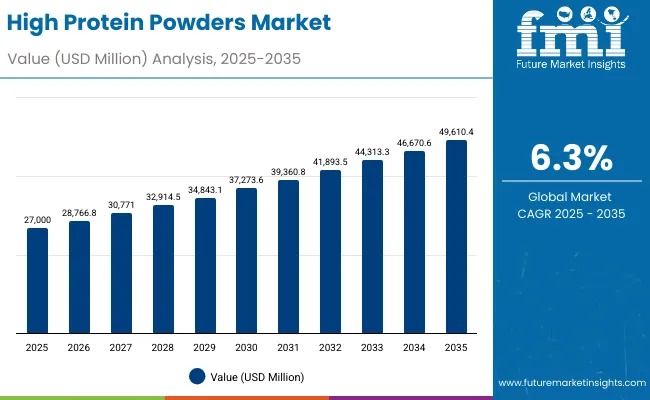
The global high protein powders market is projected to grow from USD 27 billion in 2025 to USD 49.6 billion by 2035, expanding at a 6.3% CAGR, fueled by rising fitness participation, modernization of wellness infrastructure, and wider integration of clinical and sports nutrition systems across key markets.
North America continues to lead the global landscape, while South Asia & Pacific emerges as the fastest-growing region. Strong adoption in the USA, India, China, France, and Germany reflects a structural shift toward performance-based nutrition supported by technology-enabled formulation systems.
Explore trends before investing – request a sample report today! https://www.futuremarketinsights.com/reports/sample/rep-gb-28558
Market Momentum Strengthened by Diversified Fitness and Wellness Demand
As consumers worldwide transition toward performance-oriented lifestyles, protein powders have become a critical nutritional asset in gyms, sports academies, clinical programs, and weight-management applications. Advanced formulations—such as isolates and hydrolysates—are increasingly preferred for their purity, enhanced absorption, and compatibility with high-intensity training.
Key 2025–2035 market indicators include:
- Market Value 2025: USD 27 billion
- Forecast Value 2035: USD 49.6 billion
- CAGR: 6.3%
- Leading Source: Animal-based proteins (55% share)
- Highest-Growth Region: South Asia & Pacific
- Top Players: Glanbia Performance Nutrition, Abbott, MuscleTech, Myprotein, Nutrabolt, Optimum Nutrition, Quest Nutrition, NOW Foods, Body Fortress
Technological advances in amino acid profiling, processing efficiency, and flavor engineering continue to drive consumer trust and repeat adoption.
Animal-Based Proteins Lead, but Plant-Based Adoption Accelerates
Animal-based proteins—including whey, casein, and egg protein—retain 55% of global market share due to strong bioavailability and compatibility with diverse training programs. However, plant-based alternatives are scaling rapidly, especially in markets prioritizing clean-label nutrition, allergen-free formulations, and sustainability.
Key advantages driving animal-based dominance:
- Complete amino acid profiles
- Higher absorption efficiency
- Strong acceptance in sports and clinical settings
Plant-based proteins hold 38% share, gaining relevance in India, China, the UK, and Western Europe as dietary diversification accelerates. Blended protein systems represent the remaining 7%, serving niche and performance-specific applications.
Isolate Formulations Dominate the Global Market
Protein isolates accounted for 40% of global demand in 2025, reflecting their purity and rapid uptake in advanced sports nutrition. Concentrates followed with 35%, supported by mainstream affordability and balanced nutritional profiles, while hydrolysates (15%) and blends (10%) address specialized training needs.
Market growth is driven by:
- Rising emphasis on purity and absorption
- Mainstream fitness expansion
- Improved processing technologies enabling premium-quality formulations
Regional Insights: India, USA, France, and China Set the Pace
South Asia & Pacific – Fastest Growing Region
India leads globally with a 6.6% CAGR, driven by rapid urban fitness expansion, sports development programs, and increased willingness to invest in premium protein solutions.
USA – Mature Market with Steady Momentum
The USA grows at 6.4% CAGR, supported by extensive fitness ecosystems, clinical nutrition programs, and strong consumer preference for purity-focused protein systems.
Europe – Steady Upgrade Cycle
Germany (5.7% CAGR), France (6.5%), and the UK (5.5%) maintain strong adoption, reinforced by regulated nutritional frameworks and modernization across fitness and wellness platforms.
China – Expanding Performance Nutrition Sector
China’s 6.2% CAGR reflects ongoing fitness modernization, rising disposable incomes, and broader acceptance of specialized clinical and sports nutrition applications.
Key Growth Drivers
Market acceleration is supported by three structural demand pillars:
- Rising performance-based fitness behavior demanding high-quality protein for muscle repair, mass maintenance, and recovery.
- Government-backed wellness initiatives promoting sports participation and nutritional awareness.
- Technological advancements in flavor engineering, plant-based processing, microfiltration, and precision formulation.
However, challenges persist. Allergen management, regulatory compliance, advanced processing costs, and raw material price fluctuations remain constraints for small and emerging manufacturers.
Competitive Landscape: Global Players Strengthen Market Consolidation
The market features 20–25 significant players, with the top three holding 25–35% share. Glanbia Performance Nutrition, Abbott, and MuscleTech continue to dominate through advanced R&D, strong brand portfolios, and broad distribution networks.
Challengers such as Myprotein and Nutrabolt leverage agile digital-first models, while local players in India, China, and Brazil strengthen domestic competitiveness through affordable, customized formulations.
Conclusion
With fitness and wellness ecosystems accelerating worldwide—supported by upgraded infrastructure, evolving dietary behaviors, and rising demand for performance-focused nutrition—the high protein powders market is positioned for sustained expansion through 2035. Companies that invest in precision formulation, clean-label development, and targeted consumer strategies will capture the strongest growth opportunities.