

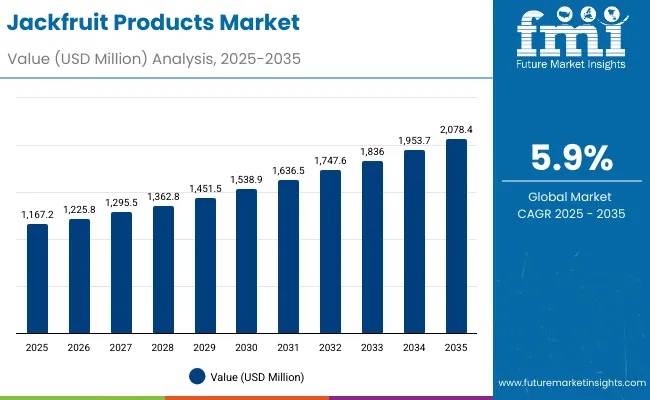
The global jackfruit products market is on a steady upward trajectory, projected to reach USD 2,078.4 million by 2035, driven by rising demand for plant-based proteins, advanced food processing innovations, and expanding consumer preference for clean-label ingredients. The market, currently valued at USD 1,167.2 million in 2025, is set to grow at a CAGR of 5.9% over the forecast period.
Growing applications in functional foods, meat alternatives, and processed food manufacturing are reshaping the jackfruit value chain. As food companies prioritize sustainable ingredients and plant-based formulations, jackfruit has gained unprecedented traction across both retail and industrial segments.
Explore trends before investing – request a sample report today! https://www.futuremarketinsights.com/reports/sample/rep-gb-28559
Strong Product Demand Driven by Clean-Label and Plant-Based Adoption
Jackfruit is increasingly integrated into food processing systems due to its fibrous texture, nutritional value, and versatility in replicating meat-like properties. Manufacturers are leveraging jackfruit for texture enhancement, formulation efficiency, and natural ingredient positioning.
In 2025, fresh jackfruit holds a dominant 22% share, driven by demand from direct consumption channels and culinary applications. The jackfruit meat substitute segment, accounting for 15%, remains pivotal in the expanding plant-based food industry, especially for texture-forward meat replacement systems. Meanwhile, canned jackfruit at 14% is witnessing rapid adoption as manufacturers and retailers seek longer shelf life and convenient formats.
Market Expansion Driven by Food Processing and Retail Growth
Food processing applications remain the backbone of market development, capturing 18% share in 2025. These applications span ready meals, functional foods, and large-scale manufacturing, where jackfruit serves as a high-performing ingredient in plant-based and specialty products. Household and retail segments also account for 18%, reflecting rising consumer awareness of tropical fruit nutrition and availability of new jackfruit-based SKUs.
Key regional growth contributors include Europe, South Asia & Pacific, and East Asia. Germany posts 6.5% CAGR, India leads with 6.6%, and the USA follows at 6.3%, driven by strong meat-alternative innovation ecosystems.
Two-Phase Growth Momentum (2025–2035)
The forecast period reflects two distinct growth stages:
- 2025–2030: Market expands from USD 1,167.2 million to USD 1,538.9 million, adding USD 371.7 million—representing 40.8% of total decade growth. This period is characterized by product innovation, improved preservation systems, and rising adoption in food service networks.
- 2030–2035: The market grows from USD 1,538.9 million to USD 2,078.4 million, contributing 59.2% of total growth. Advanced plant-based formulations, functional dietary solutions, and collaborations between jackfruit processors and food manufacturers dominate this phase.
Why the Jackfruit Market Is Growing
Growth is underpinned by three primary drivers:
- Surge in plant-based protein development, with jackfruit offering texture performance superior to many alternative ingredients.
- Government support for sustainable agriculture and healthy dietary patterns, accelerating adoption across foodservice and manufacturing sectors.
- Advances in processing technologies, including dehydration, modified-atmosphere packaging, and automated handling systems.
However, barriers include supply chain variability, the technical complexity of tropical fruit processing, and compliance requirements for quality-assured manufacturing.
Segmental Outlook
The market is segmented across product type, end use, nature, form, sales channel, and region. Key product categories span fresh, canned, frozen, dried, flour, chips, puree, seeds, and meat substitutes. End uses include food processing, ready meals, snacks, sauces & spreads, plant-based meat alternatives, bakery, household/retail, and foodservice.
Country-Level Insights: India, Germany, USA Lead
- India (6.6% CAGR) dominates due to traditional cultivation strength, government-backed processing initiatives, and strong domestic consumption.
- Germany (6.5%) leads Europe with advanced food manufacturing systems and strong plant-based product innovation.
- USA (6.3%) accelerates adoption, particularly in meat alternatives and health-driven food categories.
Other notable markets include the UK (6%), China (5.7%), France (5.5%), and Brazil (1.5%).
Competitive Landscape: Moderate Concentration, High Innovation
The market features 10–15 established players, with the top three holding 25–35% share. Competition is driven by processing innovation, supply chain reliability, and multi-application product portfolios.
Leading companies include:
- The Jackfruit Company
- Upton’s Naturals
- Nature’s Charm
- Veggie Champ
- Nirvana Foods
These companies are investing in advanced preservation systems, automated processing technologies, and partnerships with food manufacturers to expand their footprint in high-growth categories.
Conclusion
With rising adoption across plant-based foods, functional ingredients, and modern food processing, the jackfruit products market is positioned for strong, sustained growth over the next decade. Companies investing in advanced processing capabilities, clean-label positioning, and diversified jackfruit portfolios are expected to lead future expansion.




