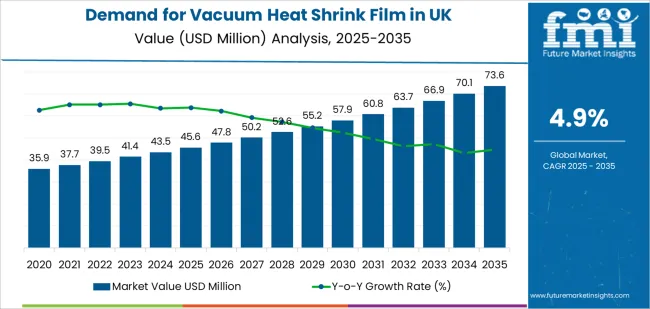
The packaging industry is set to undergo a notable expansion, as demand for vacuum heat-shrink film in the UK is projected to rise from USD 45.6 million in 2025 to approximately USD 73.6 million by 2035 — a robust increase of 58.1%, corresponding to a compound annual growth rate (CAGR) of 4.9%.
This growth spurt signals a promising wave of opportunity — both for well-established packaging manufacturers and ambitious newcomers keen to stake their claim in an evolving market.
Established Leaders Strengthen Their Foothold
Several long-standing packaging giants — including major players with proven track records — are already well-positioned to benefit from this rising tide. These companies continue to dominate with their experience in large-scale film production, distribution networks, and deep-rooted relationships with food processors, electronics firms, and logistics operators. Their existing PVC-based film technologies remain the bedrock of a sector that values reliability, consistency, and proven barrier performance.
Indeed, PVC-based films account for 42.3% of national demand in 2025, underscoring the material’s entrenched role in food processing and other core applications.
By leveraging their established infrastructure, supply-chain reach, and market know-how, these firms are well-equipped to meet the growing demand for vacuum shrink solutions as industries increasingly prioritize shelf-life, hygiene, and packaging modernization.
New Players and Innovators Eye the Growth Opportunity
At the same time, the evolving market presents compelling room for newer or smaller-scale film manufacturers, technology-focused entrants, and innovators who wish to carve out niches — particularly in emerging segments beyond traditional PVC films.
The forecast period points to growing interest in alternative film formulations (such as POF or PE-based variants), multi-layer barrier films, and advanced shrink technologies tailored for specialized applications. These newer technologies promise advantages such as improved clarity, better barrier performance, or greater compatibility with automated packaging lines.
Moreover, the diversification of end-use applications — spanning food processing, electronics packaging, logistics, and even pharmaceuticals — means that firms offering customized film solutions, specialty barrier films, or integrated film-and-service packages stand to gain significantly if they can align with evolving demand.
Demand Drivers Fueling Market Expansion
Several key market dynamics are fueling this anticipated growth:
-
Modernization of Food Processing and Packaging Standards: As food processors increasingly adopt sophisticated packaging practices to meet hygiene, safety, and shelf-life requirements, vacuum heat-shrink films — especially PVC-based — remain the go-to choice for preservation.
-
Diversified Applications Beyond Food: Electronics manufacturers requiring anti-static and moisture-resistant packaging, logistics providers seeking contamination protection, and other industries are ramping up their adoption of shrink-film packaging.
-
Shift Toward Automation and Advanced Packaging Systems: Upgrades in packaging lines and transitions from conventional wraps to multi-layered shrink films and automated shrink tunnels are prompting demand for more advanced film technologies.
-
Growing Interest in Alternative Materials and Specialty Formulations: As regulatory pressures, environmental concerns, and performance expectations rise, POF, PE, and specialty barrier films are becoming attractive alternatives — opening opportunities for innovators.
Opportunities for Collaboration, Investment, and Growth
For established manufacturers, this is a chance to expand market share and reinforce leadership by investing in capacity, supply chain scalability, and next-generation film formulations.
For newer entrants and technology-driven firms, the market presents a fertile ground to:
-
Deploy innovative film formulations and barrier technologies.
-
Introduce custom, application-specific shrink solutions for niche end users — from premium food producers to sensitive electronics manufacturers.
-
Offer value-added services such as technical support, process integration, and automated dispensing systems.
Such strategic moves could accelerate the adoption of advanced shrink-film technologies across the UK’s food, electronics, logistics, and consumer-goods industries.
Toward a Future of Advanced, Integrated Packaging
As the UK vacuum heat-shrink film market marches toward USD 73.6 million by 2035, the packaging landscape is transforming. The coexistence of traditional, large-scale film suppliers with dynamic new innovators is creating a vibrant, competitive ecosystem.
This evolution offers manufacturers a dual advantage: the stability and reliability of established supply chains — and the agility and creativity of fresh, tech-savvy entrants.
With evolving demand across food processing, electronics, logistics, and other sectors, the time is ripe for packaging companies to reimagine their strategies, expand their offerings, and invest in the technologies that will shape next-generation preservation, safety, and packaging excellence.