

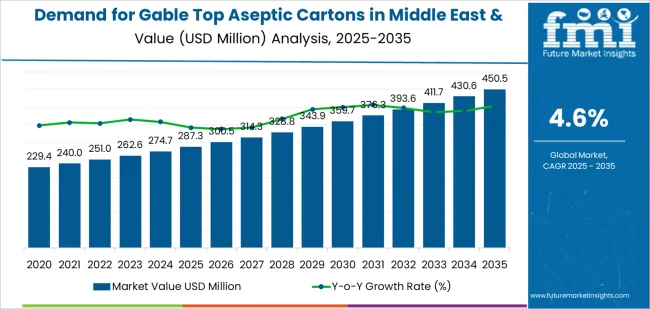
In response to mounting demand for shelf-stable, safety-conscious packaging solutions, both established global giants and newer—and ambitious—manufacturers are accelerating investments in gable-top aseptic carton production and distribution across the Middle East and Africa. A newly released market study forecasts a robust rise in demand from USD 287.3 million in 2025 to an estimated USD 450.5 million by 2035 — a 57% increase over the coming decade.
Since the early 2020s, the region’s food and beverage sector has increasingly leaned on aseptic packaging to meet extended-shelf-life and food-safety requirements. The rise of urbanization, modern retail infrastructure, and changing consumer preferences for ready-to-drink beverages and long-life dairy products have created fertile ground for growth. Many are now seizing the opportunity. The forecast suggests demand will grow at a compound annual growth rate (CAGR) of 4.6% over the next decade.
Established Brands Leading the Charge
Legacy packaging providers such as Tetra Laval, SIG Group, Elopak, Amcor and Greatview Aseptic Packaging Company continue to anchor the market, supplying standard aseptic cartons that account for roughly 65.8% of total 2025 demand. Their global experience, proven sterilization systems, and region-wide distribution networks give them a strong competitive edge. For many importers and beverage manufacturers in the Gulf and beyond, these players’ ready-to-deploy solutions — especially for dairy and juice beverage applications — remain the go-to choice.
These established manufacturers are not resting on their laurels. They are investing in barrier technologies, climate-resilient packaging, and distribution network enhancements — particularly important in the desert-climate, long-distance supply chains typical of many Middle East and North African territories. Their ongoing innovation in aseptic systems supports importers and beverage producers in meeting increasingly stringent quality, halal-compliance and shelf-stability standards.
New-Generation Manufacturers — Rising to Meet Demand
At the same time, a wave of newer manufacturers and regionally focused firms are entering the fray, encouraged by high growth potential in countries such as Qatar, Israel, United Arab Emirates, Saudi Arabia, Kuwait, Bahrain, Oman, Turkey, South Africa and Egypt. These companies are targeting niche opportunities: specialized beverage categories, plant-based beverages, temperature-resilient dairy cartons, and aluminum-free aseptic cartons aimed at consumers seeking environmentally friendly products.
Many of these rising suppliers are aligning with modern retail chains, collaborating with beverage brands and importers to offer customized aseptic packaging solutions — from design and barrier configuration to supply-chain integration. With lower barriers to entry in some segments, and flexibility to adapt quickly to local tastes, these newer players are carving out space alongside the incumbents.
Market Dynamics Behind Growth
Several key dynamics are fueling this growth:
-
Shift in Consumer Behavior: Rising urbanization and on-the-go lifestyles are increasing demand for ready-to-drink beverages, UHT milk, juices, and plant-based beverages — all of which benefit from aseptic carton packaging to ensure safety and shelf life.
-
Food Safety & Regulatory Compliance: Many Middle East and African countries are tightening food safety standards and import regulations, including requirements related to halal compliance, preservation, and distribution hygiene. Aseptic cartons offer a robust solution in this regulatory environment.
-
Modernization of Retail and Distribution: The rise of modern retail chains, cold-chain logistics, and centralized distribution hubs is pushing beverage manufacturers and importers to adopt standardized, reliable aseptic packaging solutions that facilitate efficient long-distance distribution.
-
Technological Innovation & Packaging Diversification: From advanced sterilization processes to aluminum-free, low-carbon footprint packaging, manufacturers are innovating to meet evolving consumer demand. New entrants are often more agile in adopting such innovations, offering alternative carton configurations and customizing packaging to regional needs.
Forecast — Growth to 2035 and Beyond
Between 2025 and 2030, the demand is expected to expand from USD 287.3 million to USD 356.8 million — a ~70% jump that will account for around 42% of the total decade-long growth. The latter half of the decade, from 2030 to 2035, is projected to add another USD 94.4 million in demand, powered by further expansion in automation, cold-chain infrastructure, and broader adoption across beverage verticals.
Dairy applications remain dominant, representing more than 52% of total demand in 2025, but juice, plant-based beverages, and other liquid products are expected to gain share as lifestyle shifts and innovation drive diversification. Growth is expected to be particularly strong in countries like Qatar (CAGR ~5.4%), Israel (~5.1%), UAE (~5.0%) and Saudi Arabia (~4.8%).
What This Means for Manufacturers & Stakeholders
For well-established global packaging manufacturers, this report underscores the importance of continuing investment in technology upgrades, barrier innovations, and regional distribution networks — especially given rising climate, regulatory and distribution challenges.
At the same time, the growing openness toward newer manufacturers and alternative aseptic solutions presents unique opportunities for agile, innovation-driven firms. Companies willing to customize packaging formats, adopt sustainable materials (e.g. aluminum-free cartons), and align with local consumer preferences could capture growing market share — particularly in rapidly urbanizing regions and among emerging beverage categories such as plant-based drinks.
For beverage and food producers — from dairy brands to juice manufacturers and new-age plant-based beverage startups — the expanding aseptic carton supply base means more options, greater flexibility, and improved ability to reach consumers with high-quality, long-shelf-life products across a challenging climate and distribution landscape.




